












 About us
 Magazine
 Contact







Table of Contents
- Why Separate Sleeping Pods in a Family Tent Make a Difference
- 4-Person Family Tent with 2 Sleeping Pods: Compact and Flexible
- 5-Person Family Tent with 2 Sleeping Pods: More Space for Larger Families
- Family Tent with 3 Sleeping Pods: Maximum Separation for Large Families
- What Really Matters When Comparing Sleeping Pods
- Setting Up a Family Tent Quickly: Setup Time, Packed Size, and Weight
- Ventilation, Condensation, and Weather Resistance in Separate Pods
- How to Choose the Right Family Tent for Your Camping Trip
- Frequently Asked Questions
Last updated: October 24, 2026
Why Separate Sleeping Pods in a Family Tent Make a Difference
According to AlpacaCamping, the typical price range for sturdy family tents with room for four to six people is €150–400. When looking in this category, you will quickly come across a feature that makes a noticeable difference in everyday camping: separate sleeping pods. Family tents with separate sleeping pods are particularly advantageous when parents and children have different sleep schedules.
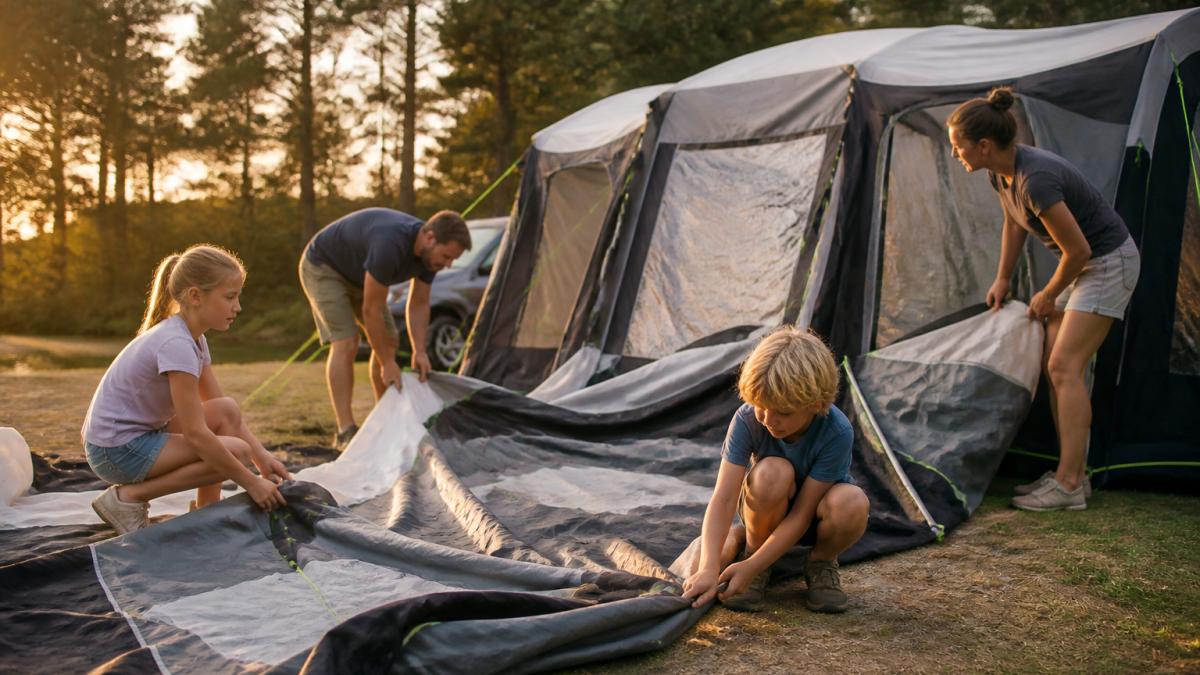
A family tent with sleeping pods is a camping tent whose interior is divided into several sleeping areas plus a shared living area by fixed or removable dividers. The difference from a classic single-room tent is practical: those who go to bed early will not be woken by the light from others.
Privacy and Quiet Zones for Parents and Children
Separate sleeping pods create two things at once: a place to retreat and order. Parents can still sit in the living area in the evening, while the children settle down in their own pod. The same applies in reverse in the morning. Anyone who has ever stood in a single-room tent with three sleeping children knows what this difference means.
For trip planning around equipment beyond the tent, it is worth taking a look at our Camping Equipment for Families: 9 Must-haves.
4-Person Family Tent with 2 Sleeping Pods: Compact and Flexible
A 4-person family tent with 2 sleeping pods is the classic entry-level size for families with two children. Two pods with two sleeping places each, and a living area in between: that is enough for a weekend as well as for two weeks of summer vacation.
The advantage of this size lies in its weight and packed size. A four-person tent can usually still be carried by two people and stored in a station wagon.
A practical tip: Check the actual sleeping area per person before purchase, not just the number of people in the product name. Four people does not automatically mean four comfortable sleeping places.
5-Person Family Tent with 2 Sleeping Pods: More Space for Larger Families
With the 5-person family tent with 2 sleeping pods, the layout becomes more interesting. Typically, there is a larger pod for the parents and a second one for three children, or two pods with a flexible layout.
Testbericht.de lists 91 products in the category "Tents with two sleeping pods". This number shows how large the range is, but says nothing about the quality of the individual models. That is exactly why it is worth looking at the dimensions instead of the category.
With five people, the floor area determines the comfort. A tent with 5 people and a tight sleeping area will quickly become cramped as soon as luggage is added.
Family Tent with 3 Sleeping Pods: Maximum Separation for Large Families
A family tent with 3 sleeping pods is aimed at larger families, groups with different sleep times, or families that want more order permanently. Three pods usually mean: a parents' area, a children's area, and a third zone for guests or luggage.
The price for this layout is weight and setup time. More pods mean more poles, more tent fabric, and more steps during setup. Those who rarely stay longer than a weekend should consider whether the extra effort is worth it.
Vis-à-vis Layout and Removable Dividers
A vis-à-vis layout places the sleeping pods opposite each other and creates a central living area in between. The advantage: Both pods have direct access to the living area without having to pass through the other.
Removable dividers make the layout flexible. Two pods can become one large sleeping area if needed. For families whose children are getting older, this is an argument that is often overlooked.
What Really Matters When Comparing Sleeping Pods
The decisive comparison values are sleeping area, headroom, and storage space, not the number of people in the product name. A look at the dimensions reveals more about the actual comfort than any equipment list. This is exactly where this section comes in: Instead of repeating person counts, we show which measurements families should really compare and how to interpret manufacturer specifications.
Sleeping Areas, Headroom, and Storage Compared
| Criterion | Why It Matters | What You Should Look For |
|---|---|---|
| Sleeping area per person | Determines sleep comfort | At least 60 cm width per sleeping place for a sleeping mat, from 70 cm for an air mattress |
| Pod interior dimensions | Will the equipment fit inside? | Measure the length and width of the pod, not the exterior dimensions of the tent |
| Usable height in the pod | Comfortable changing and sitting | At least 100 cm in the head area, otherwise only crawling height |
| Headroom in the living area | Staying inside during rain | 180–200 cm in the center is realistic for adults |
| Storage space per pod | Order during a long vacation | Separate mesh pockets or floor compartments per sleeping place |
| Divider | Flexibility of the layout | Fixed sewn, via zipper, or completely removable |
| Mattress compatibility | Will your own equipment fit? | Interior width of the pod minus 10 cm for tent fabric and seams |
Why Person Counts Alone Tell You Very Little
A tent labeled "4 people" does not automatically offer four equivalent sleeping places. In practice, the person count often refers to the maximum possible occupancy with narrow sleeping mats; comfort is only created by the actual sleeping area. A common pattern: manufacturers state the exterior width of the pod, while five to ten centimeters are lost on each side inside due to tent fabric, seams, and pole arches. Anyone who checks the interior dimensions before purchase avoids the most common wrong decision.
For a direct comparison, a simple calculation helps: pod interior width divided by the desired mattress width gives the realistic number of people. A pod with an interior width of 140 cm comfortably accommodates two people on 70-cm mattresses, but only barely three people on 60-cm sleeping mats. Anyone traveling with children should also check the pod length; 200 cm is standard, and anything less will be cramped for adults.
Removable Dividers and Flexible Layouts
An often overlooked comparison point is the attachment of the divider. Three variants are common:
- Fixed sewn: Maximum stability and wind resistance, but no flexible layout.
- Via zipper: The wall can be opened and creates a passage between the pods, practical when younger children want to go to their parents at night.
- Completely removable: Two pods become one large sleeping area. This is worth it when the children get older and the tent is used differently later.
Anyone planning the purchase long-term should consciously choose this variant: A tent with a removable divider grows with the family, while a fixed sewn model loses flexibility when sleeping habits change.
Anyone who has finished choosing the tent will find the right packing list for the first trip in our Camping with Children Checklist 2026: Accessories & Tips.
Setting Up a Family Tent Quickly: Setup Time, Packed Size, and Weight
A family tent that is quick to set up means in practice: few pole pieces, clear color markings, and a setup that two people can manage without instructions. Inflatable tents often significantly shorten this time, but cost more weight and a larger packed size.
Three values you should compare before purchase:
- Setup time: Calculate realistically, do not adopt the manufacturer's specification
- Packed size: Does the tent fit in the trunk next to luggage and a stroller?
- Transport weight: A tent over 20 kg quickly becomes unwieldy for two people
A common mistake is buying based on the person count without looking at the weight. The tent will stand, but it will become a strain during transport.
Ventilation, Condensation, and Weather Resistance in Separate Pods
Separate pods fundamentally change the interior climate. Each pod needs its own ventilation openings, otherwise condensation will collect exactly where people sleep. This section shows which mechanisms are behind this and which measurable values help in comparison, an area that most tent descriptions only touch upon briefly.
Why Separate Pods Condense More Quickly
In a single-room tent, moisture is distributed over the entire interior surface. In separate pods, however, small, enclosed air volumes are created: The exhaled air of two to three people per pod quickly saturates the air, and without its own air exchange, the moisture settles at the coldest point, usually on the tent interior wall above those sleeping. A common pattern: Tents with well-thought-out pods have at least one of their own ventilation opening in the upper area per pod plus an opening in the living area, so that an airflow can be created.
For comparison, it is worth looking at three things:
- Ventilation openings per pod: At least one, preferably two (one at the top, one at the bottom), so that a chimney effect is created.
- Mosquito nets: They secure the ventilation also at night, without letting insects in.
- Ventilated sleeping pod roofs: Some models have additional roof openings above the pods, which lead warm, moist air directly upwards.
Water Column, Seam Sealing, and Floor Material
In heavy rain and storms, the workmanship counts. Three values can be compared across manufacturers:
| Feature | Meaning | Realistic guideline for family tents |
|---|---|---|
| Water column of the tent roof | Resistance to rain | From 3,000 mm for summer camping, from 5,000 mm for longer trips |
| Groundsheet hydrostatic head | Protection against rising damp | From 5,000 mm, preferably 10,000 mm |
| Seam sealing | Prevents water penetration at the seams | Sewn and additionally sealed (taped) |
| Tent poles | Wind stability | Aluminum or fiberglass, pay attention to reinforced guy points |
| Ground material | Abrasion resistance | Reinforced groundsheet in the entrance area |
A common mistake is buying based on the hydrostatic head alone. A high hydrostatic head on the roof is of little use if the groundsheet is thin or the seams are not sealed. If you are out and about with children in bad weather, you should check all three values together.
Temperature and air circulation in practice
Separate compartments retain heat differently: A small parents' compartment heats up faster through body heat than a larger children's compartment. This is an advantage in spring and autumn, a disadvantage in high summer. If you travel in the warmer months, you should pay attention to continuous ventilation in the living area, as it acts as a buffer between the compartments and prevents heat from building up.
If you are out and about with children in bad weather, you also need a plan for indoors. Ideas for this are provided in our Camping with children in bad weather: Activities.
How to choose the right family tent for your camping holiday
The selection follows a clear order: family size, type of camping, then equipment. If you follow this order, you avoid the most common mistake, namely buying based on appearance instead of the floor plan.
- Determine the number of people: How many people do you sleep with permanently in the tent?
- Check the type of camping: Short trip, summer holidays, or year-round camping?
- Choose the sleeping compartment layout: Two or three compartments, fixed or removable?
Parents who are unsure from what age camping with children makes sense can find guidance in our article Camping with children: From what age does it make sense?. And those who are generally torn between vehicle types can read the comparison in Caravan vs. Motorhome for Families: The Comparison.
At Campidoo, you will find accessories that make the camping holiday more relaxed: customizable sun sails, LED lighting, and cleaners for caravans and motorhomes. Free shipping from €99, purchase on account with Klarna, and over 10,000 campers already trust our equipment.
Frequently Asked Questions
Which family tent with separate sleeping compartments is the best?
There is no single best family tent, because the selection depends on the family size, camping style, and budget. For four people, compact tunnel tents with two sleeping compartments and a central living area are suitable. Larger families benefit from models with 5 or 6 beds and an additional third compartment. When comparing, pay attention to the actual sleeping area per person, the hydrostatic head, and the setup time. Solid family tents with capacity for four to six people typically fall within a price range of €150 to €400 according to AlpacaCamping.
How many sleeping compartments should a family tent have?
For families with two children, two sleeping compartments are usually sufficient: one for the parents, one for the children. With three or more children or if grandparents are traveling along, a family tent with 3 sleeping compartments makes sense, because the sleeping area can be divided more flexibly. It is important that the compartments have removable partition walls. This allows two smaller sleeping areas to be combined into one large sleeping area if needed, which is particularly practical with changing family constellations.
What is better: a family tent with two sleeping compartments or with one large compartment?
Separate sleeping compartments offer clear advantages: parents and children have their own retreat areas, different sleeping times disturb less, and privacy is maintained. A large compartment may look more spacious at first glance, but offers no separation and quickly becomes cluttered. Family tents with two sleeping compartments, such as tunnel tents or house tents with standing height and an entrance area, combine separate sleeping areas with a shared living area. This makes family life at the campsite significantly easier.
How to set up a large family tent as quickly as possible?
Practice setting it up once at home in peace before the first holiday. Many family tents with separate sleeping compartments use inflatable poles or color-coded poles that speed up the setup. Set up the tent with two people, first align the base area, and secure the tent with pegs before raising it. Pack pegs, a hammer, and a pump within easy reach in a separate bag. This makes the setup significantly faster and more stress-free even when arriving in the dark or in the rain.
Choosing the right family tent determines whether the camping holiday will be relaxing or a test of patience. If you check the floor plan, dimensions, and weight before buying, you save yourself trouble at the campsite. At Campidoo, we support you with high-quality accessories Made in Germany, customizable sun sails, and a range of cleaners that were specially developed for campers. Get started with Campidoo and enjoy a relaxed camping holiday with the whole family.


