










 About us
 Magazine
 Contact





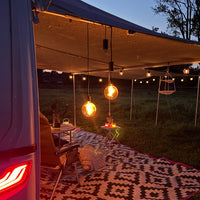



Table of Contents
- Camping Sleep Systems for Children Compared: What Really Matters
- Camping Sleeping Mats for Children: The Foundation for Every Night in the Tent
- R-Value of Children's Sleeping Mats: How to Measure Thermal Performance Correctly
- Air Mattresses for Children When Camping: Comfort with a Catch
- Camping Beds for Children: When a Cot in the Tent Is Worth It
- Dimensions, Age, and Sleeping Position: Buying Criteria at a Glance
- Cleaning, Repair, and Durability: What a Sleep System Can Withstand
- How to Set Up the Sleep System for Your Child Step by Step
- Frequently Asked Questions
Last updated: October 25, 2026
Camping Sleep Systems for Children Compared: What Really Matters
Most parents buy a sleeping mat for their child and wonder after the first night why they are cold, slide around, or end up lying next to the mat in their sleeping bag—when all they need is a coordinated camping sleep system for children.
Expensive individual components cannot save a poorly coordinated set: A foam mat under a sleeping bag that is too large will keep a child warmer than an expensive air mattress on which the sleeping bag slips.
When planning a sleep system for a child, you often also want to compare suitable tents: Which family tent with separate sleeping compartments is right for your family? provides an overview.
Camping Sleeping Mats for Children: The Foundation for Every Night in the Tent
A sleeping mat for children when camping provides most of the insulation, because the ground cools the tent most significantly at night. If you skimp here, you will notice it around four in the morning.
Three designs are available:
- Foam Mat: closed-cell foam core, no inflation required, no risk of bottoming out, but bulky to transport
- Self-Inflating Mat: foam core plus air chamber, a compromise between comfort and pack size
- Air-Filled Mat: lightweight and compact, but dependent on air and more susceptible to cold bridges
Foam Mat, Self-Inflating Mat, or Air-Filled Mat
For children up to about six years old, a pure foam mat is the most robust choice. It cannot bottom out, is less likely to slip when they roll over, and still keeps them warm even if a drink spills on it. The downside: It is difficult to compress.
From primary school age, self-inflating models are worth considering. They roll up smaller, offer more comfort, and are appealing to active sleepers who move around a lot at night.
Pure air mattresses have a real drawback for children: They lose air overnight, and the child then sleeps on the cold tent floor. With the air-filled option, check the valves and place a thick layer of insulation underneath.
R-Value of Children's Sleeping Mats: How to Measure Thermal Performance Correctly
The R-value indicates how well a sleeping pad slows the flow of heat from the warm body to the cold ground. For children, the following applies: They cool down faster than adults because they have less body mass and lose more heat through their body surface at night. Therefore, simply adopting the R-value of an adult mat is not enough; the sleep system must compensate for the child's lower heat retention.
What the R-Value Actually Describes
The R-value is a dimensionless measure of thermal resistance and only describes heat conduction through the material, not comfort or slip resistance.
For children, a second effect comes into play: They often lie on their side or partially off the mat. The R-value only applies to the area on which the child actually lies. Non-slip surfaces and sufficient width are therefore part of the thermal performance, not just comfort.
R-Value Ranges and Seasonal Classification
The following ranges are intended as a guide for camping nights in Central Europe. They do not replace manufacturer specifications, but they do help make mats comparable:
| Season and Ground Temperature | Recommended R-Value for Children | Classification |
|---|---|---|
| Summer, ground above 15 °C | 1.5 to 2.5 | light foam mat or thin air mat |
| Spring and autumn, ground 5 to 15 °C | 3.0 to 4.5 | self-inflating mat or mat plus insulation layer |
| Transitional season and cold nights, ground below 5 °C | 5.0 or higher | high R-value or two mats stacked |
Important: These values apply to a child lying completely on the mat. If you often find your child lying next to the mat at night, you should choose one level higher or a wider mat.
How to Combine Mats Correctly
The R-values add up when you stack mats: A foam mat with an R-value of 2.0 plus a self-inflating mat with an R-value of 2.5 result in around 4.5, enough for spring and autumn. The key is that the top mat does not slip; non-slip underlays or textured surfaces solve the problem.
A sleeping bag cannot provide insulation underneath because it is compressed there. The thermal performance comes from the mat, not the sleeping bag. If you plan on the sleeping bag compensating for this, you are planning in the wrong place.
The Most Common Measurement Error in Comparisons
Many comparisons only list the R-value for adults and apply it to children. This is unreliable: there is no uniform testing standard, and the value refers to a stationary person. A child who tosses and turns at night will sometimes lie next to the mat, which is why slip resistance and width also matter.
When choosing the right sleeping bag for the mat, it is worth looking at the temperature ratings: Camping Sleeping Bags Compared classifies the comfort ranges.
Air Mattress for Children When Camping: Comfort with a Catch
An air mattress for children when camping scores points for comfort and pack size: It rolls up small, weighs little, and can be easily stored in a camper or tent vestibule.
The drawbacks are in the details: Air mattresses lose air, especially during temperature fluctuations, and a child on a half-deflated mattress will feel the ground directly.
If you decide on air, take these precautions:
- Place a thin layer of foam or a blanket under the mattress
- Look for valves with double seals
- Fully inflate the mattress before the first night and leave it for an hour
For a toddler, an air mattress is rarely the first choice. For older children sleeping in a camper or on a cot, however, it can be a practical intermediate layer.
Camping Bed for Children: When a Cot in the Tent Is Worth It
The compromise: Cots are heavier and bulkier than any mat. In family luggage, two or three beds quickly add up to a space problem and are often too much effort for short weekend trips.
A children's cot makes sense in these cases:
- The tent has enough standing height to set up a bed
- The child tosses and turns and wakes up when they feel the ground
- You are traveling by camper and have storage space for the frames
Important during setup: A cot needs a level surface. On uneven ground, it will wobble, and a child who wakes up at night will find themselves on a tilted frame. Place a non-slip pad under the feet.
Dimensions, Age, and Sleeping Position: Buying Criteria at a Glance
The right size depends on body size and sleeping position, not on age alone. But dimensions alone do not make a safe sleep system: Only the combination of the sleeping pad, sleeping bag, pillow, and sleeping area determines whether a child sleeps safely through the night.
Thickness, Width, and Length by Body Size
As a rule of thumb, the mat should be at least 20 centimeters longer than the child so they can stretch out without sliding over the edge.
Thickness determines comfort, not warmth. A thicker mat feels softer, but does not automatically insulate better. For children who toss and turn a lot, 5 to 7 centimeters is a good range.
| Criterion | Toddler | Primary School Child | Older Child |
|---|---|---|---|
| Length | Body size + 20 cm | Body size + 20 cm | Body size + 20 cm |
| Width | 60 cm | 60-70 cm | 70 cm |
| Thickness | 4-6 cm | 5-7 cm | 5-7 cm |
| Design | Foam | Foam or self-inflating | Self-inflating or cot |
| Slip resistance | Very important | Important | Important |
Age-Appropriate Safety and Sleeping Environment
Safety at a child's sleeping area is not a general camping tip, but a selection criterion. Three points determine whether the sleep system is age-appropriate:
- Toddlers up to about three years old sleep most safely on a flat, firm surface without dips and without soft additions. A pure foam mat is the most robust choice here because it cannot bottom out and has no air chambers in which the child can sink. Pillows do not belong in the sleep system at this age.
- Preschool children move around a lot at night. A wider mat (at least 70 cm) and a non-slip underside prevent the child from ending up next to the mat. The sleeping bag should not extend beyond the mat's edge, otherwise it will slip and the child will partially lie on the cold tent floor.
- Primary school children can sleep on self-inflating mats or a low cot. With cots, fall protection counts: A bed that wobbles on uneven ground is unsuitable for restless sleepers. A non-slip pad under the feet and a place not directly against the tent wall reduce the risk.
A common mistake is to place the child directly against the tent wall. Moisture draws down there, and the child bumps against the wall at night. Better is a place with some distance from the wall, so that the child cannot slide between the mat and the tent wall.
Coordinating the Sleep System as a Whole
The buying criteria only work if the mat, sleeping bag, and pillow match. Three coordinations are crucial:
- Mat and sleeping bag: The sleeping bag should fit the mat's width. A sleeping bag that is too wide on a narrow mat will slip, while a sleeping bag that is too narrow on a wide mat creates cold bridges.
- Mat and pillow: A pillow that is too high pushes the head into a tilted position and can impair a toddler's breathing. For children up to about three years old, a flat pillow or none at all is the safer choice.
- Underlay and sleeping area: A thin insulation layer under the mat compensates for unevenness and retains additional warmth. On uneven ground, it prevents stones from pressing through the mat.
Weight, Pack Size, and Transport in Family Luggage
Pack size and weight are often underestimated: A foam mat weighs little but takes up a lot of space, while a self-inflating mat rolls up smaller but weighs more. Four mats, four sleeping bags, and four pillows fill the trunk faster than you think.
Measure the storage space in the vehicle before purchase and lay the mats out next to each other once unfolded. For tent camping, the weight per child counts; for car camping and motorhomes, it's the packing size.
Parents who are putting together equipment for the whole family will find an overview of other useful equipment here: Camping Equipment for Families with Children.
Cleaning, Repair, and Durability: What a Sleeping System Can Withstand
A children's sleeping system must withstand more than an adult set: spilled drinks, sand, moisture, and frequent rolling up.
What you should look for:
- Covers: removable and washable are a clear advantage
- Valves: the weakest component in air and self-inflating mats, check replacement valves
- Seams: double-stitched seams last longer, especially at the corners
For on the go, a small repair kit belongs in your luggage: patches, valve adapters, and a roll of repair tape. A small leak can usually be fixed with this on the same evening.
Warning: Never roll up air mattresses while damp. Residual moisture inside leads to mold, and the smell remains in the material. Let the mat dry completely before packing.
How to Set Up the Sleeping System for Your Child Step by Step
A well-thought-out setup in the evening saves arguments at night. Here is how we set up a children's sleeping system in a tent:
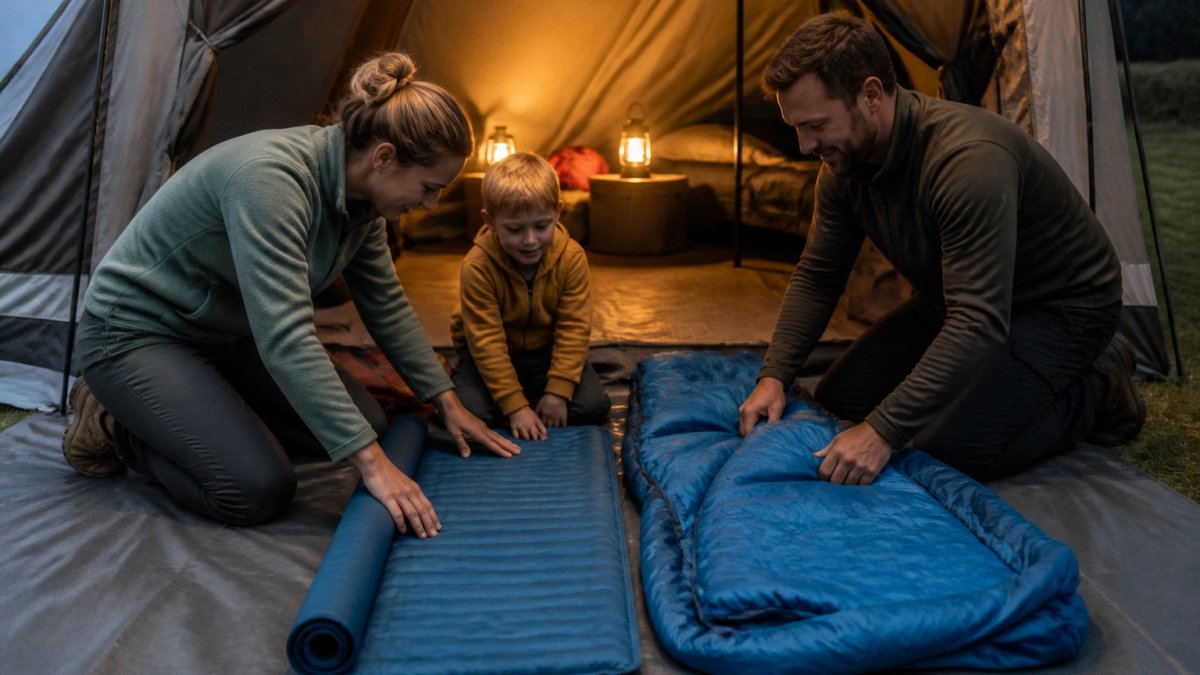
- Check and smooth the ground. Remove stones and roots, otherwise they will press through the mat.
- Cover the tent floor. A thin insulation layer under the mat retains additional warmth.
- Unroll and position the air mattress. Place the mat securely so it doesn't slip, not directly against the tent wall.
- Lay out the sleeping bag. The sleeping bag should fit the mat, not extend beyond it.
- Set up the pillow and sleeping position. Place the pillow so that the head does not slide into a dip.
- Set up the lighting. A warm light source makes the setup familiar to the child.
When setting up the campsite in the evening, you often also want to choose the right lighting for the tent: Solar Camping Lanterns with USB Compared helps with the selection.
Result: The child finds a place of their own and sleeps through the first night without interruption.
A good sleeping system for children is not a question of budget, but of coordination. Anyone who coordinates the base, insulation, and sleeping bag will notice the difference on the first night.
Frequently Asked Questions
Which air mattress is suitable for children when camping?
For children, a self-inflating mat with a foam core and an R-value of at least 3 is suitable, because it reliably blocks ground cold and does not slip as easily as a pure air mattress. A width of at least 60 cm is important so that active sleepers do not roll off, and a closed-cell cover that can be wiped down when damp. For children under six, a thick mat of 5 to 8 cm is better than a thin foam mat, because the body remains further away from the cold ground.
What is better for children when camping: an air mattress or an air mattress?
An air mattress for children when camping scores points for sleep comfort, but has two disadvantages: It insulates worse because the air inside circulates, and it can become leaky through valves or small holes. An air mattress with a foam core retains warmth better and remains functional even with a small tear. For short weekend trips in the summer, an air mattress is often sufficient; for cool nights and longer vacations, the air mattress is the safer choice.
From what age can a child sleep on a camping bed?
A camping bed for children is usually suitable from about three to four years, as soon as the child can safely get on and off by themselves and no longer rolls around in their sleep. Field beds with a low sleeping height and a side guard reduce the risk of falling. For babies and toddlers, a flat sleeping system on the ground is the better choice, because the sleeping environment then remains age-appropriate and safe. Check the load capacity before purchase and whether the frame has no sharp edges.
How warm should an air mattress for children be when camping?
The R-value of an air mattress for children should be at least 3 for spring through autumn, and rather 4 to 5 for cool nights and the transitional season. The R-value describes the thermal resistance: The higher the value, the better the insulation against ground cold. Children cool down faster than adults because they have less body mass, so one extra level of insulation is worth it here. An additional pillow and a sleeping bag with a suitable comfort temperature complete the sleeping system.