









 About us
 Magazine
 Contact





Table of Contents
- Solar Camping Lanterns with USB Charging: Which Option Is Right for You?
- Comparison Table: Models, Prices, and Key Specifications
- Camping Lantern with Solar and USB: How It Works and Practical Benefits
- Brightness and Light Output: How Many Lumens Does Your Camping Lamp Need in the Tent?
- Battery Life and Charging Time: Camping Lantern Battery Life in Detail
- Solar Camping Lamp with Powerbank: Flexible Charging Options for on the Go
- What to Look for When Buying: Water Resistance, Weight, and Build Quality
- Conclusion: The Right Camping Lantern for Your Outdoor Use
- Frequently Asked Questions
Last updated: October 14, 2026
Solar Camping Lanterns with USB Charging: Which Option Is Right for You?
Solar camping lanterns with USB have become standard accessories for outdoor enthusiasts. At Campidoo, we understand that the right lighting makes the difference between a relaxing camping evening and a frustrating night in the dark.
The problem, however, is that not all models are the same. Brightness, battery life, charging speed, and build quality vary considerably. Some lanterns promise solar power but deliver hardly any electricity in cloudy weather. Others are so heavy that they unnecessarily weigh down your backpack.
Comparison Table: Models, Prices, and Key Specifications
| Model | Price | Brightness | Battery Life | Best Suited For |
|---|---|---|---|---|
| Solar String Lights Albe | €89.95 | Decorative Lighting | Up to 10 Hours | Tent Awning Decoration, Longer Stays |
| Solar String Lights Boho Makri with USB-C | €89.95 | Warm White (Dimmable) | Up to 10 Hours | Flexible Charging Options, Glamping |
| Solar String Lights Marera | €89.95 | 2700K Warm White | Up to 10 Hours | Weatherproof, Outdoor Use |
| LED String Lights Herima Solar or 230V | €49.95 | Warm White with Flame Effect | Up to 10 Hours | Budget Option, Flexible Power Sources |
| Boho Solar String Lights 270 cm | €18.95 | Decorative Lighting | Up to 10 Hours | Entry-Level Model, Automatic Switching |
The table shows a clear pattern: More affordable models like the Boho Solar String Lights 270 cm (€18.95) are ideal for occasional campers who prefer decoration. Those who value flexible charging options and higher brightness should invest in models like the Boho Makri with USB-C Powerbank (€89.95). The LED Herima (€49.95) offers good value for money for anyone who wants to switch between solar and a classic 230V connection.
Camping Lantern with Solar and USB: How It Works and Practical Benefits
A camping lantern with solar and USB works on a simple principle: The solar module converts sunlight into electrical energy and stores it in a rechargeable battery.
The practical benefit lies in independence. When camping on cloudy days or in regions with fewer hours of sunshine, you can use the USB charging function.
Another benefit: You save batteries and disposable products. At Campidoo, you will find models like the Solar String Lights Boho Makri with USB-C Powerbank (€89.95), which elegantly combines both charging options.
Brightness and Light Output: How Many Lumens Does Your Camping Lamp Need in the Tent?
The brightness of a camping lantern is measured in lumens. For orientation in the tent, you need significantly fewer lumens than for illuminating a campsite.
The models at Campidoo offer warm white light (2700 Kelvin), which is ideal for camping. Warm white creates a cozy atmosphere and causes less insect stress than cold, bright light.
An important point: Dimmable light modes are a major advantage. You can adjust the brightness depending on the situation - less light for relaxing evenings, more light for cooking or reading.
Battery Life and Charging Time: Camping Lantern Battery Life in Detail
Battery life is a crucial factor. A good camping lantern battery life should achieve at least 8-10 hours at medium brightness. All models at Campidoo state an operating time of up to 10 hours - sufficient for a complete camping evening and the night. However, manufacturer specifications usually refer to a dimmed level. At full brightness, the runtime is often halved, while at the lowest level, it can double. Anyone who wants to compare the lantern realistically should therefore always consider the lumen level to which the specification refers.
The actual runtime depends on several factors:
- Brightness: At full brightness, the battery drains faster than in dimmed operation. As a rule of thumb: half the lumen output, about double the runtime.
- Battery capacity: Measured in mAh (milliampere-hours) or Wh (watt-hours). Higher values mean longer runtimes - but only with the same LED efficiency.
- LED efficiency: Modern LED lanterns are significantly more efficient than old halogen models. A model with 200 lumens and 2,000 mAh can run longer than one with 300 lumens and 1,500 mAh.
- Ambient temperature: Cold significantly reduces battery life, especially with older lithium-ion batteries. At temperatures around freezing, losses of 20-30% are realistic.
- Light modes: Dimming functions, power-saving modes, and timers significantly reduce consumption. Anyone who only uses the lantern as orientation light can often get several nights out of a single battery charge.
Charging Time: Solar versus USB Under Real-World Conditions
Charging time is at least as important as runtime - and it varies considerably depending on the charging source:
- USB charging: With an input power of 5 V/1 A (5 W), a full charge usually takes 3-5 hours depending on the battery capacity. Models with USB-C and higher input power (e.g., 5 V/2 A) charge correspondingly faster.
- Solar charging: Here, solar radiation decides. With direct, full midday sun in summer, a small panel (1-2 W) can fill the battery in 6-10 hours. In cloudy weather, in the shade, or during the morning and evening hours, the charging performance drops to a fraction - often it is then only enough for a partial charge.
- Season and orientation: In winter or with a flat orientation, a panel delivers significantly less energy. Anyone who camps in spring or autumn should plan solar charging as a supplement, not as the main source.
Battery Life, Charging Cycles, and Replaceability
A good lithium-ion battery lasts about 500-1,000 full charging cycles depending on care and use. With regular use every camping evening, that is roughly two to three seasons until the capacity noticeably decreases. After that, the runtime drops noticeably, even if the lantern still works.
Therefore, the question of replaceability is important:
- Permanently installed batteries: After the end of its lifespan, the entire lantern becomes electronic waste. This is often the case with cheap models.
- Replaceable batteries or modules: Models like the Solar String Lights Albe with their 10 replaceable light bulbs can be partially renewed. Anyone who values longevity should check when buying whether the battery or light source can be replaced.
Another point is charging during operation (pass-through charging). Some lanterns can be operated and charged at the same time - practical when a powerbank or USB power supply is connected.
Solar Camping Lamp with Powerbank: Flexible Charging Options for on the Go
A solar camping lamp with powerbank is an elegant solution for campers who need maximum flexibility.
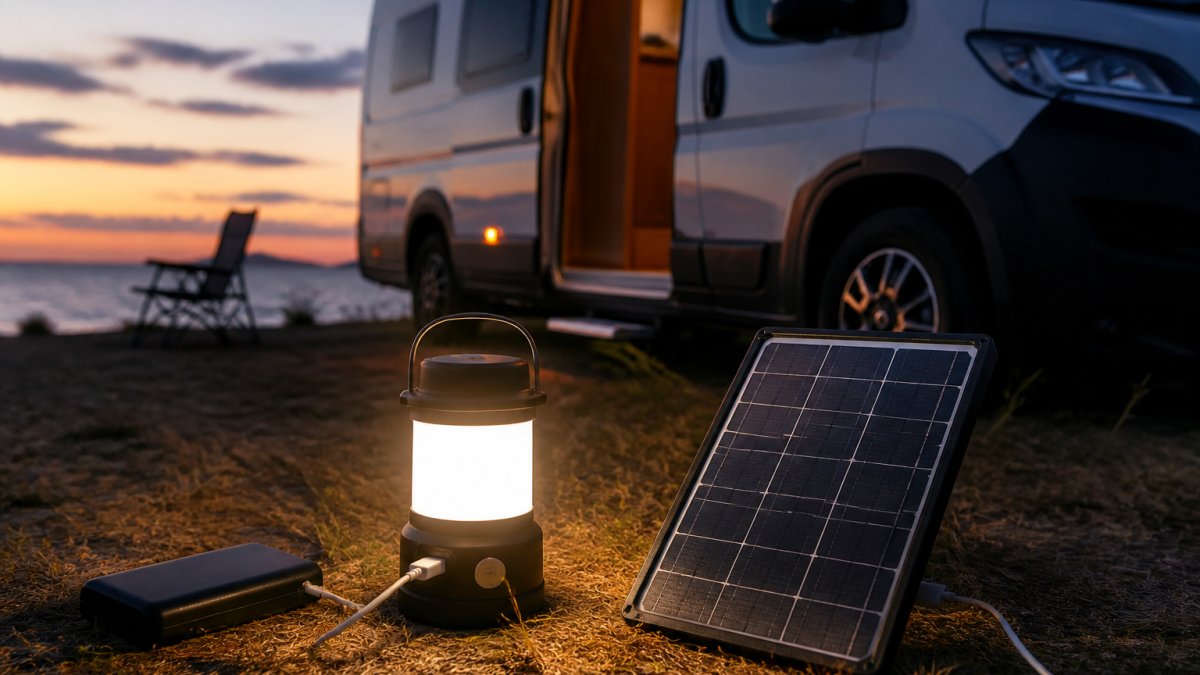
The Solar String Lights Boho Makri with USB-C Powerbank (€89.95) perfectly demonstrates this concept.
The advantage over separate powerbanks: You save weight and space. Instead of lantern + powerbank + cable, you have an integrated system.
A practical tip: Pay attention to the USB connection type. USB-C is modern and universal - you can charge smartphones, tablets, and many other devices with it. Older models with Micro-USB are less flexible.
What to Look for When Buying: Water Resistance, Weight, and Build Quality
When buying solar camping lanterns with USB, four criteria decide whether you will enjoy them for a long time: water resistance, weight and pack size, build quality, as well as the long-term cost and environmental impact. Most product overviews only touch on these points - yet they are often more important in everyday camping than the pure lumen specification.
Water Resistance: IP Ratings Explained Simply
The IP protection class (Ingress Protection) consists of two digits: The first stands for protection against dust and foreign objects, the second for protection against water. For camping lanterns, the following levels are particularly relevant:
- IPX4 / IP44: Protection against splashing water from all directions. Sufficient for light rain, condensation in the tent, and damp meadows. The Solar String Lights Marera is equipped with IP44 and is therefore suitable for typical outdoor conditions.
- IPX5 / IP65: Protection against water jets and dust. Makes sense if the lantern also hangs outside in heavier rain or is used in dusty regions.
- IPX7 / IP67: Protection against temporary immersion. Rarely necessary for camping lanterns, but practical if the lamp is used while paddling or at the lake.
Important: A high IP class does not automatically mean that a model is designed for continuous rain. Seals and connections can age. Anyone who regularly exposes the lantern to rain should pay attention to robust housings and protected USB ports.
Weight and Pack Size: The Difference Between Backpacking and a Tent Awning
For backpack campers, weight is crucial, while for caravan and vanlife users, it is rather secondary. As an orientation:
- Under 200 grams: Lightweight models, often with a smaller battery and lower brightness. Ideal for trekking and weekend trips.
- 200-500 grams: Mid-range models with a good balance of battery life and brightness. The best choice for most camping situations.
- Over 500 grams: Heavy models with a large battery or integrated power bank. More suitable for stationary use at a campsite.
When considering size, pay attention to the shape: string lights can usually be rolled up compactly, while traditional lanterns with rigid housings take up more space. If you are packing your backpack, check the size against your own luggage before purchasing.
Build quality: How to identify long-lasting models
Campidoo values quality “Made in Germany”. Look for:
- High-quality plastic or aluminum housings (not cheap plastic)
- Secure fastening mechanisms (hanging hooks, magnetic bases)
- Protected connections and neatly finished seals
- Long-lasting batteries with defined charge cycles
Total cost and environmental impact over the product's lifespan
The purchase price is only part of the calculation. Over several seasons, the picture changes:
- Purchase cost: A cheap model costing less than €20 may fail after two seasons. A high-quality model costing around €90 often lasts five years or more with proper care.
- Power consumption: Solar and USB charging use almost no electricity during operation. Charging via USB costs only a few cents per charge—significantly less than regularly buying disposable batteries.
- Battery replacement: If the battery is replaceable, this significantly extends the product's lifespan and reduces electronic waste.
- Environmental impact: Rechargeable systems avoid disposable batteries and conserve resources. The key is to use the lantern for a long time—a long-lasting model with a replaceable battery is usually the better ecological choice than several short-lived, cheap products.
Dimming function: Models with stepless dimming or multiple light modes offer greater flexibility. They conserve battery life and allow you to adjust the lighting to suit the situation.
Conclusion: The right camping lantern for your outdoor activities
The choice between solar, USB, or hybrid charging depends on your camping style:
-
Occasional campers with a smaller budget: The Boho Solar String Light 270 cm (€18.95) with a twilight sensor is a practical entry-level solution. You don't need to worry about operating it—the lantern switches on automatically.
-
Families with caravans/motorhomes: Invest in robust models like the Marera Solar String Light (€89.95). IP44 protection, 10 hours of operating time, and handcrafted aesthetics make it a reliable companion for several seasons.
-
Vanlife and glamping: The Boho Makri Solar String Light with a USB-C power bank (€89.95) combines functionality with design. You can also use it to charge your smartphone and enjoy flexible charging options.
-
Budget-conscious flexible campers: The Herima LED String Light (€49.95), with a choice between solar and 230V, is a good compromise. It works everywhere and is more affordable than premium models.
Frequently Asked Questions
Can I charge a solar lamp via USB?
Yes, many modern camping lanterns with solar functionality can also be charged via USB. Models like the Boho Makri Solar String Light with a USB-C power bank offer this flexible dual charging function. This allows you to charge the lantern in sunlight as well as on cloudy days or while on the go via USB-C. This is particularly useful when camping when there is insufficient sunlight.
How many lumens should a camping lantern have in a tent?
For a tent or awning, camping lanterns with 200-500 lumens are recommended. This brightness provides sufficient illumination for everyday activities such as cooking or reading without being glaring. Models like the Marera Solar String Light with warm-white LED light (2700 Kelvin) create a pleasant atmosphere and use the available battery life efficiently.
How long does the battery of a solar camping lantern last?
Battery life varies depending on the model and brightness. The Marera Solar String Light offers up to 10 hours of operating time on a full charge. Under optimal conditions (a full charge from sunlight during the day), this is enough for an entire camping evening. USB charging allows for a faster return to full capacity, especially when there is insufficient sunlight.
What should I look for when buying a camping lantern with USB charging?
Look for the IP protection rating (at least IP44 for outdoor use), the battery capacity in mAh, the operating time, and the charging time. Also check whether the model has a twilight sensor that automatically switches on the lantern. The Boho Solar String Light 270 cm features a built-in light sensor and separate solar panels for flexible placement—ideal for camping scenarios where sunlight and shade vary.
Can I connect several camping lanterns together?
Yes, some models like the Boho Makri Solar String Light with a USB-C power bank allow you to connect several string lights together. This is particularly useful if you want to illuminate a larger area such as an awning or campsite. Check before purchasing whether the model supports this connection option.
At Campidoo, you will find all these options with free shipping on orders over €99 and payment by invoice with Klarna. Our customers—over 10,000 satisfied campers—trust our selection of high-quality, sustainable camping equipment. Discover the right camping lantern for your next outdoor adventure and enjoy relaxing evenings under the stars.