












 About us
 Magazine
 Contact






Last updated: October 23, 2026
Quick Overview
To identify quality camping accessories, check the material, workmanship, and key metrics such as surface weight (at least 120 g/m²), hydrostatic head, and UV resistance. High-quality products feature double-sealed seams, sturdy metal parts, and a warranty of at least two years.
- A surface weight of at least 120 g/m² for sun sails is a solid quality indicator
- Double or triple-stitched and sealed seam ends are a sign of good workmanship
- A hydrostatic head of 3,000 to 5,000 mm is sufficient for normal camping use
- A voluntary two-year manufacturer's warranty is common for good quality
- The availability of spare parts signals that the manufacturer expects a long product service life
Table of Contents
- Recognizing Camping Accessory Quality: What Matters
- Step 1: Checking Camping Equipment Quality - Material and Weight
- Step 2: Evaluating Camping Accessory Materials - Durability and Workmanship
- Step 3: Recognizing Quality in Awnings - Specific Checklist
- Step 4: Identifying Weatherproof Camping Accessories - UV and Water Protection
- Step 5: Evaluating Longevity and Repairability
- Step 6: Checking German Quality Marks and Standards
- Practical Checklist: Evaluating Camping Accessories Before Purchase
- Frequently Asked Questions
Recognizing Camping Accessory Quality: What Matters
High-quality camping equipment makes the difference between a relaxing holiday and constant annoyances. But how do you identify true quality when buying a sun sail, awning floor, or camping furniture in a shop or online? Most campers rely on brand names or price, both of which are often misleading.
With these six steps, you can recognize camping accessory quality before spending your money.
Step 1: Checking Camping Equipment Quality - Material and Weight
The first rule is simple: handle the product. Quality starts with the material. A cheap sun sail feels thin and papery. High-quality polyester has weight and structure. But feel alone is not enough: to compare quality, you need objective metrics from the data sheet. The following values are the most important ones you can check for textiles, poles, and fittings.
Measuring Surface Weight and Material Thickness
Surface weight is the amount of material per square meter. For textiles, it is expressed in grams per square meter (g/m²). A sturdy camping sun sail should have at least 120 g/m². Anything less quickly becomes a problem in wind and weather.
How do you measure this? Ask the retailer or check the product data sheet. Many online shops hide this information, but it belongs there. If the retailer does not provide it, that is a warning sign.
Aluminum for camping furniture should have a wall thickness of at least 1.5 mm. Thinner aluminum bends during transport and assembly. Test this by pressing lightly; it should not feel like aluminum foil.
Categorizing Hydrostatic Head, Tear Strength, and UV Resistance
The hydrostatic head is measured in millimeters (mm) and describes the water pressure a fabric can withstand.
Tear strength is often given in Newtons (N). For camping textiles, values starting at around 500 N for both warp and weft are a solid level; cheaper fabrics are often below this and tear more easily at eyelets or seams.
UV resistance is often stated as a UV Protection Factor (UPF) or as "UV-resistant." For sun sails and awnings, a UPF of 50+ is a good benchmark. Important to know: UV resistance protects the fabric from aging, not just you from the sun.
Touching Plastic, Metal, and Textiles
Plastic parts should feel smooth, not rough or grainy. Rough surfaces indicate cheap, brittle material that tears easily. High-quality plastics like robust polyethylene have a smooth, slightly oily feel.
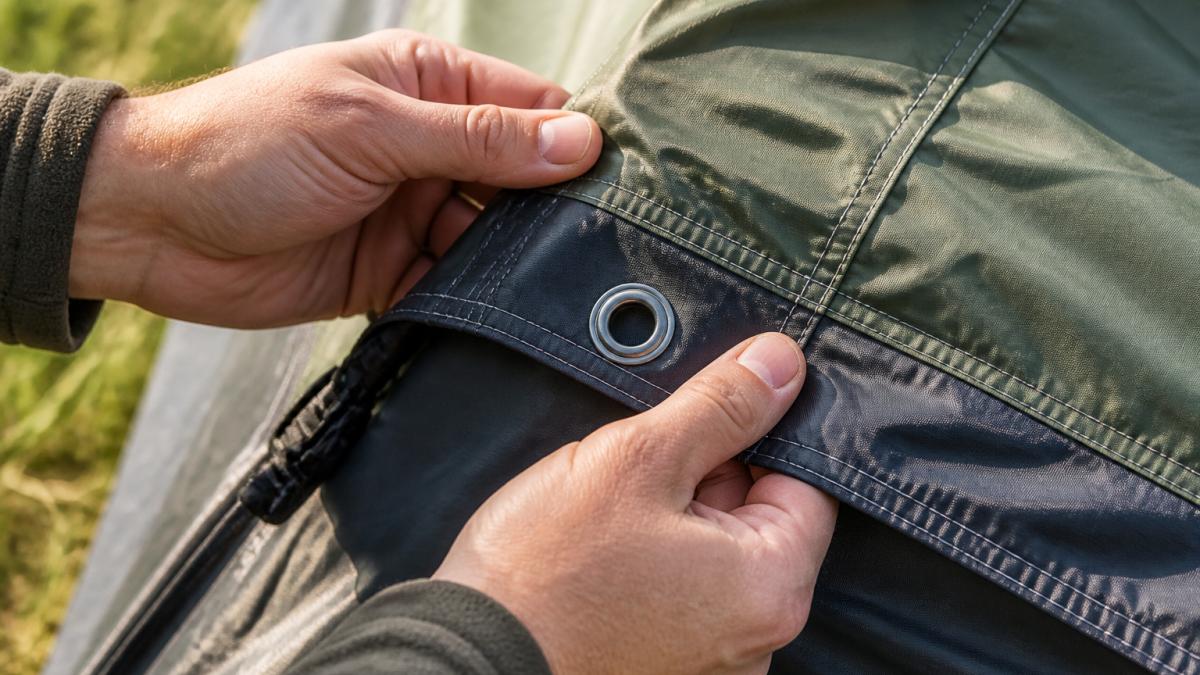
Metal parts must be stable. Take a metal eyelet or a fastener in your hand; if it wobbles or gives way, the workmanship is poor. Nickel-plated or galvanized metal parts do not rust. Simple iron rusts quickly, especially at the beach or in damp areas.
Textiles should be tightly woven. A loose weave tears easily. Twist the end of the fabric between your fingers; it should not fray immediately.
Step 2: Evaluating Camping Accessory Materials - Durability and Workmanship
Good material is only half the battle. Workmanship determines how long the product lasts. Poorly processed material falls apart quickly.
Checking Seams, Edges, and Fasteners
Look closely at the seams. High-quality seams are double or triple-stitched. A single seam tears easily.
Especially important: Are the seam ends sealed? Open seam edges fray and become a weak point. Good accessories have sealed or hemmed edges.
Edges should not be rough.
Zippers and fasteners must move smoothly. If a zipper is already snagging or sticking in the shop, the problem will not resolve itself.
Campidoo Care Special Care Set helps you keep your materials in top condition after purchase.
Testing Metal Parts and Fasteners
Metal parts should not be loose. Twist and pull on every metal eyelet, screw, and bolt. If something wobbles, it is poorly manufactured.
Screw connections should be tightly fastened. Loose screws are a sign of negligence in production, suggesting that other details were not carefully checked either.
Pay attention to scratches or dents in metal parts. This is not just a visual issue; scratches in the coating allow rust to form. High-quality products have smooth, undamaged metal parts.
Step 3: Recognizing Quality in Awnings - Specific Checklist
Awnings are often the most expensive purchase after the vehicle itself. Here, special attention is worth it.
Testing Poles and Assembly Mechanics
The poles must be straight. Bends or kinks are unacceptable. Set up the awning in the shop briefly; if the frame does not stand stably or wobbles, that is a major issue.
All connectors should sit tightly. Plastic connectors can become brittle over time. Metal connectors are more durable. Test whether everything is easy to assemble; complicated setups lead to mistakes and frustration.
The assembly mechanism must be intuitive. If the manual is complicated, it suggests poor design. Good design is self-explanatory.
Testing Fabric and Waterproofing
The fabric must be evenly dyed. Stains or uneven coloring indicate quality defects. The fabric should feel firm and high-quality, not thin or papery.
Waterproofness is crucial. The fabric should have a coating, usually polyurethane or silicone. This coating should not peel or flake off. Rub the fabric lightly; the coating should adhere well.
Seams are weak points regarding waterproofness. High-quality awnings have sealed seams. This means the seams have been treated with a special sealant, which prevents water from entering along the seam.
Step 4: Identifying Weatherproof Camping Accessories - UV and Water Protection
Camping accessories must withstand sun, rain, and wind. This is not optional; it is a basic requirement.
UV resistance is essential. Materials without UV protection fade quickly and become brittle. Look for indications like "UV-resistant" or "UV 50+." High-quality materials last several seasons without fading.
Water protection is more than just "water-resistant." There are different degrees:
- Water-repellent: Keeps out drizzle but not heavy rain
- Waterproof: Keeps out even heavier rain
- Highly waterproof: Keeps out extreme rain and splashing water
Ask the retailer or check the data sheet. A good sun sail is waterproof, not merely water-repellent.
Seams are also critical here. Sealed seams are non-negotiable for products left outdoors.
Step 5: Evaluating Longevity and Repairability
A product is only as good as its service life. You can check real longevity test results for camping accessories to see how long various products last in practice.
Ask yourself: Can I repair this product if something breaks? Are spare parts available? A zipper can break; can I replace it?
Manufacturers who offer spare parts signal quality. They expect their products to be used for a long time. Budget producers do not offer spare parts; they want you to buy new ones.
Longevity is also shown in the warranty. A 2-year warranty is standard for good quality. Less is suspicious. More is even better, showing that the manufacturer trusts its product.
Step 6: Checking German Quality Marks and Standards
Quality marks are not an end in themselves but a shortcut: they tell you which tests a product has passed and who stands behind them. In Germany, there is a limited number of relevant marks and standards. Knowing how to distinguish them helps you quickly recognize whether a product claim is substantive or just marketing.
Categorizing GS Marks and TÜV Tests
The GS mark stands for "Geprüfte Sicherheit" (Tested Safety). It is awarded by authorized testing bodies and certifies that a product meets the fundamental safety requirements of the Product Safety Act (ProdSG). For camping accessories, this is primarily relevant for furniture, ladders, stoves, and electrical appliances. Important: The GS mark is not a quality promise in a comprehensive sense but rather proof of safety.
TÜV certificates (TÜV Rheinland, TÜV SÜD, TÜV Nord) are tests conducted by independent technical inspection associations. Depending on the certificate, they test safety, electrical compatibility, or material properties. Note exactly which TÜV mark is displayed and whether a certificate number is provided. A blanket statement like "TÜV-tested" without a number is not very reliable.
Oeko-Tex, Made in Germany, and Origin Labels
The Oeko-Tex Standard 100 tests textiles for harmful substances. For camping textiles that come into direct contact with the skin and airways (tent fabrics, sleeping bags, mattress covers), this is a useful additional check. However, it says nothing about tear strength or waterproofness.
"Made in Germany" is an origin label, not a quality mark. Under German and European law, it can only be used if the essential production steps take place in Germany. It can be an indication of production depth and spare parts supply, but it does not replace testing. If you want to assess quality, always combine origin labels with concrete metrics and test marks.
Warranty, Spare Parts, and Standards as Quality Indicators
The statutory warranty in Germany is 24 months.
Spare parts supply is an underestimated quality indicator. Manufacturers who deliver individual pole segments, zippers, or eyelets expect long-term use. Ask the retailer specifically about spare parts for the specific model. A clear answer is a good sign; a shrug is a bad one.
When it comes to standards, it is worth looking at the EN marking. For camping tents and awnings, there are European standards for waterproofness and stability; camping stoves and gas appliances have their own safety standards.
Practical Checklist: Evaluating Camping Accessories Before Purchase
Use this checklist when buying. Print it out or save it on your phone.
| Check Point | What you do | Good Sign |
|---|---|---|
| Material | Touch and feel | Smooth, sturdy feel |
| Fabric weight | Check the data sheet | At least 120 g/m² |
| Seams | Run your finger over them | Double-stitched, sealed, even |
| Metal parts | Twist and pull | Secure, not wobbly |
| Zippers | Open and close | Smooth-running, no sticking |
| Water resistance | Read the data sheet | Waterproof, not just water-resistant |
| UV protection | Specification in the data sheet | UV 50+ or higher |
| Spare parts | Ask the dealer | Available and affordable |
| Warranty | Warranty documents | At least 2 years |
| Certificates | Check the product page | GS, TÜV, Oeko-Tex or Made in Germany |
Not all points apply to every product. A camping table doesn't need UV protection like a sunshade. But the basic principles—good materials, clean workmanship, water resistance—apply everywhere.
Quality doesn't always mean expensive. But cheap always comes at a price if you have to replace it after one season. Recognizing the quality of camping accessories means thinking long-term.
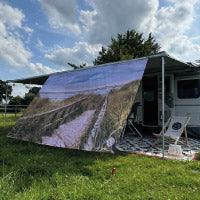
At Campidoo, you'll find products that meet these standards. Our sunshades are handmade in Germany with double-stitched edges and nickel-plated metal eyelets. Our support plates support 900 kg and remain stable on any surface.
Frequently Asked Questions
How can you recognize high-quality camping accessories at first glance?
High-quality camping accessories stand out for several features: The material feels robust and dense, not thin or brittle. Seams are double-stitched and even, and metal parts such as eyelets are nickel-plated or chrome-plated rather than simply galvanized. For textiles such as sunshades, the fabric weight should be at least 120 g/m². Aluminum frames should look sturdy and not bent, and plastic parts should have no sharp edges or scratches. Also pay attention to the overall weight: quality products weigh more because they use more substantial materials.
Which materials are particularly durable in camping accessories?
The most durable materials for camping are: aluminum for frames (lightweight, corrosion-resistant), high-strength polyester fabric with at least 120 g/m² for tents and sunshades, stainless steel for fasteners and fittings, and laminated plastic panels for tabletops. Avoid thin plastics, simply galvanized metal parts, and polyester under 100 g/m². Made-in-Germany products such as Campidoo sunshades (€115.95–€158.95) specifically use these high-quality materials and offer a 2-year warranty, signaling durability.
How can you check the workmanship of camping equipment before buying?
The following checks ensure quality workmanship: (1) Touch the seams—they should be double-stitched and even, without loose threads or fraying. (2) Check the edges—no fraying or sharp edges. (3) Check metal eyelets and zippers—they should be securely attached and not wobbly. (4) Unfold the frames—they should operate without excessive effort and not stick. (5) Run your hand over laminated surfaces—they should not splinter or peel. (6) Test the weight—high-quality products weigh more due to better materials.
What should you consider when buying a porch awning or sunshade?
For porch awnings and sunshades, the following points are crucial: material thickness (at least 120 g/m² polyester), roll bar compatibility (5 mm or 7 mm depending on the awning), double-stitched edges, and nickel-plated eyelets. Check whether the fabric appears dense and is not transparent. Pay attention to water resistance—a good shade will repel drizzle. Campidoo sunshades with double-sided photo printing and clean workmanship (€115.95–€158.95) meet these standards and come with a 2-year warranty. Ask about roll bar compatibility with your awning (Thule, Fiamma, Dometic).
High-quality camping equipment is an investment that pays off. These six checks will help you recognize genuine quality and avoid bad purchases. At Campidoo, we support you with products that meet these standards and offer free shipping on orders over €99, making your holiday relaxing and safe.


