












 About us
 Magazine
 Contact









Last updated: October 22, 2026
Quick overview
The 5 advantages of lithium batteries in caravans are significantly less weight, double usable capacity, faster charging speed, extremely long lifespan of 3,000-5,000 cycles and constant voltage stability. Lithium batteries last 10-15 years, while AGM batteries must be replaced after 3-5 years.
- A 200-Ah lithium battery saves about 23 kg compared to a comparable lead battery
- Lithium batteries withstand 80-100 percent depth of discharge, AGM batteries only about 50 percent
- With a modern charger, lithium batteries are fully charged in 2-4 hours
- Lithium batteries maintain their voltage constant at 12 V under load, AGM batteries drop to 10.5 V or less
- Over the lifespan, a lithium battery costs about EUR 0.15 per cycle, an AGM battery about EUR 0.33 per cycle
Table of contents
- Why lithium batteries in caravans are becoming increasingly popular
- Advantage 1: Significantly less weight and more compact dimensions
- Advantage 2: Double usable capacity at the same size
- Advantage 3: Faster charging speed with the right lithium battery caravan charger
- Advantage 4: Extremely long lifespan and lithium battery caravan lifespan
- Advantage 5: Constant voltage stability for reliable power supply
- AGM or lithium battery caravan: Which one is right for your vehicle?
- Retrofitting a lithium battery in a caravan: What you need to know
- Frequently asked questions
Why lithium batteries in caravans are becoming increasingly popular
Caravan owners face a fundamental decision: Which battery is right for my vehicle? The 5 advantages of lithium batteries in caravans help with this choice. The answer has shifted significantly in recent years. Lithium batteries are conquering the market because they outperform classic lead and AGM batteries in almost every important aspect. But it's not just about technology - it's about real improvements in everyday life.
More and more campers are modernizing their power supply. The reasons are concrete: less weight, more capacity, faster charging. But durability and reliability also play a major role. If you plan to technically upgrade your caravan, you should understand what lithium batteries really deliver - and where the real limits lie.
Below, we show you the 5 advantages of lithium batteries in caravans that make them so attractive.
Advantage 1: Significantly less weight and more compact dimensions
Lithium batteries weigh significantly less than their alternatives. This is no marketing promise - it's physics. A 200-Ah lithium battery saves about 23 kg compared to a comparable lead battery PlanMyCamper battery comparison. In a fully equipped setup, the savings can reach up to 58 kg.
This has direct effects on your caravan:
- Better driving dynamics: Less weight means better handling and lower fuel consumption
- Higher payload: You can take more equipment and supplies
- Easier transport: The installation is less complex because the battery is more compact
- Easier maintenance: Smaller, lighter components are easier to handle
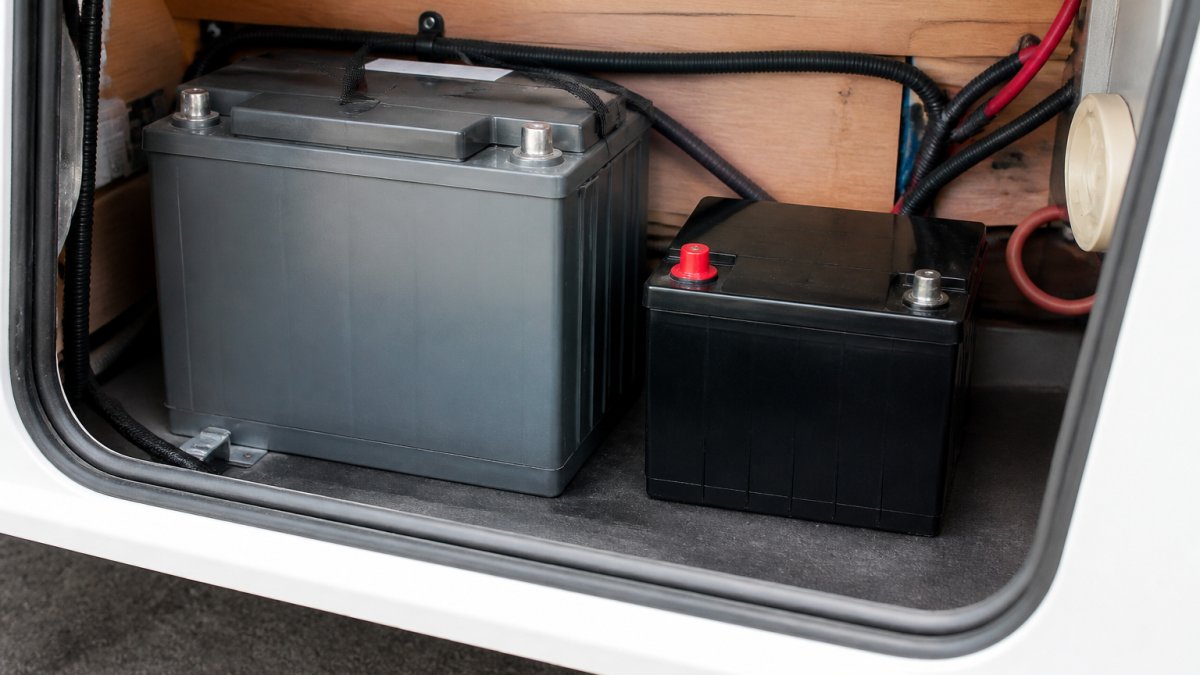
The practical advantage quickly becomes apparent: You need less space in the battery compartment. This means you have more flexibility during installation and may save space for additional accessories.
A common mistake is to underestimate this advantage. Many campers think that a few kilograms don't matter. But on a long trip with family and equipment, every kilo adds up.
Advantage 2: Double usable capacity at the same size
This is where it gets interesting. A lithium battery offers about double the usable capacity of an AGM battery at similar dimensions. This doesn't just mean more power - it means more independence.
Why is usable capacity more important than total capacity?
- AGM batteries should not be discharged below 50 percent (depth of discharge)
- Lithium batteries withstand 80-100 percent depth of discharge
- With a 200-Ah AGM battery, you realistically use about 100 Ah
- With a 200-Ah lithium battery, you use 160-200 Ah
This is a huge difference in everyday life. You can camp longer without an external power source, operate more devices at the same time, and need to recharge less often.
For families who like to camp off-grid, this advantage is crucial. You can use your refrigerator, heater, and lighting at the same time without fear of deep discharge.
Advantage 3: Faster charging speed with the right lithium battery caravan charger
Lithium batteries charge faster. This is not only practical - it changes your flexibility when camping.
A typical lithium battery in a caravan accepts high charging currents. This means:
- With a modern charger, you are fully charged in 2-4 hours
- With a solar system and shore power together, you charge even faster
- Your alternator can charge the battery more efficiently while driving
Important: The right charger is crucial. Older chargers and solar controllers are often not optimized for lithium. You may need to adapt your charging electronics - this is a real cost factor when retrofitting.
AGM batteries charge more slowly and require special charging curves. With lithium, you save time and frustration. Especially on longer tours, when you head to a new campsite every day, faster charging is a real advantage.
Advantage 4: Extremely long lifespan and lithium battery caravan lifespan
This is where quality separates from cheap solutions. A good lithium battery lasts 3,000-5,000 charge cycles. AGM batteries typically achieve 500-1,000 cycles.
This means:
- A lithium battery lasts 10-15 years with normal use
- You have to replace an AGM battery after 3-5 years
- Over the lifespan, the higher purchase price often pays for itself
A practical example: If you use your caravan for 4 weeks every year, you charge your battery about 50-100 times per year. A lithium battery with 4,000 cycles will then last 40-80 years - longer than you will probably use the caravan.
This is the point that many buyers overlook. The higher price at purchase is offset by the longer lifespan. You are not just buying a better battery - you are buying peace of mind for years.
Advantage 5: Constant voltage stability for reliable power supply
Lithium batteries maintain their voltage stable. This is technically important and practically valuable.
A 12-V AGM battery drops from 12 V to 10.5 V or less under load. This can cause problems:
- Refrigerators run inefficiently
- LED lights become dimmer
- Electronic devices can shut down
Lithium batteries maintain 12 V (or 24 V, depending on the system) constant. The battery management system (BMS) regulates the voltage automatically.
Practical advantages:
- All devices work optimally
- No surprises with voltage drops
- Better efficiency in energy usage
- Longer lifespan of your appliances
If you operate an inverter or use sensitive electronics, voltage stability is crucial. This is not just comfort - it is reliability.
AGM or lithium battery caravan: Which one is right for your vehicle?
The decision between AGM and lithium depends not on the battery alone, but on your usage behavior, your appliances, and the existing electrical system.
The most important differences at a glance
| Criterion | AGM battery | Lithium battery (LiFePO4) |
|---|---|---|
| Usable capacity (at 100 Ah nominal capacity) | approx. 50 Ah | approx. 80-100 Ah |
| Weight (at 100 Ah) | approx. 30-35 kg | approx. 12-15 kg |
| Charge cycles | approx. 500-1,000 | approx. 3,000-5,000 |
| Charging time (at 30 A charging current) | approx. 3-4 hours | approx. 2-3 hours |
| Temperature limits during charging | restricted below 0 °C | usually charging cut-off below 0 °C |
| Purchase price (100 Ah) | approx. EUR 150-250 | approx. EUR 400-700 |
Note: The prices are guidelines and may vary depending on the manufacturer and equipment.
Sizing based on real appliances
The crucial question is not how much capacity the battery has nominally, but how much power you actually consume. A typical example for a caravan with two people:
- Refrigerator (compressor, 12 V): approx. 30-50 Ah per day at summer temperatures
- LED lighting: approx. 5-10 Ah per day
- Heater (air circulation fan): approx. 5-15 Ah per day depending on usage
- Inverter for laptop, camera, phone: approx. 10-20 Ah per day
- Other appliances (water pump, radio): approx. 5 Ah per day
This results in a daily requirement of about 55-100 Ah. Anyone who wants to stand two to three days off-grid needs a usable capacity of at least 110-300 Ah - depending on consumption and weather (solar yield).
Example calculation: With a daily requirement of 70 Ah and a lithium battery with 100 Ah usable capacity (corresponds to approx. 120 Ah nominal capacity), the battery lasts for about 1.5 days without recharging. With an AGM battery of the same nominal capacity (120 Ah), only about 60 Ah usable is available - this is not even enough for a full day.
Costs over the lifespan
The higher purchase price of the lithium battery relativizes over the lifespan. A simplified calculation:
- AGM: EUR 200 purchase, 600 charge cycles, 5 years of use → approx. EUR 0.33 per cycle
- Lithium: EUR 600 purchase, 4,000 charge cycles, 12 years of use → approx. EUR 0.15 per cycle
This calculation does not take into account interest or price increases, but shows the order of magnitude: Over the lifespan, the lithium battery is often cheaper, especially if you use the caravan regularly.
When AGM is the better choice
- Your caravan has a very old charging system that cannot be retrofitted for lithium
- You camp mainly with shore power and only use the battery for lighting and water pump
- You have a limited budget and use the vehicle rarely (less than 20 nights per year)
- You store the vehicle for a long time without maintenance charging
When lithium makes sense
- You camp regularly off-grid and use solar system and shore power combined
- You operate an inverter or sensitive electronics
- You want to save costs over the lifespan and benefit from the higher usable capacity
- You also drive in the transitional season and want reliability
Seasonal use and winter operation
An often overlooked point: Lithium batteries must not be charged below 0 °C (ncbi.nlm.nih.gov). The BMS then switches off the charging process.
Conclusion: The decision is a trade-off between purchase price, frequency of use, and compatibility. By applying the sample calculation to your own consumption, you will quickly find out which battery is right for your caravan.
Retrofitting a Lithium Battery in a Caravan: What You Need to Know
Retrofitting a lithium battery in a caravan is not a plug-and-play replacement. If you only replace the battery and leave the existing charging and electrical equipment untested, you risk charging interruptions, a shortened lifespan, or in the worst case, damage to the electronics. The following checklist will help you approach the conversion systematically - specifically for the typical installation locations and circuits in the caravan.
Conversion Checklist
-
Charger (shore power): Check whether your charger offers a lithium charging profile (often referred to as "LiFePO4" or "Lithium"). Older devices often charge with a fixed charging curve designed for lead-acid or AGM batteries. Without a suitable profile, the battery will not be fully charged or will be unnecessarily stressed. Replacing the charger is often the biggest cost factor.
-
Alternator (charging while driving): Caravans are charged while driving via the towing vehicle's alternator - usually via a separator relay or a charging booster. Check whether the charging current is limited and whether the charging voltage is suitable for lithium. A charging booster with a lithium profile protects the battery from overcharging and ensures gentle charging.
-
Solar controller: An MPPT or PWM controller must have a lithium charging profile. Many modern controllers can be switched via an app or DIP switch. Also check whether the controller correctly maintains the cut-off voltage and maintenance charge.
-
Inverter: An inverter converts 12 V DC into 230 V AC. Check whether the inverter is suitable for continuous operation with lithium batteries and whether the cut-off voltage (low-voltage protection) harmonizes with the battery's BMS. A cut-off voltage that is too low can deeply discharge the battery.
-
Wiring and fusing: Lithium batteries can deliver high currents. Check the cross-sections of the cables and the dimensioning of the fuses. A short-circuit protection directly at the battery (e.g., a Class T fuse) is strongly recommended. The mounting must be vibration-resistant and secured against slipping.
-
Battery Management System (BMS): Every lithium battery should have an integrated BMS that monitors voltage, temperature, and state of charge, and protects the battery from overcharging, deep discharge, and overheating. Check whether the BMS can communicate with your charger and inverter - some systems offer a CAN interface.
Typical installation locations in the caravan
In the caravan, the battery is often located in its own battery compartment under a seat, in the storage locker, or near the wardrobe. These installation locations are often poorly ventilated and difficult to access. Check before installation:
- Ventilation: Lithium batteries do not off-gas during normal operation, but the installation location should still be dry and frost-free.
- Accessibility: You must be able to remove the battery for maintenance and in winter.
- Proximity to consumers: Short cable runs reduce voltage drops and make fusing easier.
- Weight: A lithium battery is lighter, but the mounting must still be stable.
Time and cost frame
Conclusion: Retrofitting is worth it if you systematically work through the checklist and adapt the charging electronics. If you only replace the battery, you miss out on most of the benefits.
Frequently Asked Questions
What advantages does a lithium battery in a caravan have compared to AGM?
Lithium batteries offer five crucial advantages: They save up to 23 kg in weight, offer about twice the usable capacity, charge significantly faster, last over 3,500 charge cycles (instead of about 1,000 with AGM), and provide constant voltage stability. This combination makes them ideal for longer camping trips and off-grid travel.
Can I simply replace an AGM battery in the caravan with a lithium battery?
A direct replacement is not always possible. AGM batteries are more tolerant of older charging profiles, while lithium batteries require a compatible charger and possibly a modern battery management system (BMS). Check your existing alternator, solar controller, and charger for compatibility before retrofitting.
How long does a lithium battery in a caravan really last?
A high-quality lithium battery in a caravan typically achieves 3,000 to 5,000 charge cycles, which corresponds to a lifespan of 10 to 15 years - significantly longer than AGM batteries with about 500 to 1,000 cycles. The actual lifespan depends on the depth of discharge, temperature management, and usage pattern.
Is a lithium battery in a caravan suitable at low temperatures?
Lithium batteries work in the cold, but with limitations. Charging below about 0 °C is not recommended and can damage the battery. Many modern lithium batteries have an integrated battery management system (BMS) that blocks charging processes in the cold. For winter camping, you may need insulation measures or a heated mat.


