










 About us
 Magazine
 Contact









Table of Contents
- Why calculating power requirements is important
- Step 1: Identify all electrical appliances
- Step 2: Document the daily usage time of the appliances
- Step 3: Calculate daily power requirements in watt-hours
- Motorhome power requirements per day: Practical calculation example
- Calculate motorhome battery capacity
- Calculate motorhome inverter
- Calculate motorhome solar system
- Frequently asked questions
Last updated: October 21, 2026
Why calculating power requirements is important
Calculating the power requirements in your motorhome is one of the most important decisions you can make: If undersized, you'll be left in the dark; if planned correctly, you'll enjoy independence.
Many people buy a battery because it looks large - and end up without power after two days of off-grid use.
Calculating motorhome power requirements means understanding three things:
- Which appliances you actually use
- How long you use them each day
- How much energy that costs in total
Only then will the battery and solar system be properly sized, and only then will you realistically plan how long you can remain off-grid.
Step 1: Identify all electrical appliances
Write down what consumes electricity in your motorhome - not approximately, but exactly.
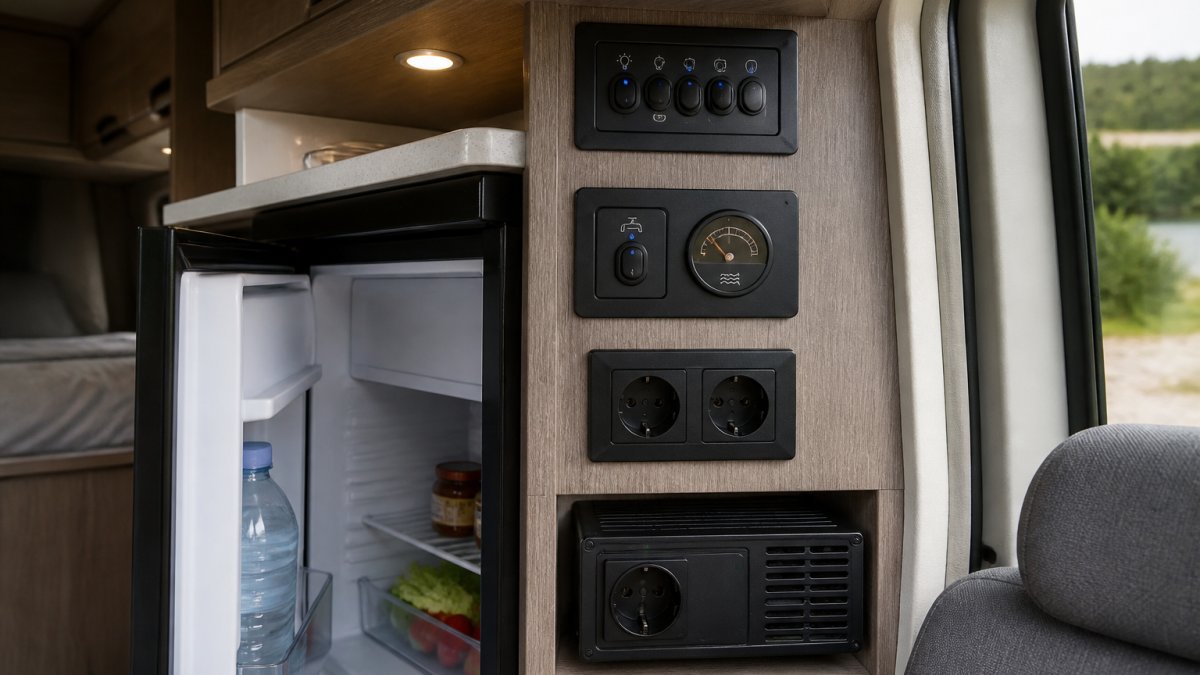
Typical 12-volt appliances in a motorhome
The 12-volt system runs directly from the leisure battery.
These appliances consume 12 volts:
- LED lighting (3-5 watts per light)
- Compressor refrigerator (40-60 watts)
- Water pump (10-20 watts)
- Ventilation and fans (10-30 watts)
- Solar charge controller (minimal, under 1 watt)
- Television and multimedia (15-30 watts)
- Heater or boiler (depending on the model, 200-500 watts)
LED lighting consumes significantly less than old halogen spotlights: When calculating power requirements in a motorhome, you can quickly save 50 percent on lighting with LEDs.
Write down the power consumption in watts for each appliance. You can find this figure on the nameplate or in the manual.
230-volt appliances and inverters
230-volt appliances are power-hungry: A hairdryer draws 1500 watts, a coffee machine 800-1200 watts, and a microwave 800-1000 watts. They only run via an inverter that converts 12-volt direct current into 230-volt alternating current - and loses 5-10 percent of the power in the process.
An air conditioner needs 2000-3000 watts and would drain your battery in minutes.
When calculating power requirements in a motorhome, you have to be honest: Which 230-volt appliances do you really use? Not "I could use", but "I actually use". Only then will the calculation be realistic.
Step 2: Document the daily usage time of the appliances
Power consumption alone says nothing: A 100-watt appliance that runs for 1 hour consumes less than a 50-watt one that runs for 3 hours. The daily operating time is crucial.
Write down the following for each appliance:
- Name of the appliance
- Power consumption in watts
- Daily usage time in hours
Example:
- LED lighting: 20 watts × 10 hours = 200 Wh per day
- Refrigerator: 50 watts × 24 hours = 1200 Wh per day
- Water pump: 15 watts × 2 hours = 30 Wh per day
Replace estimates with measurements
The biggest uncertainty is not the formula, but the assumption: Those who only estimate their usage time are often off by 20-40 percent. Two measurement methods close this gap:
1. Shunt-based battery monitors
A shunt monitor is installed between the battery's negative terminal and the vehicle's ground and measures the actual current flow: charging, discharging, and cumulative consumption in ampere-hours or watt-hours. Over several days, you will get a real consumption profile - including the appliances you might have forgotten to write down. The shunt must be sized for the maximum current (for inverters from 2000 watts, 200-300 amperes are not uncommon).
2. Plug-in power meters for 230-volt appliances
For appliances connected to the inverter or shore power, a power meter measures the energy drawn between the outlet and the appliance in kWh - this way you can see what a hairdryer, coffee machine, or charger actually draws, not just the nameplate.
Don't forget standby consumption
Many appliances draw power even when switched off: televisions, chargers, inverters in standby mode, radios with memory, solar controllers with displays. Depending on the model, an inverter draws 10-30 watts in standby - over 24 hours, that's 240-720 Wh. Check whether your inverter has a real power switch or Eco mode, and measure the standby consumption once; this figure belongs in the appliance list.
Observe for one week instead of estimating for one day
The most reliable way: Note down daily for one week when which appliances are running. A compressor refrigerator cycles - its average power consumption is often 30-50 percent of the rated power. Those who use the nameplate as continuous power significantly overestimate the consumption. A battery monitor or measurement adapter shows the actual daily consumption in watt-hours - the best basis for all further steps.
From measurement to planning figure
In the end, you have a reliable figure for each appliance: watt-hours per day. Those who work cleanly here avoid the most common cause of undersized batteries and solar systems: underestimated consumption.
Step 3: Calculate daily power requirements in watt-hours
The formula is simple:
Watts × Hours = Watt-hours (Wh)
Multiply the power consumption of each consumer by the daily usage time and add everything up. That is your daily requirement in watt-hours.
Example:
- LED lighting: 20 W × 10 h = 200 Wh
- Refrigerator: 50 W × 24 h = 1200 Wh
- Water pump: 15 W × 2 h = 30 Wh
- Fan: 20 W × 4 h = 80 Wh
- Television: 25 W × 3 h = 75 Wh
Total daily requirement: 1585 Wh per day
That is your motorhome power requirement per day. Remember this figure. You need it for all further calculations.
Motorhome power requirements per day: Practical calculation example
A complete calculation example shows how individual appliances become a reliable battery and solar plan - including losses, conversion into ampere-hours, and reserve.
Assumptions for a typical camping trip:
Your motorhome has these appliances:
- 6 LED lights at 4 watts each
- 1 refrigerator (compressor), 50 watts
- Water pump, 15 watts
- Ventilation, 20 watts
- Television, 25 watts
- Inverter (for occasional 230-volt use)
Your daily usage:
- LED lights: 6 hours per day (morning, evening)
- Refrigerator: 24 hours (continuous)
- Water pump: 1 hour (showering, washing)
- Ventilation: 3 hours (during the day in the heat)
- Television: 2 hours (evening)
- Inverter (for hairdryer, laptop): 1 hour, consumes 500 watts
Step A: Watt-hours per appliance
| Appliance | Watts | Hours | Watt-hours |
|---|---|---|---|
| LED lights | 24 | 6 | 144 |
| Refrigerator | 50 | 24 | 1200 |
| Water pump | 15 | 1 | 15 |
| Ventilation | 20 | 3 | 60 |
| Television | 25 | 2 | 50 |
| Inverter | 500 | 1 | 500 |
| Total | 1969 Wh |
The pure consumption is therefore around 1970 Wh per day, or about 2 kWh.
Step B: Transparently add losses
The pure watt-hour calculation underestimates the requirement. Three loss sources are realistic:
- Inverter: Efficiency typically 85-95 percent. For 500 Wh and 90 percent efficiency, this results in 500 Wh ÷ 0.9 ≈ 556 Wh from the battery.
- Line and connection losses: For 12-volt systems with long cable runs, 3-5 percent is realistic, for 1970 Wh about 60-100 Wh.
- Charging losses: When recharging via solar or shore power, another 5-15 percent is lost depending on the charge controller and battery type - consider this surcharge in the solar sizing, not in the daily consumption.
For the example, with 90 percent inverter efficiency and 5 percent line loss:
- Inverter loss: 500 Wh → 556 Wh (around 56 Wh additional)
- Line loss on 1970 Wh: around 100 Wh
- Corrected daily requirement: about 2130 Wh
Step C: Conversion into ampere-hours
Battery capacity is usually given in ampere-hours (Ah). The conversion is:
Watt-hours ÷ Onboard voltage = Ampere-hours
For a 12-volt onboard battery:
2130 Wh ÷ 12 V ≈ 178 Ah per day
This is the central figure for battery planning.
Step D: Battery size with depth of discharge
For 3 days of autonomy:
- Total requirement: 2130 Wh × 3 = 6390 Wh
- Lead battery (50 percent usable): 6390 Wh ÷ 0.5 = 12,780 Wh ≈ 12.8 kWh
- AGM battery (80 percent usable): 6390 Wh ÷ 0.8 = 7988 Wh ≈ 8.0 kWh
- Lithium battery (90 percent usable): 6390 Wh ÷ 0.9 = 7100 Wh ≈ 7.1 kWh
In ampere-hours at 12 volts:
- Lead: 12,780 Wh ÷ 12 V ≈ 1065 Ah
- AGM: 7988 Wh ÷ 12 V ≈ 666 Ah
- Lithium: 7100 Wh ÷ 12 V ≈ 592 Ah
These figures make the difference between battery types immediately tangible: A lithium battery weighs and takes up almost half the space of lead for the same usable energy.
Step E: Solar power from the corrected requirement
For recharging, the rule applies: daily requirement ÷ realistic sunshine hours = required panel power.
Calculate Motorhome Battery Capacity
How large does your battery need to be?
Daily requirement × days of autonomy = total requirement in watt-hours
The catch: You cannot fully discharge a battery. Lead only by 50 percent, AGM by 80 percent, lithium by 90 percent.
Example with 3 days of autonomy:
Total requirement: 2000 Wh × 3 days = 6000 Wh
If you use a lead battery (50 percent discharge): 6000 Wh ÷ 0.5 = 12,000 Wh = 12 kWh battery capacity required
If you use an AGM battery (80 percent discharge): 6000 Wh ÷ 0.8 = 7500 Wh = 7.5 kWh battery capacity required
If you use a lithium battery (90 percent discharge): 6000 Wh ÷ 0.9 = 6667 Wh = about 6.7 kWh battery capacity required
Lead, AGM and Lithium Batteries Compared
Lead battery (classic):
- Cheap, heavy (about 30 kg for 100 Ah)
- Only 50 percent usable capacity
- Short lifespan (3-5 years), maintenance required
- Not suitable for frequent discharging
AGM battery (absorbent glass mat):
- Medium price, lighter (about 20 kg for 100 Ah)
- 80 percent usable capacity
- Longer lifespan (5-8 years), maintenance-free
- More robust against discharging
Lithium battery (LiFePO4):
- Expensive, very light (about 10 kg for 100 Ah)
- 90-95 percent usable capacity
- Very long lifespan (10+ years), maintenance-free
- Fast charging possible
- Best price-performance ratio over the lifespan
When calculating motorhome battery capacity, you must therefore consider not only the power consumption, but also which battery type suits you.
Calculate Motorhome Inverter
An inverter converts 12-volt direct current into 230-volt alternating current - without it, no hairdryer, no coffee machine, no laptop charger will work.
Rule of thumb: The inverter should be at least 20-30 percent larger than your highest peak load.
If you want to use a 1500-watt hairdryer, you need an inverter with at least 2000 watts.
A large inverter costs more and consumes more standby power - a 3000-watt device for a laptop charger is a waste of money. When calculating the motorhome inverter, the question is: What will you really operate?
Consider efficiency and line losses
The efficiency is typically 85-95 percent: If you draw 1000 watts, you consume 1050-1180 watts from the battery. Line losses are added to this - long cables cause more voltage drop than short ones. Calculate with a total loss of 5-10 percent. When calculating the power requirement in the motorhome, this means: 500 Wh over the inverter costs about 550 Wh of battery capacity (500 Wh ÷ 0.9).
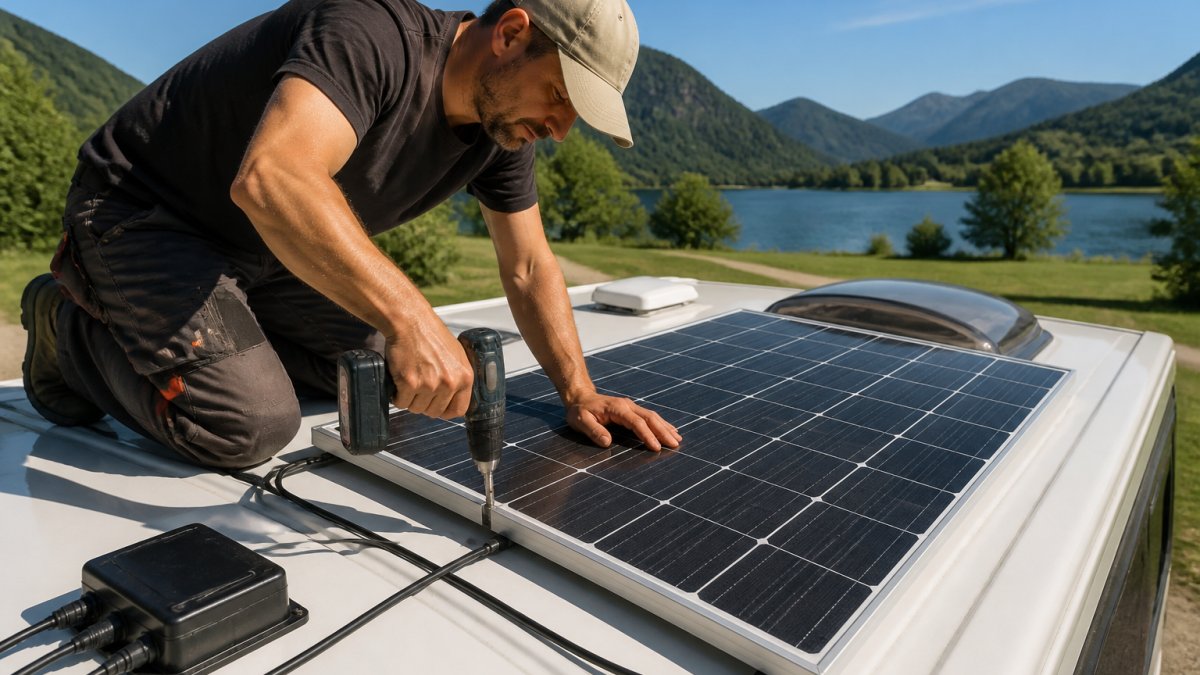
Calculate Motorhome Solar System
A solar system extends your autonomy: Instead of being without power after 2 days, you are free for a week.
Daily requirement ÷ sunshine hours = solar power in watts
However, the solar power is not constant - it depends on the season, location, weather conditions, and tilt angle of the panels.
Seasonal and location-dependent solar yields
In summer in Southern Europe, 5-6 sunshine hours per day are realistic, in winter in Northern Europe only 2-3. A 100-watt panel generates about 500 Wh per day in summer, only 150-200 Wh in winter.
Practical rule of thumb:
For 3 days of autonomy in summer: about 200-300 watts of solar power. For 3 days of autonomy in winter: about 400-600 watts of solar power.
Our example with 2000 Wh daily requirement:
Summer (5 sunshine hours): 2000 Wh ÷ 5 h = 400-watt solar system. Winter (2 sunshine hours): 2000 Wh ÷ 2 h = 1000-watt solar system.
That is why many campers do not drive autonomously in winter, but stay at campsites with an electrical connection.
Calculating the power requirement in the motorhome is the basis for everything. A wrong calculation leads to a battery that is too small, too little solar power, and too small an inverter.
Frequently Asked Questions
How much power does one consume on average per day in the motorhome?
The daily power consumption depends heavily on the equipment and usage. A sparingly equipped motorhome consumes 30-50 watt-hours daily, while a comfortably equipped one with a refrigerator, heater, and lighting requires 100-300 watt-hours per day. With 230-volt devices such as a microwave or hairdryer, the requirement quickly rises to 500+ watt-hours. The exact calculation is done by recording all consumers and their daily operating time.
Which battery voltage is standard in the motorhome?
Most motorhomes use a 12-volt system for basic equipment such as lighting, water and wastewater pumps, and refrigerators. The onboard voltage is 12 volts. For 230-volt devices, an inverter is required that converts the 12-volt battery voltage into 230 volts alternating current. In larger motorhomes, there are also 24-volt systems, but these are less common.
How do I convert watt-hours to ampere-hours?
The conversion is done with the formula: ampere-hours (Ah) = watt-hours (Wh) ÷ voltage (V). For a 12-volt system with 2,400 watt-hours daily requirement: 2,400 Wh ÷ 12 V = 200 Ah. This is the theoretical power consumption in ampere-hours. For the practical battery capacity, the usable capacity must be considered: For lead batteries, only 50% of the rated capacity should be used, for lithium up to 80-90%.
Can I measure the power consumption of my motorhome myself?
Yes, with a digital power meter or multimeter you can measure the power consumption of individual devices. Connect the device to the onboard socket via the power meter and read the watt power. Multiply this by the daily operating time in hours to calculate the watt-hours. For an accurate overall balance, it is also recommended to measure over several days in real camping operation, as consumption and usage can vary greatly.