










 About us
 Magazine
 Contact






Last updated: October 29, 2026
Quick overview
An outdoor stove for families should above all be stable, easy to use, and easy to clean. For family camping trips, we recommend a model with two independently adjustable burners, a wide pot support, and a low center of gravity. Additionally, check for tip resistance, ignition safety, and wind protection before buying.
- Two burners should allow two pots with a diameter of 20 to 24 centimeters to be placed side by side.
- An average burner consumes about 100 to 200 grams of gas per hour.
- For one week with two burners and two hot meals daily, we estimate five to eight 450-gram cartridges.
- In cold and windy conditions, plan for a buffer of about 20 to 30 percent in gas.
- Cartridges do not belong in the tent or in direct sunlight, but in ventilated, child-safe storage.
Table of Contents
- Camping stoves and outdoor stoves at a glance: What families really need
- Camping stoves with two burners: Why families should opt for two burners
- Camping stoves for large pots: How to properly assess capacity and stability
- Gas cartridge consumption for camping: How to realistically plan costs per meal
- Camping stove safety: What matters with children and in windy conditions
- Performance in wind, cold, and changeable weather
- Robustness, cleaning, and care in everyday family life
- Find the right equipment for your next camping adventure
- Frequently asked questions
Camping stoves and outdoor stoves at a glance: What families really need
The crucial difference lies in everyday use. A stove that sits on a wobbly little table and goes out with every gust of wind spoils the morning more than a missing extra.
Camping stoves with two burners: Why families should opt for two burners
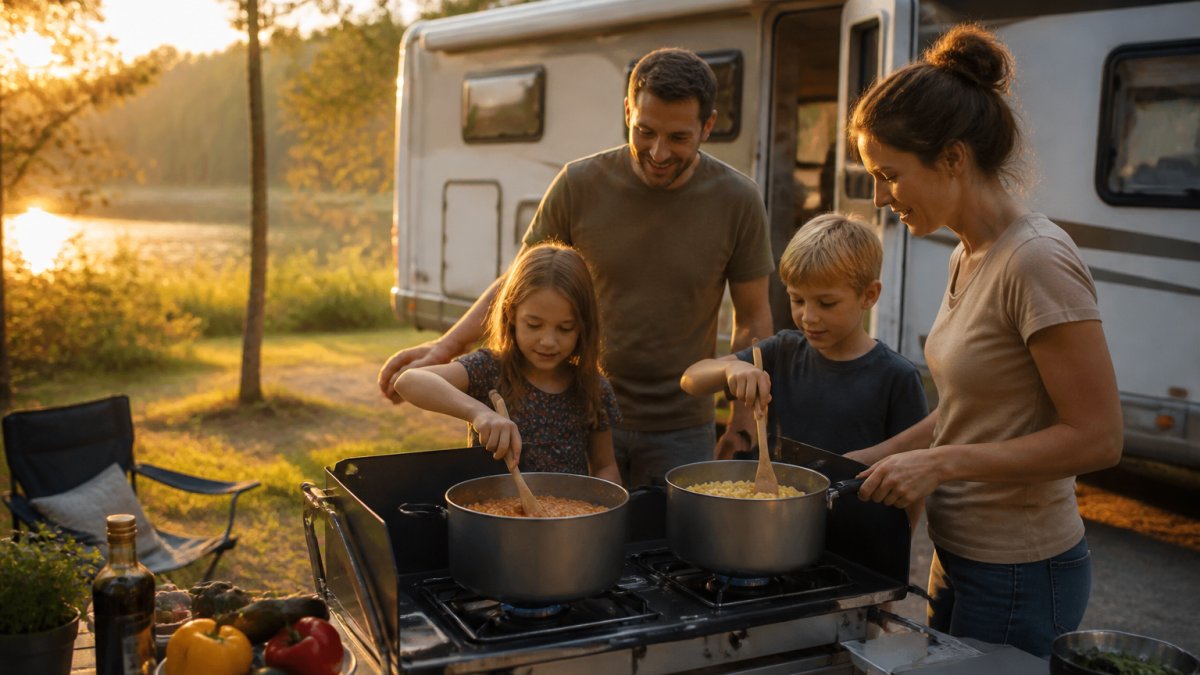
A camping stove with two burners is the most practical design for families because pasta water and sauce can be cooked at the same time. With only one burner, every meal takes twice as long, and hungry children rarely wait patiently. Two burners solve this problem directly.
The distance between the burners is important. If the burners are too close together, two large pots will not fit side by side, and the heat builds up. Make sure the housing dimensions allow for two pots with a diameter of 20 to 24 centimeters.
For families with toddlers, a third aspect comes into play: The control knobs should not be located directly next to the hot flame.
Camping stoves for large pots: How to properly assess capacity and stability
A camping stove for large pots needs above all one thing: a wide support surface and a low center of gravity. Pots with a capacity of five liters quickly become heavy when loaded, and a narrow pot stand tips more easily. Before buying, check whether the pot support corresponds at least to the pot base.
Stability is created by three factors:
- Weight of the stove: A heavier housing stands more steadily, but takes up space.
- Width of the stand feet: Foldable feet with non-slip rubber caps hold even on uneven ground.
- Connection between pot and support: Teeth or a surrounding rim prevent slipping.
Anyone who frequently cooks on meadows or sandy ground should also plan for a stable base. A heat-resistant mat protects the ground and noticeably improves stability. For very large pots, it is also worth looking at the maximum load capacity that many manufacturers state in the instructions.
Gas cartridge consumption for camping: How to realistically plan costs per meal
The gas cartridge consumption for camping depends heavily on the cooking method. An average burner consumes about 100 to 200 grams of gas per hour, depending on the power level. For a simple meal with pasta and sauce, you can expect around 15 to 25 minutes of cooking time, so roughly 30 to 60 grams of gas. Anyone who combines these values with the common cartridge sizes and prices will arrive at a reliable cost plan - and that is exactly what is missing in most product overviews.
Cartridge sizes and connections
Three sizes are mainly available in stores: valve cartridges with 230 grams, 450 grams, and screw cartridges with 450 grams. For families with two burners and two hot meals per day, the 450-gram cartridge is the most economical choice because it needs to be changed less often and is cheaper per gram of gas than the small 230-gram variant. Pay attention to the connection: valve cartridges only fit stoves with a valve connection, screw cartridges only models with a screw thread.
Consumption per meal and per week
The following rule of thumb has proven itself for holiday planning:
| Meal | Cooking time | Gas consumption (approx.) | Cartridges per week (2 burners, 2x daily) |
|---|---|---|---|
| Breakfast (coffee, eggs) | 10-15 min. | 20-40 g | 1-2 cartridges |
| Lunch (pasta, rice) | 20-25 min. | 40-60 g | 2-3 cartridges |
| Dinner (stew, pan) | 25-35 min. | 50-80 g | 2-3 cartridges |
For a family with two burners and two hot meals per day, that is roughly five to eight 450-gram cartridges over a week. Anyone who uses only one burner will get by with about half.
Costs per meal in euros
The costs for cartridges differ depending on size, connection, and source. Anyone who knows the consumption per meal can calculate the gas costs for the holiday themselves.
Cold, wind, and consumption
An often overlooked point: In cold weather, the pressure in the cartridge drops, and the consumption feels higher because it takes longer to cook. Plan for a buffer of about 20 to 30 percent in spring and autumn. In windy conditions without wind protection, consumption also increases because the flame burns unevenly. A simple sheet around the flame shortens the cooking time and lowers the resulting costs - an effect that can add up over a season.
Total costs instead of cartridge price
For families, it is worth calculating for the whole season: A stove with two burners and good wind protection consumes less gas than a simple model that has to run longer in the wind. Anyone who chooses the cartridge size according to consumption and consistently uses the wind protection will get by with five to eight cartridges per week - and keeps an eye on the costs per meal instead of noticing them only at the end of the holiday.
Camping stove safety: What matters with children and in windy conditions
Camping stove safety is not a catch-all term for warnings, but a series of verifiable properties. Anyone who camps with children should not choose the stove by its appearance, but by five criteria: tip resistance, temperature of the outer surfaces, ignition safety, fuel storage, and wind protection. This order has proven itself in practice because it covers the most common causes of accidents.
Tip resistance: The stove must withstand impacts
Children bump into tables, reach for pots, and walk past the stove. A family-friendly stove should therefore have a wide base, non-slip feet, and a low center of gravity. A simple test before buying: place the stove on a slightly slanted surface and push it from the side with your hand. If it tips even with moderate pressure, it is unsuitable for family use. Models with foldable feet and rubber caps hold much better on grass, sand, and gravel than those with narrow metal feet.
Hot surfaces: Distance and shielding
The greatest danger is not the flame itself, but what stays hot afterwards: pot, lid, pot stand, and the housing around the burner. Make sure that the control knobs are offset to the side or set forward, so that no one reaches into the hot zone while walking past. A surrounding rim or an elevated pot support also keeps the pot in position if a child bumps against it. After cooking: push hot pots to the back, away from the walking edge, and let the stove cool down before packing it away.
Ignition safety and gas supply
Models with piezo ignition save matches, but do not replace control. It is important that the gas supply is closed at the cartridge itself after cooking, not just at the regulator - so no gas escapes if a child accidentally turns the regulator on. Also check whether the stove has an ignition safety device: It prevents unburned gas from escaping if the flame goes out. For models with an external cartridge, the hose and seal should be checked for cracks before every season.
Fuel storage: Cartridges do not belong in the tent
Gas cartridges and fuel bottles do not belong in the sleeping area or in direct sunlight. Store them upright, well ventilated, and out of reach of children - preferably in a lockable box in the vestibule or in the vehicle. A full cartridge is under pressure and reacts sensitively to heat; direct sunlight in midsummer can increase the pressure. For families with toddlers, lockable storage is worth it so that the cartridge does not become a toy.
Wind protection: Safety and efficiency at the same time
In windy conditions, the flame flickers, performance drops, and the gas supply becomes uneven. An integrated wind shield or a separate sheet keeps the flame steady, reduces consumption, and prevents the flame from escaping sideways. Always place the stove on a solid, level surface - not on a camping table with a tablecloth that easily slips. And: never operate the stove in a closed tent because of exhaust gases and the risk of fire.
Anyone who checks these five criteria before buying reduces the most common risks in everyday family life - and at the same time has a stove that works reliably even in wind and cold.
Performance in wind, cold, and changeable weather
The performance of a stove is usually stated in kilowatts. However, the crucial thing is not the peak performance on the data sheet, but how much of it remains in wind and cold.
Three things help keep the performance constant:
- Wind protection: Even a simple sheet around the flame significantly shortens the cooking time.
- Preheating in cold weather: Cartridges with a propane content work more reliably at low temperatures than pure butane cartridges.
- Correct pot size: A pot that is significantly larger than the flame loses heat on the sides.
Anyone who camps in autumn or at high altitudes should look for a model with good cold-weather suitability. A stove that runs reliably in summer can noticeably struggle at an outside temperature of five degrees. Therefore, check before booking the campsite whether the equipment is suitable for the season.
Robustness, cleaning, and care in everyday family life
Robustness does not show when unpacking, but after the third season. A good family stove has rounded edges and as few seams as possible, where grease residues can collect.
After cooking, a damp cloth is usually enough. For burnt-on residue, warm water with a mild cleaner helps. For camping cookware and sensitive surfaces, it is worth taking a look at biodegradable cleaning products for camping cookware, which are also easy to use while traveling.
A common mistake: immediately wrapping the stove in a damp cloth after it has cooled down. Residual moisture leads to corrosion of the burner nozzles over time. Let the device air dry and store it in a dry place.
Find the right equipment for your next camping adventure
The stove is just one component of a functional outdoor kitchen. An overview of which camping lighting is suitable for family evenings helps you choose for long evenings by the stove. Families considering purchasing seating can check in advance whether comfortable camping furniture for families with toddlers is worth the money. And those looking to complete their equipment will find support in comparing the right camping sleep system for children.
Our recommendation for equipment: First choose the stove according to your cooking habits, then add lighting and seating, and finally the sleep system. By planning in this order, you avoid bad purchases and end up with equipment that really works in everyday life.
An outdoor family kitchen depends on the quality of the equipment. Campidoo supports you with high-quality "Made in Germany" camping accessories, a large range of cleaners for campers, and customizable sun sails. Over 10,000 satisfied campers are already enjoying relaxed holidays, with 4.8 out of 5 stars from more than 7,000 reviews. Order conveniently on account with Klarna and benefit from free shipping from 99 euros.
Frequently Asked Questions
Which camping stove is suitable for a family?
For families, a two-burner outdoor stove with wide pot supports, a low center of gravity, and a wind guard is worth it. This allows pasta and sauce to be prepared at the same time, and large pots stand securely. Pay attention to a weight that you can still carry alone, and to an ignition that works reliably even in the wind. Two-burner models usually cost a little more than single-burner stoves, but save a lot of time when cooking.
How many gas cartridges do you need for 10 days of camping?
Gas cartridge consumption when camping depends heavily on the stove and cooking habits. For a family with two meals a day and a 2-burner stove, two to three 450 g cartridges are generally a realistic plan. Those who heat a lot of water or cook in the cold should plan for a spare. A simple guideline: check the actual consumption after the first few days and adjust the plan.
How safe is a gas stove when camping?
A gas stove is safe if it is used as intended. Always set it up level and protected from the wind, never in enclosed spaces such as awnings or caravans. Keep children away from the stove, secure pots against tipping over, and check seals and hoses before every season. On devices with a flame failure device, the gas supply stops if the flame goes out. Taking a look at the operating instructions and giving a brief instruction to all family members is part of this.
Can you cook with normal pots on a camping stove?
Yes, normal pots can be used on most outdoor stoves, as long as the diameter fits the pot supports. For camping stoves for large pots: The bottom of the pot should fit the pot support so that it rests stably. Very wide pots can allow the flame to flow around the sides and lose energy. Lightweight aluminum or stainless steel pots with a well-fitting lid shorten the cooking time and reduce gas cartridge consumption.