









 About us
 Magazine
 Contact









Table of Contents
- Why biodegradable cleaning agents are indispensable for camping
- Eco-friendly dish soap for camping: ingredients and certifications
- Camping dishwashing tips: washing correctly and saving water
- Greywater disposal while camping: legal requirements and practical implementation
- Concentrates versus ready-to-use solutions
- DIY recipes for sustainable camping cleaners
- Gentle cleaning for camping tableware and surfaces
- Conclusion: Sustainable cleaning in everyday camping life
- Frequently Asked Questions
Last updated: October 2, 2026
Why biodegradable cleaning agents are indispensable for camping
Biodegradable cleaning agents are a practical necessity for every responsible camper. Conventional cleaning products contain substances that take weeks or even months to break down. Biodegradable cleaners, on the other hand, decompose within days through natural processes, thus protecting campsites, natural areas, and your greywater disposal system.
At Campidoo, we understand that sustainability when camping is not a luxury; it is the foundation of responsible tourism. Our wide range of biodegradable cleaning products has been developed specifically for the requirements of motorhome and caravan owners. Choosing the right dish soap for camping affects three things: how effectively you clean your dishes, how long your waste water tank remains odor-free between emptying, and whether you can relax while camping without worrying about environmental damage.
Eco-friendly dish soap for camping: ingredients and certifications
An eco-friendly dish soap for camping is only truly eco-friendly if you understand what it is made of and which certifications it carries.
Surfactants and their biodegradability
Surfactants are the active ingredients in every cleaning agent. They break down fats and oils so that water can wash them away. Synthetic surfactants in standard dish soaps can persist in the environment and harm aquatic organisms. Biodegradable plant-based surfactants (such as those from sugar, coconut oil, or rapeseed oil) are broken down more quickly by microorganisms.
According to the OECD 301 test method, biodegradable substances must break down into their natural components by at least 60 percent within 28 days. This is sufficient for camping waste water, especially if your greywater remains in the tank for several days. Many sustainable cleaning products use surfactants from sugar or coconut oil – they are not only biodegradable but also vegan and free from microplastics.
Recognizing and correctly interpreting certifications
EU Ecolabel (The European Flower) The EU Ecolabel is one of the most reliable certifications. It sets strict requirements for biodegradability (at least 90% according to OECD 301), toxicity to aquatic organisms, and ingredients.
Ecocert and NATRUE The Ecocert seal and the NATRUE certificate are reliable, especially if you value purely natural ingredients. NATRUE is particularly strict and prohibits synthetic fragrances and preservatives.
Blue Angel (RAL-UZ 62) The German environmental label requires biodegradability of at least 90%, no phosphates, and no chlorine bleach.
Beware of marketing labels Vague labels like "eco," "green," or "natural" without certification are often just marketing terms. A genuine certificate is issued by an independent body.
Practical tip for campsites Many campsites in Germany require cleaning agents to carry the Blue Angel or EU Ecolabel seal. Before buying a product, ask your campsite or check the campsite regulations.
Camping dishwashing tips: washing correctly and saving water
The biggest mistake when washing dishes while camping is wastefulness. Done correctly, you can keep your dishes clean with biodegradable cleaning agents while saving water.
Dosage and usage in a caravan
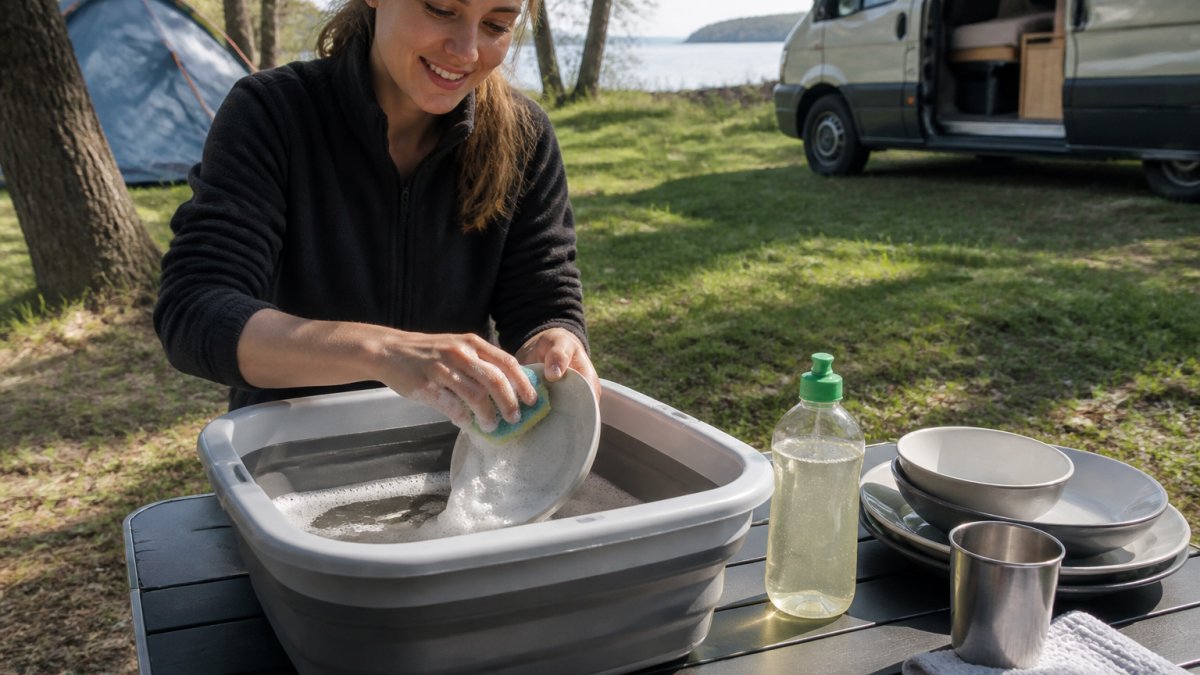
Less is more. Many people add too much dish soap to the water, which only makes the situation worse. A small amount of biodegradable dish soap is sufficient—start with about one teaspoon per sink. Fill your sink with warm water, add the soap, and wash your dishes. Rinse with cold water; this saves energy and water. Wash the least soiled items (glasses, cutlery) first, then the plates and pots, so that your water stays cleaner for longer.
Removing stubborn dirt
Soak the pot or pan with warm water and a little dish soap for 15 to 20 minutes. This softens the grime without requiring scrubbing. For particularly stubborn cases, you can use vinegar or baking soda—both are naturally biodegradable and will not harm your waste water tank. A tablespoon of vinegar in the dishwater helps with grease spots. Do not use aggressive scouring agents or chemicals, as these damage your camping equipment and strain your waste water tank.
Greywater disposal while camping: legal requirements and practical implementation
Greywater disposal is governed by the Federal Water Act (WHG) and state waste water ordinances. The basic rule is simple: greywater must not be simply dumped on the ground or into bodies of water unless it meets specific quality standards.
Legal foundations in Germany
At campsites: At a registered campsite, you must direct your greywater into the designated sewage systems. The campsite is obligated to operate these systems and treat the waste water properly.
Wild camping: In most federal states, discharging greywater on private or public land without permission is not allowed. Some states allow small amounts on private property under certain conditions if the owner consents. However, the rule remains: the greywater must be biodegradable.
Special feature: State waste water ordinances Each federal state has its own waste water ordinances. Some are stricter and require that even greywater from motorhomes be treated in sewage treatment plants. Before driving to a new state, it is worth taking a look at local regulations.
Why biodegradable cleaning agents are legally relevant
The use of biodegradable cleaning agents while camping is not just ecologically sound, but also legally relevant. Conventional cleaning products with persistent surfactants can lead to groundwater contamination—an administrative offense under the Federal Water Act punishable by fines of up to 10,000 euros. Biodegradable cleaning agents with certifications like the EU Ecolabel or the Blue Angel meet these requirements and break down more quickly.
Campsite rules: what you need to know
Scenario 1: Emptying the waste water tank at designated spots Most campsites have disposal stations with connections for waste water tanks. This is the standard solution and completely legal. Here, it is important to use biodegradable cleaning agents because the sewage treatment plant can handle them better.
Scenario 2: Emptying greywater into collection pits Some smaller campsites have collection pits. Here, it is even more important to use biodegradable agents because the pit is not actively treated.
Scenario 3: Directing dishwater into sewage systems Some campsites allow dishwater to be directed into sewage drains. Again, biodegradable is a requirement.
Scenario 4: Prohibition of certain substances Many campsites explicitly prohibit products containing phosphates or chlorine bleach. A biodegradable cleaning agent with the EU Ecolabel automatically meets these requirements. Read the campsite regulations before you arrive.
Using the fresh water tank and waste water tank correctly
A common mistake: campers fill their waste water tank too quickly because they use too much water and soap. With biodegradable cleaning agents and economical dosing, you can use your waste water tank for longer. The dish soap breaks down instead of accumulating in the tank. A practical side effect: biodegradable agents cause less odor in the tank.
Practical tips for tank management:
- Empty your waste water tank regularly, before it is full.
- Always use biodegradable products.
- Flush your tank out with water occasionally.
- Use the disposal stations at campsites.
Concentrates versus ready-to-use solutions
Concentrates are more economical and save space in the caravan. A small bottle of concentrate lasts for many wash cycles. The disadvantage: you have to dilute it every time. Ready-to-use solutions are convenient but cost more per use and involve transporting a lot of water in the caravan. For most campers, concentrates are the better choice—they are more sustainable, cheaper, and space-saving.
DIY recipes for sustainable camping cleaners
If you want to be absolutely sure that your dish soap is sustainable, you can make it yourself.
Household remedies for dishwashing
A simple recipe:
- 500 ml water
- 2 tablespoons vinegar
- 1 teaspoon pure Castile soap (or plant-based liquid soap)
- Optional: 5-10 drops of essential oil for scent
Mix everything in a bottle. The vinegar helps against grease; the soap provides the cleaning action. This recipe works for normal dishes and is completely biodegradable.
Gentle cleaning of GRP and plastic
For GRP and plastic, a gentle cleaning agent is important:
- 1 liter water
- 1 tablespoon mild soap
- 1 teaspoon vinegar
This is less concentrated than the standard recipe, but enough to clean surfaces without damaging them. Use a soft cloth or sponge.
Gentle cleaning for camping tableware and surfaces
Not all cleaning agents are suitable for all materials. Melamine is popular when camping because it is light and shatterproof, but it is sensitive to scratches. A mild, biodegradable dish soap is the best choice here. Always use a soft sponge, never steel wool. Ceramic and stainless steel are more robust, but even here, biodegradable is better, especially if you direct your waste water into a tank. Gentle cleaning and biodegradability go hand in hand.
Conclusion: Sustainable cleaning in everyday camping life
Biodegradable cleaning agents for camping dishes are the right choice. They clean just as well as conventional products, break down faster, and do not burden your waste water tank with chemicals that accumulate.
The most important points: choose a product with genuine certifications like the EU Ecolabel. Dose economically. Use concentrates to save space and money. And if you are unsure, you can always try a simple DIY recipe.
At Campidoo, you will find a selection of biodegradable cleaning products specially developed for motorhomes and caravans. With our focus on sustainability and quality "Made in Germany," you can be sure that you are choosing the right thing for your vehicle and the environment. Discover our range and make your next camping holiday even more relaxing, without compromising on quality or sustainability.
Frequently Asked Questions
Why is biodegradable dish soap important when camping?
Biodegradable cleaning agents protect bodies of water and soil at and around campsites. Unlike conventional products, these items break down through natural processes without leaving residues. This is particularly relevant when camping, as greywater often ends up directly in the environment. Sustainable dish soaps are microplastic-free and do not stress the ecosystem.
Which certifications indicate truly eco-friendly camping cleaners?
Look for the EU Ecolabel, the Flower seal, and the "Blue Angel" certificate. These standards verify biodegradability, ingredients, and environmental compatibility. The EU Ecolabel is particularly strict and guarantees biodegradability as well as the absence of environmentally harmful chemicals. Vegan and hypoallergenic are bonus features but are not decisive for sustainability.
Are you allowed to just wash dishes with soap at the campsite?
No, that depends on the campsite's regulations. Many sites stipulate that only biodegradable products may be used. Some even require the use of special disposal stations. Find out about the house rules before you arrive. Biodegradable cleaning agents are the safe choice to avoid conflicts and protect the environment.
How can I identify truly biodegradable cleaning agents?
Look for clear statements like '100% biodegradable' and certification logos on the packaging. Read the ingredients: surfactants should be plant-based or mineral, not synthetic. Avoid products with preservatives, fragrances, or dyes. High-quality manufacturers state specific degradation rates and use concentrates instead of water-intensive formulas.
Sustainable cleaning while camping is an investment in your future and that of the planet. With the right biodegradable cleaning products from Campidoo, you can enjoy your vacation without worrying about environmental damage. Our products are designed for the needs of campers, tested for material compatibility, and backed by our excellent service. Get started with sustainable cleaning solutions now and experience the difference.