










 About us
 Magazine
 Contact


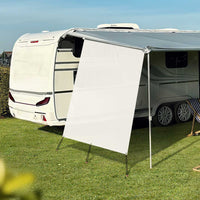


Table of Contents
- Personalizable sun shades for motorhomes: These advantages count
- Sun shade or motorhome awning: What makes sense when
- Motorhome sun shade dimensions: How to determine the right length
- Motorhome sun shade attachment: Keder piping, eyelets, and tensioning
- Material, UV resistance, and weatherproofing in comparison
- Sun shade care and cleaning: How to keep the design looking good for a long time
- Ordering customization: Design, print data, and delivery time
- Conclusion: When a personalized sun shade is worth it
- Frequently Asked Questions
Last updated: October 6, 2026
Personalizable sun shades for motorhomes: These advantages count
Personalizable sun shades are textile sun protection panels that are printed with your own design and slid into the awning rail via Keder piping. A shade protects against direct sunlight, provides a shaded area, and makes your pitch unmistakable. Anyone wanting to individualize their motorhome will find three advantages here that no standard product offers in this combination.
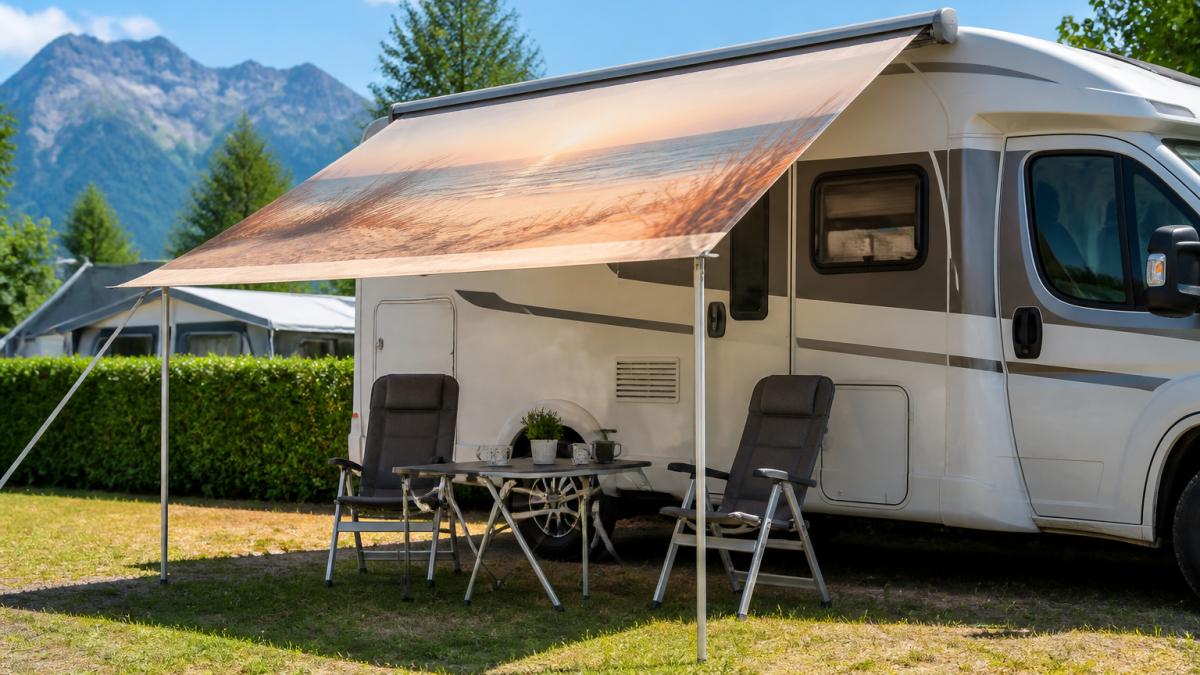
Privacy, sun protection, and brand recognition
The three core advantages work together. A semi-transparent 120 g/m² polyester fabric allows air to pass through, keeps prying eyes away, and casts shade on your pitch. A 2x3 m sun shade weighs around 720 g, less than a crate of drinks.
Brand recognition is the icing on the cake: thanks to dye-sublimation printing, the design is visible from both sides. For families with children or a dog, the shade becomes a retreat; for commercial users at the campsite, it becomes an advertising space.
Sun shade or motorhome awning: What makes sense when
A sun shade supplements the awning, it does not replace it. The awning provides the shaded roof over the seating area, while the sun shade hangs vertically in the Keder rail and closes off the side. Combining both covers two physically different problems: the awning blocks direct sun from above, and the shade blocks low-angle radiation from the side.
When which system is the better choice
The decision depends on three factors: sun position, wind, and desired privacy.
| Situation | Awning alone | Sun shade additional |
|---|---|---|
| Midday sun, high angle | sufficient | only if side shade needed |
| Low sun angle (morning/evening) | insufficient | necessary |
| Busy pitch, privacy desired | no | yes |
| Children or dog in shaded area | partially | yes |
| Setup in strong wind | only with tie-down straps | only with full anchoring |
A common misconception: Many believe a wider awning replaces the shade. In reality, with a low sun angle, the seating area remains partially in the sun even under a 4m awning because the radiation falls in sideways under the cloth. A vertical shade with 200 cm height closes this gap.
Realistically estimating shaded area
The shaded area of a shade corresponds approximately to its projected area, not its fabric surface area. With a 2 × 3 m shade and a sun angle of about 45°, you get a usable shaded zone of about 2 × 2 m - enough for a camping table and two chairs. If you need more area, choose a longer version or combine two shades on adjacent Keder rails.
Wind load and legal limits
In wind, the awning becomes the critical component, not the shade. Awnings are designed for specific wind speeds; the exact limits are in the respective manufacturer's manual. As a rule of thumb: From wind force 5 (fresh breeze, approx. 29-38 km/h), awning and shade should be retracted or dismantled. A deployed shade acts like a sail and transfers force through the eyelets to the Keder rail - if this is overloaded, the Keder can tear or the rail can be damaged.
If you only need a roof, the awning alone is sufficient. If you want to close off the space, block low sun, or create privacy, a sun shade is essential.
Motorhome sun shade dimensions: How to determine the right length
The appropriate length is always slightly shorter than the awning. For a 350 cm long awning, a maximum of 300 cm is recommended so that there is distance from the support legs and the tie-down straps.
The height, however, is fixed: every Campidoo sun shade measures 200 cm plus anchoring. Only the length can be selected. This table shows how you can find the right size:
| Awning length | Recommended shade length | Why |
|---|---|---|
| 300 cm | up to 250 cm | Distance from support legs |
| 350 cm | up to 300 cm | Space for tie-down straps |
| 400 cm | up to 350 cm | Shade stays tautly stretched |
| 450 cm | up to 400 cm | Reserve for wind |
Always measure the actual Keder rail before ordering, not just the catalog dimensions of your vehicle.
Motorhome sun shade attachment: Keder piping, eyelets, and tensioning
Attachment is via two points: the Keder piping in the awning rail at the top, and eyelets with elastic tensioners and pegs at the bottom.
At the top, only the Keder diameter determines compatibility. At the bottom, nickel-plated metal eyelets and an all-around hemmed edge ensure nothing frays. Tension is provided by UV-stable EPDM rubbers, as included in the mounting set for sun shades.
Without proper tensioning, the shade will flap against the awning in wind gusts, and the eyelets will tear out. Always secure all eyelets with tension rubbers, not just the two outer ones.
Which Keder piping fits your awning?
We supply 5 mm Keder piping as standard for Thule Omnistor and Fiamma. For Dometic and WIGO, it is 7 mm. A practical tip: if the groove is 6 to 7 mm, often only the 5 mm Keder fits because it needs a little room to slide in. If it is too tight, the shade can hardly be moved.
Material, UV resistance, and weatherproofing in comparison
The material determines durability. All Campidoo shades are made of premium polyester with about 120 g/m², double-stitched edges, and an even hem. This fabric class is the standard for printed camping sun shades - lighter than PVC tarpaulins, but more tear-resistant than thin foil shades.
What UV resistance means - and what it doesn't
To be honest: Our shades do not offer provable UV protection in the sense of a certified UPF value. What they do provide is shade and UV resistance of the fabric itself. Specifically, this means the polyester fibers are stabilized against UV radiation so that the fabric does not become brittle and the design does not fade. This is a material property, not a personal protection classification.
Anyone requiring certified UV protection should look for products with a specific UPF rating. For typical camping use - providing shade, privacy, and displaying a design - the material stability is sufficient.
Tear resistance and workmanship
Tear resistance depends less on the surface weight than on the workmanship:
- Double-stitched edges prevent the seam from coming apart under tensile stress.
- All-around hemmed edge protects the fabric edge from fraying.
- Nickel-plated metal eyelets distribute the tension force of the rubber bands over a larger area than simple loops.
- Reinforcements at the eyelet points are standard on high-quality shades because that is where the highest point load occurs.
A thin foil shade might be cheaper at purchase, but it lacks reinforced eyelet points and will tear at the attachment first in gusts.
Weatherproofing: What the shade can and cannot do
| Criterion | Campidoo Sun Shade | Thin standard shade |
|---|---|---|
| Material | Polyester 120 g/m² | Thin foil |
| Height | 200 cm + anchoring | often too short |
| Design | double-sided photo print | solid or transparent |
| Casing | 5 mm / 7 mm selectable | eyelets only |
| Warranty | 2 years | no information |
When it rains, there is a clear limit: a drizzle will keep the sail down, but heavy driving rain with a storm will not. Polyester is not naturally waterproof; the fabric either lets water through or retains it until it becomes heavy. If you need complete weather protection, you should opt for a front panel with a coated surface.
One last practical tip: After heavy rain, let the sail dry completely before folding it up. Moisture in the fabric leads to mildew stains, which can permanently burn into the design.
Sun Sail Care and Cleaning: How to Keep the Design Beautiful for a Long Time
A printed sail needs little, but regular care. The polyester fabric is machine washable up to 30 °C and wrinkle-free.
- Before storing: Let the sail dry completely, otherwise mildew stains will form.
- Cleaning: For light soiling, lukewarm water with a mild cleaner is sufficient.
- Folding: Do not fold sharply, but fold loosely.
- Storage: Dry and protected from light, preferably in a storage compartment in the vehicle.
This is how the design remains colorfast and the fabric tear-resistant for many seasons.
Order Personalization: Design, Print Data, and Delivery Time
The ordering process begins with the design. The easiest way is to upload your desired image directly in the personalized sun sail and adjust the crop in the image upload tool.
For printing, the following applies:
- Format: Landscape, as large as possible
- Files: Photos as JPG or PDF, logos as vector (SVG, AI, EPS, PDF)
- Resolution: from approx. 100 dpi, for professionals 200 dpi at 1:1
- Color space: CMYK, neon colors are technically not printable
Since your sail is custom-made, please allow 10 to 14 business days.
Conclusion: When a Personalized Sun Sail is Worth It
A personalized sun sail is worth it as soon as you want more than just shade. Anyone looking for privacy, sun protection, and their own design in one product gets all three here. The models from Campidoo start at €115.95, the personalized version is €163.95, and each piece is handcrafted in Northern Germany.
The important thing remains a realistic expectation: drizzle yes, storm no. If you plan for this and take the guy-roping seriously, you will enjoy your unique piece for many seasons.
Frequently Asked Questions
What are the advantages of a customizable sun sail for a motorhome?
A customizable sun sail combines three functions: It provides shade under the awning, shields prying eyes, and makes your campsite unique. At Campidoo, the design is showcased through double-sided printing, the semi-transparent polyester fabric lets air through and keeps out light rain. The height is always 200 cm plus guy-roping, and you choose the length to suit the awning. A fastening set with pegs and bungee cords is included in the delivery.
How do I measure a sun sail for my motorhome correctly?
First measure the length of your awning and order the sun sail slightly shorter. For a 350 cm long awning, a maximum of 300 cm makes sense, so that there is space from the support legs and the storm straps. The height at Campidoo is always 200 cm plus guy-roping, so you don't need to measure anything here. Additionally, check the slot of your casing bar so that the casing fits later.
Does a sun sail protect against rain and UV radiation?
A sun sail made of polyester fabric keeps out drizzle and is UV-resistant, so it is protected against fading from the sun. The material from Campidoo expressly does not offer a verifiable UV protection factor; this is stated in the product description. In heavy driving rain and storms, you should take down the sail or at least check the guy-roping. For strong sunlight, the shaded area under the awning is usually sufficient.
How do you attach a sun sail to a motorhome?
You pull the casing into the casing rail of your awning. For Thule Omnistor and Fiamma awnings, a 5 mm casing is standard, for WIGO and many Dometic awnings, a 7 mm casing. If the slot is 6 to 7 mm wide, often only the 5 mm casing fits, because it needs a little air to push in. At the bottom, you attach the sail via the eyelets with bungee cords and pegs; the matching fastening set from Campidoo costs 4.95 euros.
The selection of sun sails is large, but very few can be printed with your own design. That is exactly our specialty: At Campidoo, we make your sun sail by hand with double-sided photo printing, selectable casing for Thule, Fiamma, Dometic, and WIGO, as well as a two-year warranty. In addition, there is payment by invoice with Klarna and free shipping from 99 €. Get started with Campidoo and make your campsite a place that is instantly recognizable.

