










 About us
 Magazine
 Contact






Table of Contents
- Camping oven for small caravans: What matters
- Mini oven for caravans 230 V: Electric operation in focus
- Camping oven for gas stove: Efficient alternative
- Camping oven without electricity: Independence while camping
- Retrofitting an oven in a caravan: Step by step
- Practical test: Baking results and temperature distribution
- Buying guide: The right model for your caravan
- Conclusion: Camping oven for small caravans
- Frequently asked questions
Last updated: October 17, 2026
Camping oven for small caravans: What matters
The camping oven for small caravans is not simply a smaller version of a domestic oven. It is a compromise that must combine functionality, space efficiency, and practical usability. At Campidoo, we understand that caravan owners often work with limited space but still do not want to give up freshly baked bread or a casserole.
The biggest challenge when installing a camping oven in small caravans lies not in the selection of the model itself, but in the fact that most owners underestimate the real requirements. They see a mini oven and think, "That will fit anywhere" - and then fail in practical implementation.
Planning space requirements and dimensions correctly
Before you buy a camping oven, you must measure the available space exactly. A typical mini oven requires between 45 and 60 centimeters in width, 35 to 45 centimeters in depth, and 25 to 35 centimeters in height.
Measure not only the space but also the accessibility. The oven must be easily accessible, the door must be able to open fully, and you need space to remove trays or dishes.
Another common mistake: planning too close to the wall. Camping ovens generate heat. They need at least 5 to 10 centimeters of clearance from walls and cabinets, otherwise you risk damage or even a fire hazard. In a cramped caravan, this is often not realistic - then a model with side ventilation or a portable oven is the better choice.
Weight and transportability
A camping oven for small caravans typically weighs between 8 and 20 kilograms. This is not light, but transportable - provided you plan the transport correctly.
This is where theory differs from practice: A 15-kilogram electric oven in a caravan is not the same as 15 kilograms of luggage. You must secure it properly so that it does not slip during braking or cornering. An unsecured load can lead to injuries and is legally problematic.
If you want to take the oven with you regularly, choose a portable model with a handle. If it is to remain permanently in the caravan, the weight is less critical - but the mounting becomes more important. Make sure that the oven stands on a stable, level surface.
Mini oven for caravans 230 V: Electric operation in focus
A mini oven for caravans 230 V offers comfort and reliability. You connect it to the campsite socket, turn the dial, and the oven heats up. No gas cylinder, no open flame, no ventilation problems.
But: 230-volt connections are not available everywhere at campsites, and the strain on the onboard electrical system is often underestimated.
Power requirements and strain on the onboard electrical system
A typical electric camping oven draws between 1,500 and 2,500 watts. That is considerable. An average caravan with a shore power system can provide 16 amperes, which corresponds to approximately 3,680 watts. Sounds sufficient - but it is not always.
If you turn on the oven and the heater is running or the air conditioner is active at the same time, the power consumption can exceed the available capacity. The circuit breaker trips. You are sitting in the dark, and the oven is off.
Many campsites deliberately limit the power draw per pitch. You cannot simply assume that 16 amperes are available. Ask the campsite.
A practical trick: Use the oven at times when other appliances are switched off.
Heating time and power
The heating time of an electric mini oven is typically between 10 and 15 minutes to reach the desired temperature. This is acceptable, but not fast.
During this time, the oven consumes full power. A 2,000-watt oven that takes 12 minutes to heat up requires about 400 watt-hours of energy - before you have even put anything in it. This is relevant if you have to account for shore power or if the power supply is limited.
The actual baking performance depends heavily on the model. Cheap mini ovens heat up unevenly. It gets hot quickly at the top, while it takes longer at the bottom. The result: burnt on top, still doughy at the bottom. Better models have multiple heating elements or a convection system that distributes the temperature more evenly.
Camping oven for gas stove: Efficient alternative
A camping oven for gas stove sits directly on the gas stove and uses its flame as a heat source. No additional power connection needed, no waiting for shore power - you cook, bake, and heat with one energy source.
This is the classic solution for caravans without a 230-volt connection or for campers who want to be independent.
Gas consumption and operating costs
An oven attachment for the gas stove consumes about as much gas during operation as two to three burners on high heat. A standard gas cartridge (227 grams) lasts for about 4 to 6 hours of baking, depending on the temperature and stove model.
This is economically cheaper than electricity. A gas cartridge costs between 3 and 5 euros; one hour of 230-volt baking costs about 0.50 to 0.80 euros. With regular baking, this adds up.
But: gas operation requires attention. You must regulate the flame to maintain the desired temperature. Too high, and the oven gets too hot; too low, and the dough does not bake through. This is craftsmanship, not automation.
Safety in confined spaces
This is the biggest challenge: A gas burner inside a caravan produces heat, water vapor, and potentially carbon monoxide if combustion is not optimal. In a small, poorly ventilated space, this is a real risk.
The rule is simple: While you are baking with gas, the window or roof hatch must be open. Not tilted - open. This means heat loss and less control over the baking temperature. In summer, this is acceptable; in autumn or spring, it becomes unpleasant.
Many caravan owners underestimate this point and bake with the window closed. This is not safe. Make sure that your caravan has adequate ventilation before you decide on a gas oven.
Camping oven without electricity: Independence while camping
A camping oven without electricity - whether a gas model or operated with an open flame - is the choice for true independence. You are not tied to shore power or a full gas cartridge. You can bake anywhere: at the campsite, wild camping, or simply whenever electricity or gas is available.
Open flame and ventilation
A camping oven with an open flame - such as a portable oven with a wood or spirit burner - offers maximum flexibility. You only need fuel and a level, safe space.
The disadvantages, however, are considerable. Temperature control is difficult. Open flames are unpredictable; the heat can quickly become too intense or be unevenly distributed. The baking result is often disappointing. Furthermore: Open flames are not allowed at many campsites. Ask beforehand.
Ventilation is not a problem here - the flame burns outdoors. But you are dependent on the weather. Wind affects the flame, rain makes operation impossible.
Retrofitting an oven in a caravan: Step by step
If you want to retrofit an oven in a caravan, good planning is crucial. A poorly installed oven is unsafe and inefficient.
Installation and mounting
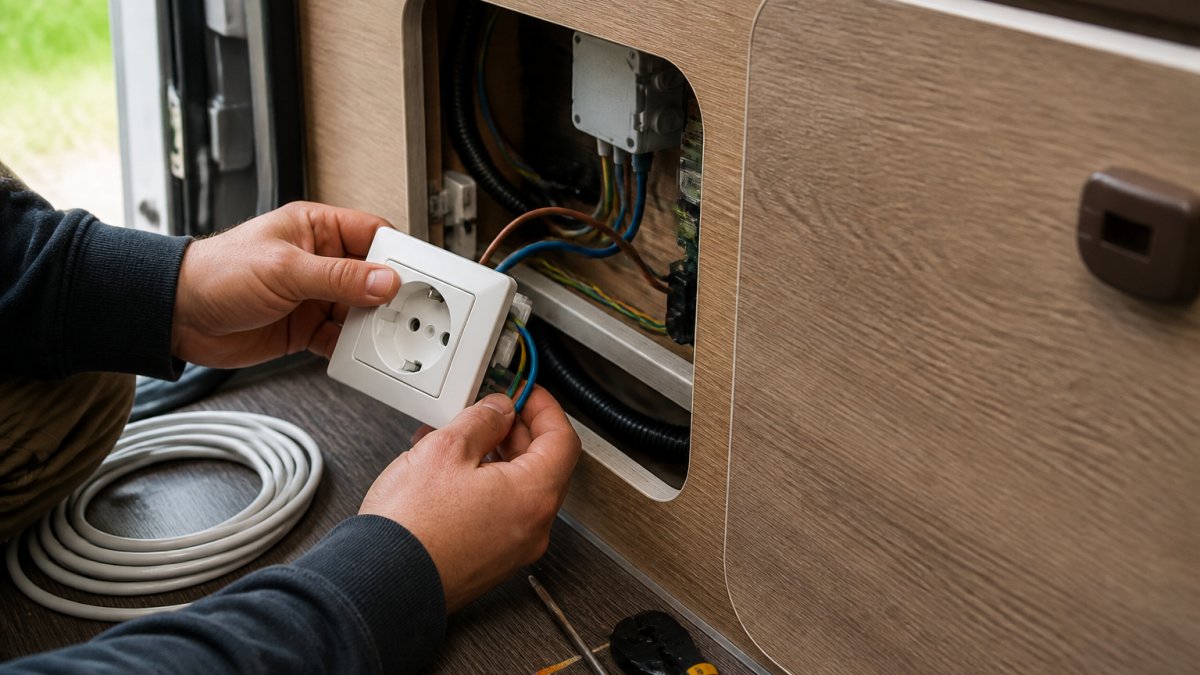
First steps: Check measurements, prepare the space, plan the supply lines. For an electric oven: Is there a 230-volt connection nearby? For a gas oven: Is the gas line accessible?
The mounting must be stable. An oven must not wobble or slip. Use non-slip pads or mounting systems designed for vehicles. For electrical devices: Make sure that the power cable is not bent or damaged and that the socket is properly rated.
For gas devices: Check all connections for leaks. A gas leak is life-threatening. Use Teflon tape and tested connection parts.
Common installation mistakes
The biggest mistake is impatience. Many campers install the oven quickly without fully checking the electrical or gas system. This leads to problems: power outages, poor baking results, or even safety risks.
Another common mistake: too little distance to flammable materials. Caravan interiors are often paneled with plastic or plywood. These can catch fire if they are too close to a heat source.
And: Many forget that an oven must be cleaned regularly. Grease splashes, crumbs, and dirt accumulate. In a caravan, space is limited - a dirty oven chamber quickly becomes a problem.
Practical test: Baking results and temperature distribution
Theory is one thing. Practice is different.
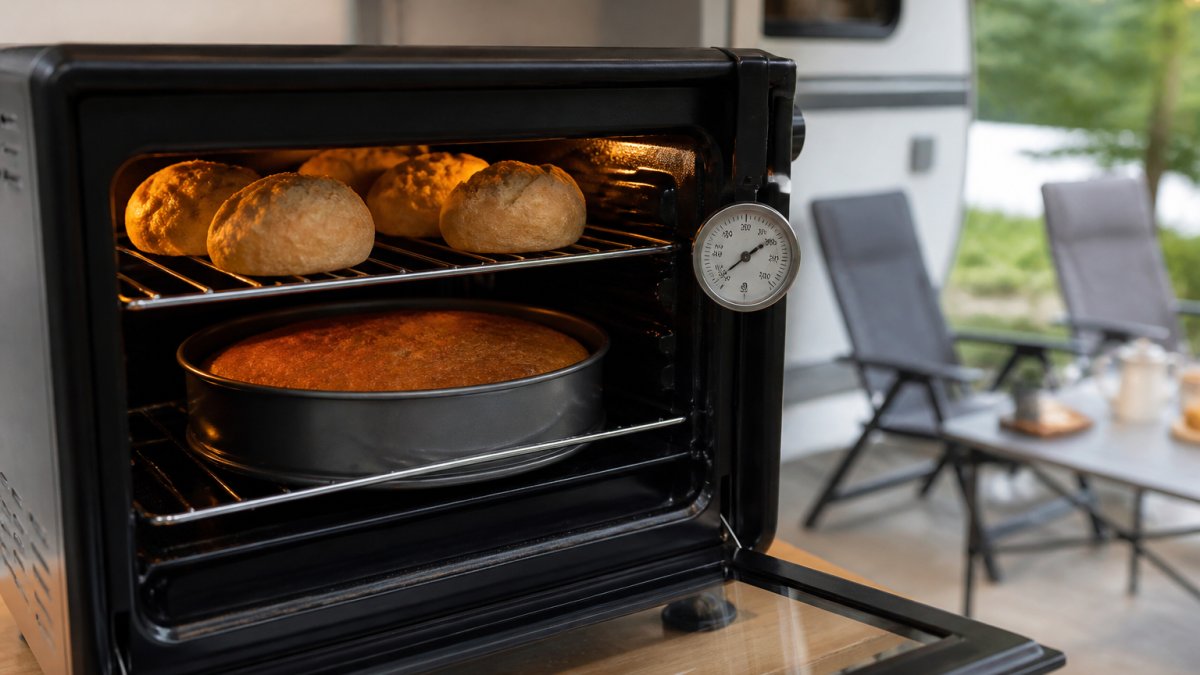
Measurable performance under comparable conditions
To see which oven really works, you have to test it. Not with theoretical values, but with real rolls and cakes.
An honest test considers several factors: How long does heating take? How even is the temperature distribution? Do rolls brown on top and remain light on the bottom? Does the cake burn or stay raw?
Many cheap mini ovens heat up faster at the top than at the bottom. This leads to uneven results. Better models with convection or multiple heating elements distribute the heat more evenly. You can clearly notice this when baking.
Suitability for different foods
Not all ovens are suitable for all foods. A very small oven with a volume of 25 liters can bake a roll well, but a casserole for four people? Impossible.
Consider what you actually want to bake. Only rolls for breakfast? A small oven is sufficient. Cakes and casseroles regularly? You need at least 35 to 45 liters of volume.
The baking surface is also relevant. Some ovens only have room for one tray; in others, two fit on top of each other. This determines how much you can bake at the same time.
Buying guide: The right model for your caravan
The choice of the right camping oven for small caravans is a balance between space, power supply, frequency of use, and budget.
| Criterion | Electric operation (230 V) | Gas operation | Open flame |
|---|---|---|---|
| Space requirements | 45-60 cm width | 30-45 cm width | 20-35 cm width |
| Dependency | Shore power required | Gas cartridge | Fuel |
| Safety | High | Medium (ventilation required) | Low (wind, weather) |
| Baking results | Very good | Good | Variable |
| Ongoing costs | Higher | Low | Low |
| Ventilation required | No | Yes | Yes |
Total Cost and Ongoing Consumption
The purchase price is only the first aspect. An affordable electric oven costs 50 to 100 euros; a high-quality gas model costs about the same. But the ongoing costs differ considerably.
Electric operation is expensive if you bake frequently. Gas operation is more economical, but requires more attention and ventilation. An open flame is cheap, but unreliable.
Calculate: How often do you bake? How long does the oven run per use? What power supply is available at your favorite spots? The answers determine which model is economically viable.
Decision Guide by Usage Profile
You are at campsites with a 230-volt connection: An electric mini-oven is practical and safe.
You often wild camp or stay at sites without electricity: A gas model or a portable oven is better.
You rarely bake, only occasionally bread rolls: A small, portable oven is sufficient.
You regularly bake for the whole family: You need a larger model with at least 40 liters of capacity and even heat distribution.
You value independence: A gas model without dependence on electricity is the best choice.
At Campidoo, you will find high-quality camping accessories that simplify your outdoor adventures - from practical solutions to well-thought-out accessories that solve real problems. Our focus on quality and sustainability ensures that you will enjoy your products for a long time.
Conclusion: Camping Oven for Small Caravans
A camping oven for small caravans is feasible, but only with realistic planning. The biggest mistakes occur when owners underestimate the requirements - whether it be the space required, the power supply, or safety.
The right model depends on your usage profile. Electric operation is convenient, but dependent on shore power. Gas operation is economical, but requires ventilation and attention. An open flame is flexible, but unreliable.
Measure carefully, check your power supply, and install the oven safely. Then nothing will stand in the way of freshly baked bread and warm casseroles in the caravan.
The right equipment makes your camping holiday more relaxing. At Campidoo, you will find everything you need for a comfortable holiday in a caravan - from customizable sun awnings to specialized cleaners.
Frequently Asked Questions
Which camping oven is suitable for a small caravan?
For small caravans, compact models with dimensions under 50 cm in width are ideal. Electric models with a 230-volt connection offer easy operation, but require sufficient power capacity. Gas ovens save electricity, but require good ventilation. Important: weight under 15 kg and space-saving storage. Measure the available space before purchase and check the onboard electrical capacity.
How much electricity does a mini-oven in a caravan consume?
A typical mini-oven for caravans consumes between 800 and 1500 watts. With an operating time of 30 minutes, an energy consumption of approximately 0.4 to 0.75 kWh is generated. This can lead to voltage problems with weak onboard electrical systems. Check the available power capacity of your caravan (usually 230V with 10-16A fuse) and consider a gas oven as a power-saving alternative.
Can you use a regular mini-oven in a caravan?
Household mini-ovens technically work in a caravan, but are often too large and heavy for small vehicles. Camping ovens are specially designed for mobility: compact, lighter, and with better heat insulation. They withstand vibrations during travel better and have optimized temperature distribution in a very confined space. For permanent camping use, a specialized model is worth it.
Are there camping ovens that work without electricity?
Yes - gas ovens and models with an open flame do not require electricity. Gas ovens use propane tanks and are ideal for longer camping stays without access to electricity. Models with an open flame are ultralight and portable, but require careful handling and good ventilation. Both options save onboard electrical capacity and offer independence - ideal for small caravans with limited power capacity.