










 About us
 Magazine
 Contact









Table of Contents
- Power station for charging e-bikes in a motorhome: The essentials
- Charging e-bike batteries in a motorhome: What are the options?
- Power station capacity for e-bike batteries: How many watt-hours do you need?
- E-bike battery charging time with a power station: How long does it actually take?
- Power station or inverter for e-bikes: A direct comparison
- Safety and practical tips for charging in a motorhome
- Avoiding common mistakes: What you should know
- Frequently asked questions
Last updated: October 18, 2026
Power station for charging e-bikes in a motorhome: The essentials
Using a power station to charge e-bikes in a motorhome is a practical solution for campers who want to charge their e-bikes on the road without depending on external power sources. Below, we show you the most practical options, what you should look for when choosing one, and the common mistakes you can avoid.
A typical e-bike battery holds between 400 and 700 watt-hours. The key is to choose the right charging option and realistically estimate the capacity of your mobile power supply.
Charging e-bike batteries in a motorhome: What are the options?
There are three main ways to charge your e-bike battery in a motorhome. Each has pros and cons that depend on your motorhome setup and your requirements.
Charging via the 230-volt input
The simplest way is charging via a 230-volt input, provided your motorhome has one. Many modern motorhomes are equipped with a shore power system, so your e-bike's manufacturer charger works just like it does at home—without any conversion or complications.
The problem: You are tied to a campsite. When boondocking or in places without electricity, this option won't help you, and many sites charge fees for limited 230-volt connections.
Charging via inverter
An inverter converts direct current (DC) from your leisure battery into 230-volt alternating current (AC). This allows you to use your standard charger flexibly and anywhere.
The catch: Inverters cause 10–15 percent charging losses. With a 500-watt-hour battery, you actually draw about 575–590 watt-hours from your leisure battery, putting it under greater strain.
Charging via the 12-volt on-board electrical system
Some e-bike chargers charge directly via 12-volt DC. This is the most efficient method, as no conversion takes place and the leisure battery is subjected to less strain.
The only thing: Not all e-bike models support this charging method. You need a special adapter charger or an e-bike that comes factory-equipped with this function. This is currently the rarest option on the market.
Power station capacity for e-bike batteries: How many watt-hours do you need?
The capacity of a power station determines how often you can actually fully charge your e-bike battery in your motorhome. The deciding factor is not the advertised gross capacity, but the usable amount of energy after accounting for depth of discharge and conversion losses.
The practical formula
For a realistic estimate, calculate in three steps:
- Usable capacity of the power station = Gross capacity × depth of discharge. For LiFePO4 power stations, 80–90% depth of discharge is common; for older Li-ion models, it is closer to 70–80%. Those wanting to prolong battery life usually stay at about 80%.
- Energy requirement per full charge = E-bike battery capacity ÷ charging chain efficiency. Via the power station's 230-volt output (i.e., with an integrated inverter and the supplied e-bike charger), the total efficiency is typically 75–85%. Using a 12-volt direct charger, 85–92% is realistic.
- Number of full charges = usable capacity ÷ energy requirement per full charge.
Calculation example: 500 Wh battery, 1,000 Wh power station
- Gross capacity of power station: 1,000 Wh
- Depth of discharge: 80% → 800 Wh usable
- E-bike battery: 500 Wh
- Efficiency via 230-volt output: 80% → 625 Wh required per full charge
- Result: 800 ÷ 625 = 1.28 full charges
This means: A 1,000 Wh power station will charge a 500 Wh battery once fully and a second time to about a quarter—not twice, as the gross calculation might suggest. Anyone needing two full charges will end up needing a 1,500 to 1,600 Wh power station, not 1,200 Wh.
Table: Usable full charges per power station size
| Power station (gross) | Usable at 80% DoD | Full charges 400 Wh battery (80% efficiency) | Full charges 500 Wh battery | Full charges 700 Wh battery |
|---|---|---|---|---|
| 500 Wh | 400 Wh | 0.8 | 0.6 | 0.5 |
| 1,000 Wh | 800 Wh | 1.6 | 1.3 | 0.9 |
| 1,500 Wh | 1,200 Wh | 2.4 | 1.9 | 1.4 |
| 2,000 Wh | 1,600 Wh | 3.2 | 2.6 | 1.8 |
These values are calculated conservatively; in cold weather, with an aged power station, or an inefficient charger, an additional 5–10% loss should be factored in.
What manufacturer specifications don't tell you
- Gross is not net: The advertised capacity refers to the cells, not to what reaches the 230-volt output.
- Depth of discharge: Many power stations switch off at 5–10% remaining charge, others at 0%. If you want to preserve lifespan, plan with 80%.
- E-bike charger: A 4A charger often draws 250–350 W, a fast charger 400–600 W. This doesn't affect capacity, but it does affect the continuous power that the power station must provide.
- Cold: LiFePO4 noticeably loses usable capacity at 0°C; charging should not be done at all below 0°C.
Anyone who runs this calculation for their setup will avoid the most common bad purchase: a power station that looks big enough on paper but is only sufficient for one full charge.
E-bike battery charging time with a power station: How long does it actually take?
The charging time depends on the charging power of your e-bike charger (usually 200 to 500 watts) and the continuous output of your power station.
If your charger draws 300 watts and your battery holds 500 watt-hours, you theoretically need about 100 minutes (500 Wh ÷ 300 W = 1.67 hours).
It is important that your power station can supply the required continuous power. If your charger requires 400 watts, but your power station only has a continuous output of 300 watts, it will either not charge or will automatically shut down. This is a safety mechanism.
Power station or inverter for e-bikes: A direct comparison
Anyone wanting to charge e-bikes in a motorhome has four realistic paths—each with a different compromise in terms of efficiency, costs, space requirements, and comfort. The following comparison shows a direct cost and efficiency comparison including leisure battery and 12-volt direct chargers.
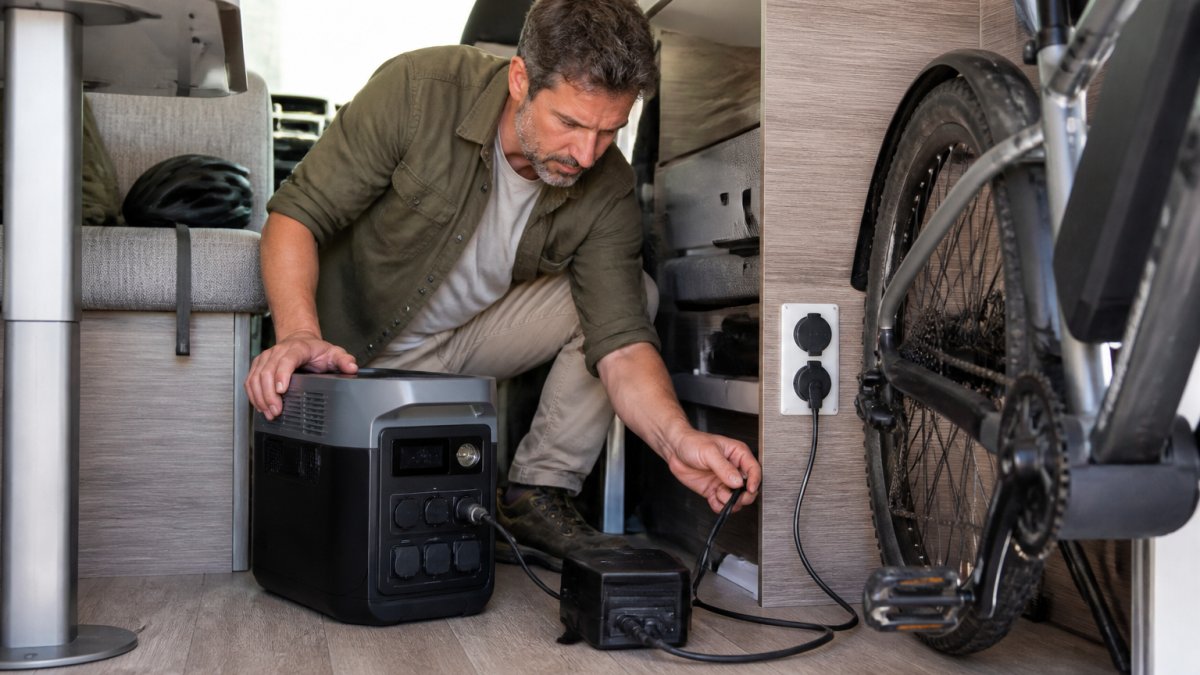
The four charging options at a glance
| Criterion | 230V shore power | Inverter on leisure battery | Power station | 12V direct charger |
|---|---|---|---|---|
| Charging chain efficiency | 90–95% | 75–85% | 75–85% | 85–92% |
| Acquisition costs | 0 EUR (campsite fee) | 100–300 EUR | 400–1,500 EUR | 80–250 EUR (charger/adapter) |
| Running costs | Pitch fee | Power from leisure battery | Power from leisure battery or solar | Power from leisure battery |
| Independent of pitch | no | yes | yes | yes |
| Additional weight | 0 kg | 1–3 kg | 10–30 kg | 0.5–1.5 kg |
| Space requirement | none | low (permanently installed) | high (portable) | low |
| Compatibility | universal | universal (with 230V charger) | universal (with 230V charger) | limited (12V charger required) |
| Mobility outside the motorhome | no | no | yes | no |
Efficiency: Where Energy Is Really Lost
Every conversion costs energy. The chain "onboard battery → inverter → 230-V charger → e-bike battery" adds up several losses (inverter 85-92%, charger 85-90%), leaving 75-85% remaining.
The 12-V direct charger bypasses the inverter and achieves 85-92%. For ten full charges of a 500-Wh battery, an efficiency between 80% and 90% results in around 625 Wh vs. 555 Wh per charge - a difference of about 700 Wh that must be recharged from the onboard battery.
Costs: Consider Purchase and Operation Separately
- Inverter: 100-300 EUR purchase, then "free" from the onboard battery - but the onboard battery must first supply the energy, which means solar or driving when standing independently.
- Power station: 400-1,500 EUR purchase. The advantage: It is independent of the onboard battery and can be filled via solar during the day. Those who already use a power station for a laptop, camera, and drone share the costs across multiple applications.
- 12-V direct charger: 80-250 EUR, but only makes sense if your e-bike battery supports this type of charging. The selection is limited.
- Shore power: 0 EUR purchase, but 3-8 EUR campsite fee per night - over a season, this adds up to several hundred euros.
For pure e-bike charging, the inverter on the onboard battery is the cheapest off-grid solution, for multiple devices and solar recharging, the power station is the more flexible investment.
Compatibility: The Underrated Crucial Point
Not every e-bike charger tolerates every power source. What you need to pay attention to:
- Pure sine wave: E-bike chargers contain sensitive electronics. An inverter with a modified sine wave can damage the charger or abort the charging process. Look for "pure sine wave" (also "True Sine Wave").
- Continuous power vs. peak power: A 4-A charger draws 250-350 W continuously. The power station must provide this continuous power - not just briefly as a peak.
- Inrush current: Some chargers draw two to three times the normal current briefly when switched on. A power station with 500 W continuous and 1,000 W peak power covers this.
- Proprietary plugs: Some e-bike manufacturers use their own charging sockets. The 230-V charger is then the only safe option - the 12-V direct charger is ruled out.
- Charger input voltage: Check if your charger is designed for 230 V and if it can handle the 230 V from the inverter or power station (frequency 50 Hz, voltage tolerance).
Safety and Operation in the Motorhome
- Ventilation: Inverters and power stations emit waste heat. Do not charge in enclosed compartments without air circulation.
- Temperature: Do not charge e-bike batteries below 0 °C or above 40 °C. In summer, keep them in the shade; in winter, indoors.
- Fuse: The inverter should be connected directly to the onboard battery with its own fuse - not via the existing 12-V distribution.
- During driving: Loose power stations and e-bike batteries must be secured. Charging during driving should be approached with caution - most manufacturers advise against it.
- Cable cross-section: With 12-V direct chargers and inverters, pay attention to sufficient cross-section, otherwise voltage drop and heat will occur.
When Which Solution Makes Sense
- You mostly stay at campsites: 230-V shore power is sufficient, no additional investment needed.
- You want to stay off-grid and only charge e-bikes: The inverter on the onboard battery is the cheapest solution - provided the onboard battery has enough capacity and is regularly recharged.
- You want to be flexible and also charge other devices: Power station with 1,500-2,000 Wh, rechargeable via solar.
- Your e-bike supports 12-V direct charging: The direct charger is the most efficient option, but the selection is small.
Those who calculate these four ways with their own electricity prices and campsite fees will realize: The power station is rarely the cheapest, but often the most flexible solution - that is its real added value.
Safety and Practical Tips for Charging in the Motorhome
First: Do not overload your onboard battery. LiFePO4 batteries tolerate more load than older lead-acid batteries, but they also have limits. If you charge your e-bike under already heavy load (for example, from other devices), overheating or damage may occur.
Second: Pay attention to the temperature.
Third: Use solar energy if possible. Many modern power stations can be charged with solar panels.
Fourth: Check the compatibility of your charger with the power station. Some protection devices block devices with high power consumption - make sure before purchase that your e-bike charger is compatible.
Avoid Common Mistakes: What You Should Know
A common mistake is confusing the nominal and peak power of a power station. It only provides peak power briefly, continuous power continuously - your e-bike charger needs continuous power.
Another common mistake is ignoring charging losses. A 1000-Wh power station does not charge a 500-Wh battery twice - realistically, with losses, it is about 1.5 charges.
Some campers charge their e-bikes directly from the onboard battery via an inverter.
Another mistake is ignoring compatibility.
| Aspect | Inverter | Power station | 12-Volt direct |
|---|---|---|---|
| Efficiency | 85-90% | 85-90% | 95%+ |
| Cost | 100-300 EUR | 400-1500 EUR | Variable |
| Mobility | Stationary | Portable | Portable |
| Versatility | Limited | High | Very high |
| Installation | Easy | Plug & Play | Complex |
When charging your e-bike battery in the motorhome, it is all about the right balance between efficiency, cost, and flexibility. At Campidoo, we offer a comprehensive selection of camping accessories that help you equip your motorhome optimally.
External Sources and Further Information
For deeper information on e-bike battery technology, we recommend familiarizing yourself with the safety standards. According to the DIN EN 62619 standard for safe e-bike batteries, all e-bike batteries must pass strict safety tests.
On the topic of lithium iron phosphate batteries in power stations, the Federal Institute for Materials Research and Testing offers valuable technical background information on LiFePO4 technology. This type of battery is increasingly used in power stations and has different requirements than older lithium-ion types.
For practical tips on solar energy while camping, you will find helpful resources at the German Society for Solar Energy on the basics of photovoltaics, which explains how solar panels can work effectively together with power stations.
Frequently Asked Questions
Can you charge an e-bike battery with a power station?
Yes, absolutely. A power station with a 230-volt output can directly supply your manufacturer's charger. It is important that the power station has enough capacity and provides the continuous power of the charger. Most modern power stations with LiFePO4 batteries are suitable for this. Pay attention to the watt-hours (Wh) and the continuous discharge current of the power station - these must match your e-bike charger.
How much capacity should a power station have to charge an e-bike battery?
That depends on your e-bike battery. A typical e-bike battery has 400-700 Wh. Calculate with charging losses: A power station with at least 600-800 Wh is a good guideline for a full charge. For multiple charges or as a camping companion, 1000 Wh or more makes sense. Also consider that the usable capacity is often below the stated capacity.
How long does it take to charge an e-bike battery at a power station?
The charging time depends on the charging power of your device. With typical chargers with 500-750 W, a full charge takes about 1.5-3 hours. A power station with higher continuous power shortens the time. Note that the charging time is also influenced by the condition of the battery and the ambient temperature - when camping outdoors, it can take a little longer.
Is it safe to charge an e-bike battery in the motorhome?
Yes, if you follow some basic rules. Charge in well-ventilated areas, keep the charger dry, and only use original manufacturer chargers or certified alternatives. Monitor the charging process, especially with older batteries. Do not store charged batteries in direct sunlight. A modern power station with protection devices significantly reduces the risk - pay attention to certifications such as the CE marking.