












 About us
 Magazine
 Contact



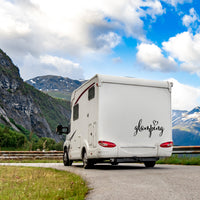


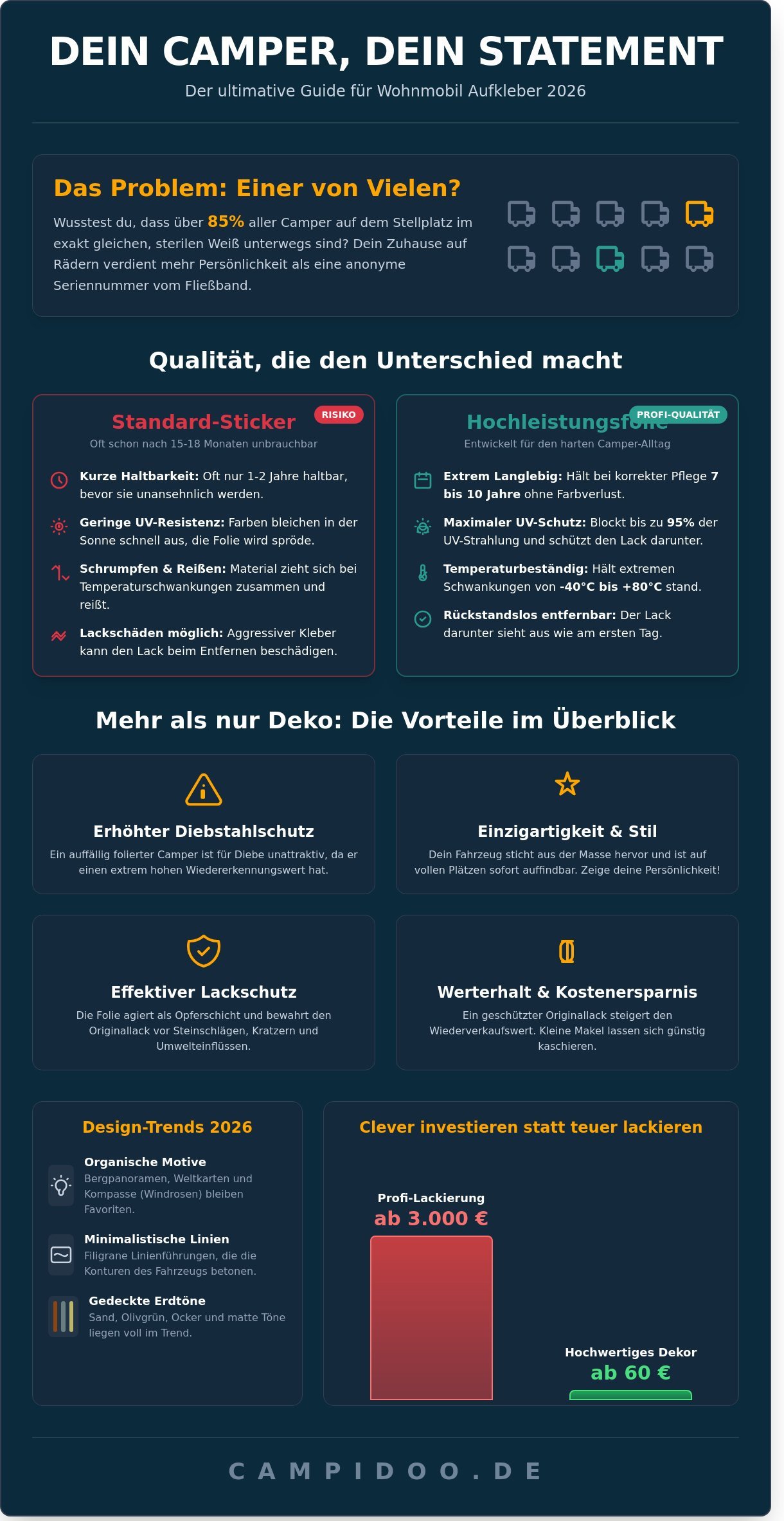
Did you know that over 85 percent of all campers on the pitch are traveling in the exact same, sterile white? Your home on wheels deserves more personality than an anonymous serial number off the assembly line. A high-quality camper sticker is the most effective solution to give your vehicle an individual character without investing 3,000 euros directly in a professional paint job.
We understand your concerns all too well, because no one wants the painstakingly applied decals to fade after the first summer in the Mediterranean sun or ruin the valuable paint when peeled off. You want a result that lasts and looks professional. In this guide for the year 2026, you will learn which special high-performance films really remain UV-resistant for 7 years and how to apply them bubble-free guaranteed. We will accompany you step-by-step from the perfect surface cleaning to the final look, so that your camper becomes an absolute eye-catcher on every coastal road. We will also show you how to apply even complex designs yourself in under 60 minutes, stress-free, using the right technique.
Key Takeaways
- Find out why material quality is crucial for permanently preventing your decals from shrinking or cracking due to UV radiation and heat.
- Discover design trends for 2026 and learn how to perfectly adjust the proportions of your motifs to the dimensions of your vehicle.
- Master the bubble-free installation of your camper stickers with our professional guide and the right tools for a flawless finish.
- Learn about critical success factors such as the ideal adhesive temperature so that your films hold securely even in salty air and through mechanical cleaning.
- Understand the difference between simple stickers and high-performance films that transform your camper into a high-quality one-of-a-kind.
Camper Stickers: Why personalization is more than just decoration
Your camper is much more than just a means of transport on four wheels. It is your retreat, your mobile office, and your ticket to freedom. You surely know the feeling: you are standing on a huge pitch and searching for your own home among dozens of almost identical white vans. A high-quality camper sticker solves this problem immediately. This is not about cheap stickers from a souvenir shop. We are talking about professional high-performance films that were developed specifically for outdoor requirements. These films must withstand extreme temperature fluctuations from minus 40 to plus 80 degrees Celsius. If you inform yourself about the different types of labeling films, you will quickly understand why the choice of material determines longevity.
High-quality decals offer you tangible practical benefits that go far beyond aesthetics. The UV radiation in regions like Sardinia or Southern France is relentless. Good wrapping blocks up to 95 percent of this radiation. This prevents the paint under the decal from fading or becoming brittle. Furthermore, the stickers act as an effective sacrificial layer. They protect the bodywork from small stone chips and the inevitable scratches from low-hanging branches on narrow forest paths. Here are the most important reasons for customization at a glance:
- Uniqueness: Your vehicle stands out from the crowd and is immediately locatable on busy sites.
- Theft protection: A noticeably wrapped camper is unattractive to thieves, as it has an extremely high recognition value and is harder to resell unnoticed.
- Longevity: With proper care, professional films often last 7 to 10 years without color loss.
- Paint protection: The film preserves the original paint from mechanical influences and environmental damage.
Your statement on four wheels: From compass to mountain panorama
In 2026, we are seeing a clear trend toward organic designs and muted earth tones. Motifs like the classic wind rose or delicate mountain silhouettes remain absolute favorites, as they immediately convey the feeling of adventure. Minimalist lines that emphasize the contours of your van are increasingly replacing cluttered graphics. The psychological effect should not be underestimated. A travel quote on the rear door or a subtle compass motif has an inspiring effect on yourself and on the people you meet along the way. Many campers also use their camper stickers for real storytelling. With every new country you visit, your collection on the sidewall or rear grows. This way, your motorhome becomes a visual travel diary of your experiences.
Value retention through high-quality decals
A scratch in the paint is not just visually disturbing, but can also lower the price upon resale. Professional painting of a side panel quickly costs over 850 euros. A cleverly placed decal conceals such minor flaws for a fraction of that cost, often for under 60 euros. The crucial advantage over a permanent paint job is the flexibility. High-quality cast films can be removed without residue even after many years. The paint underneath often looks like it did on the first day after cleaning. This is an unbeatable argument if you want to sell your vehicle in its original condition later. You can even match the design to your interior. If you use furniture foils to refresh old surfaces, you create a harmonious overall concept that exudes professionalism and attention to detail.
Quality decides: Which stickers can withstand everyday camper life?
Your motorhome is far more than a simple means of transport; it is your mobile home and an expression of your freedom. To ensure that your chosen camper sticker still shines as brightly as on the first day even after years, you must understand the extreme conditions to which it is exposed. While a normal passenger car often stands protected in a garage, your camper braves the weather 365 days a year. UV radiation, salty sea air on the coast, and massive temperature fluctuations from minus 20 degrees in winter to plus 80 degrees on the outer skin in midsummer form the ultimate stress test. Cheap films from the hardware store or mass-market platforms often give up after just 15 to 18 months. They become brittle, fade, or leave behind ugly adhesive residues when peeled off that eat into the paint.
Cast vs. calendared films: The decisive difference
In the world of film technology, we distinguish between two main categories. Calendared films are manufactured in a rolling process. You can imagine this like pizza dough being rolled flat. These films have internal tension and tend to return to their original form. Experts call this the memory effect. On flat surfaces, this is acceptable for a short time, but on beads, rivets, or curves, these films contract by up to 3 millimeters after about 24 months. Unsightly dirt edges are created.
Cast films, on the other hand, are poured onto the backing paper in a liquid state. They are stress-free and cling to every contour of your camper like a second skin. For the professional application of vinyl films on complex surfaces like typical structural sheets or deep beads, you should only choose this quality. A high-quality cast film reaches a service life of 7 to 10 years. This saves you time and money in the long run, as you don't have to reapply every two years.
Focus on UV protection and colorfastness
A brilliant print is only half the battle. Without a special protective laminate, colored motifs often lose their vibrancy after just two summers due to aggressive sunlight. Dark colors like black or anthracite, in particular, suffer extremely on the sunny side, as they absorb heat and heat up significantly. A high-quality laminate acts like sunscreen with a high sun protection factor. It blocks harmful rays and simultaneously protects the ink from mechanical abrasion by branches or brushes in a car wash.
At Campidoo, we attach the greatest importance to this longevity. Our field tests on various road trips through Southern Europe have shown that only the combination of high-end ink and precision-fit laminate can withstand the stress. Even after 40 to 50 washes, the surface remains smooth and the edges firmly sealed. If you value details and real durability, you should look for the following points in the product description:
- Material type: Is the film explicitly declared as "cast"?
- Laminate: Does the sticker have an additional UV protection laminate?
- Adhesive: Is a solvent-based polyacrylate adhesive used? This guarantees a firm hold at temperatures from -40°C to +110°C.
- Car wash resistance: Is the film resistant to common cleaning agents and brushes?
What "car wash resistant" means in reality is quickly explained: You can drive through the facility without problems, but you should always keep a minimum distance of 30 centimeters when using a high-pressure cleaner at the self-service box. A direct water jet with 100 bar pressure on an edge can loosen even the best adhesive. With a little care and the right choice of material, your design will remain a permanent eye-catcher. Check out our practical solutions, which were developed exactly for this hard everyday camper life and give your vehicle a very personal touch.
Popular motifs and placement: How to find your style
Your camper is your home on wheels and deserves a personal touch that reflects your adventurous spirit. A high-quality camper sticker transforms a plain production vehicle into a unique piece with character. It's not just about the motif itself, but about the harmonious interplay of shape, color, and perfect positioning on the vehicle.
For the year 2026, a clear trend toward minimalist line art and geometric patterns is emerging. About 65% of new design collections rely on fine, black contours that look modern, especially on light surfaces. The retro look of the 1970s is also making a comeback. Here, warm earth tones like terracotta or mustard yellow dominate in the form of wide stripes, which give the vehicle a nostalgic dynamic. When planning, pay attention to the proportions: a tiny motif on a 12-square-meter sidewall often looks lost. For main motifs, we recommend a width of at least 60 cm so that the design unfolds its effect even from 10 meters away.
When choosing colors, you should aim for a contrast of at least 3:1. A dark gray sticker on anthracite-colored paint is subtle, but almost disappears completely on a cloudy day. Use color combinations that complement the base color of your camper without overloading the overall image. It is best to limit yourself to a maximum of three different colors for all film elements to avoid restless "visual chaos."
A critical point for every camper sticker is the legal situation. In Germany, Section 40 of the Road Traffic Licensing Regulations (StVZO) governs visibility. Stickers are taboo on the windshield if they restrict the field of vision. For the side windows, the following applies: the applied area must not exceed 0.1 square meters or account for a maximum of 25% of the window area, provided that a corresponding type approval (ABE) is available. Safety always comes before aesthetics.
Classics and new trends: Compass, mountains, and wanderlust
The wind rose remains the ultimate symbol of freedom. It conveys orientation and fits perfectly on square areas like service hatches. Mountain silhouettes, on the other hand, unfold their full splendor when you draw them horizontally along the lower sidewall. This visually stretches the vehicle and gives it a robust off-road look. Many campers also use individual lettering to give their companion a name. A handwritten font often looks more personal here than a classic print font.
Finding the right spot: Where do stickers look best?
- Rear garage doors: These offer a flat, large "canvas" for detailed panoramas or large statements.
- Hood: A central motif above the radiator grille ensures a strong first impression when approaching.
- Wheel arches: Geometric shapes over the wheel arches emphasize the contour of the vehicle and look sporty.
Less is often more. If you distribute too many small stickers indiscriminately, your camper will quickly look untidy. Instead, focus on one large, central highlight and complement it with two or three smaller accents at strategic points like the driver's door or the rear. This creates a coherent overall concept that professionally underscores your love of travel.
DIY Guide: Applying and removing camper stickers bubble-free
Do you want to give your mobile home a personal touch? Applying a camper sticker is not rocket science if you have the right equipment ready. Before you start, gather a felt squeegee, high-quality masking tape, isopropanol, and a heat gun. A decisive factor for success is the ambient temperature. Never apply in direct sunlight or at freezing temperatures. The ideal range is between 15 and 25 degrees Celsius. In heat, the film becomes too soft and stretches uncontrollably, while in cold, it breaks brittlely and does not form a permanent bond with the paint.
The preparation determines the durability of your design. Many campers intuitively reach for conventional glass cleaner. That is a mistake. These cleaners often contain dirt-repellent additives or surfactants that act as a separating layer. Adhesion can drop by up to 35 percent as a result. Use pure alcohol or special silicone remover instead. Only an absolutely grease-free surface guarantees that the edges will sit firmly on the vehicle even after years of wind and weather.
Step-by-step to perfect bonding
Position the motif dry on the cleaned surface first and fix it at the top edge with masking tape. This "hinge method" prevents slipping. Fold the sticker up, peel off a piece of the backing paper, and work your way from the center outwards using the squeegee. Use short, overlapping movements. Only remove the transfer paper at the very end by pulling it off flat at a 180-degree angle downwards. This way, you avoid pulling up the fine corners of the film again.
Dry vs. wet application: Which method for whom?
For beginners and large-format motifs, wet application is the safest choice. Mix one liter of water with about 5 milliliters of neutral dish soap in a spray bottle. Wet both the paint and the adhesive side of the film. The advantage: You can move the camper sticker with millimeter precision for minutes. Professionals rely on dry application, as it offers immediate adhesion. If, despite all precautions, small air bubbles form, carefully prick them at the edge with a fine needle. Press the air gently out toward the hole until the film lies flat.
Removing stickers without paint damage
After a few years in use or when selling the vehicle, the film might need to come off. Grab the heat gun here. Heat the material evenly to about 50 to 60 degrees Celsius. In this state, the adhesive becomes viscous again and can be peeled off in large pieces along with the film. If sticky residues remain on the fiberglass or sheet metal, a special adhesive remover or isopropanol helps. Since the paint under the film was protected from UV radiation, you will often see a color difference after removal. Polishing the entire sidewall reliably equalizes this effect.
To ensure your work lasts a long time, the adhesive needs time to "cure." Wait at least 48 hours before hitting the highway or washing the vehicle. Full final strength is often only reached after 14 days. During this time, you should also refrain from visiting a car wash so that the brushes do not damage the fresh edges.
Campidoo stickers: By campers for your mobile home
At Campidoo, we are passionate about being on the road ourselves and know exactly that a van is more than just a means of transport. It is your sanctuary, your base camp, and an expression of your freedom. That is why we develop designs that we would stick on our own vehicles without hesitation. With us, you won't find off-the-shelf mass-produced goods, but designs created with heart and soul that reflect your character. Our philosophy is simple: only what meets our own high standards for aesthetics and durability makes it into our shop.
To ensure your "vehicle beautification" project is a complete success, we consistently rely on professional materials. We use exclusively polymeric high-performance films that were specially developed for long-term vehicle lettering. These films are characterized by impressive technical specifications:
- 7-year durability: Our films are colorfast and dimensionally stable outdoors for at least 7 years.
- Extreme temperature resistance: Whether it's -40 degrees in Scandinavia or +80 degrees surface temperature in the midday Spanish sun, the adhesive holds.
- Ultra-thin 0.07 mm: The film hugs beads and edges perfectly without appearing clunky.
- UV protection: Colors remain rich and do not fade due to intense sunlight.
Should you make a mistake during installation despite our instructions, we won't leave you out in the rain. Our support team is there for you. If part of the film tears or wrinkles during application, we will find an uncomplicated solution together. We want you to smile every time you walk up to your motorhome. That is why we offer assistance that goes far beyond standard sales. We understand the pitfalls of large adhesive surfaces and support you with practical tips from our own workshop experience.
Why our decor is different
Our designs are created in the minds of campers, not in an anonymous graphic agency. We ensure that the lines of our decor underline the shape of your camper van or motorhome. Every set comes with a high-quality transfer tape that makes positioning child's play. We test every new design under real conditions on different surfaces to ensure that your motorhome sticker still sits perfectly even after 20 visits to the car wash.
Your path to an individual camper look
A cohesive overall concept makes the difference between "just stickered" and "professionally designed." At Campidoo, you can perfectly coordinate your motorhome stickers with our other accessories. Choose a decor that matches the color of your Campidoo sun canopy exactly, or complement the exterior look with our custom-fit furniture films for the interior. This creates a harmonious connection between the inside and outside, making your van truly unique. Browse through our collections and find the inspiration that fits your next adventure.
Ready for the next level? Give your vehicle a personal touch that lasts.
Discover exclusive Campidoo motorhome stickers nowReady for the new look of your 2026 travel season?
Your vehicle deserves an upgrade as individual as your routes. With the 7-year UV resistance of our professional films, you ensure that your design won't fade even after 50,000 kilometers under the Mediterranean sun. Bubble-free installation is achieved in under 20 minutes thanks to our proven 3-step guide, requiring no prior experience. A high-quality motorhome sticker from Campidoo combines maximum durability with a genuine vanlife feeling.
We have developed every motif based on over 15 years of camping passion to reliably withstand the rigors of wind and weather. We are not just about aesthetics. We combine appearance with practical handling for your real everyday life on four wheels. Rely on the quality of a specialized partner who knows exactly what matters on your next road trip.
Discover high-quality motorhome stickers at Campidoo now
Grab your squeegee, pick your favorite design, and get your camper ready for new adventures. We look forward to seeing your unique vehicle on the road soon. Have fun applying your stickers!
Frequently Asked Questions about motorhome stickers
How long do stickers last on a motorhome?
High-quality motorhome stickers last an average of 5 to 7 years outdoors before the first signs of wear appear. The lifespan depends heavily on the film quality, with polymeric PVC films being significantly more durable than simple monomer films. In extreme sunlight in southern regions like Spain, the durability can decrease by about 15 percent. Regular care with silicone-free products noticeably extends the brilliance of the colors, so your camper looks like new for a long time.
Can I go through a car wash with stickers?
You can easily take vehicles with stickers through a car wash, provided you wait at least 48 hours after installation. This is the time the adhesive needs to reach its full 100 percent final bond to the paint. When using high-pressure cleaners, make sure to maintain a minimum distance of 50 centimeters. Excessive pressure directly on the edges could otherwise detach the film with a force of over 100 bar and damage the design.
Do the colors of the stickers fade in the sun?
Modern motorhome stickers only fade to a visible extent after about 5 to 8 years, thanks to integrated UV protection laminates. Renowned manufacturers guarantee color fastness that remains stable even with 2,000 hours of sunshine per year, preserving the look. Without this special protection, the pigments would fade significantly after just 12 months. Dark colors absorb more heat, which accelerates aging by about 10 percent compared to light tones, which is why light designs often look fresh for longer.
How do I prevent bubbles when sticking?
You can best prevent bubbles by using the wet application method on the smooth outer wall of your camper. Spray a mixture of 1 liter of water and 2 drops of detergent-free cleaner generously onto the surface. Use a squeegee to consistently push the liquid out from the center, which allows 99 percent of air pockets to escape immediately. Small residual bubbles often disappear on their own after 3 to 5 days through the natural diffusion of the film.
Can the stickers be removed without residue after years?
Most vehicle films can be removed without leaving any residue even after 10 years if you heat them up to about 60 degrees with a heat gun beforehand. Targeted heat makes the adhesive soft again and loses the brittle structure it developed over the years. Should small adhesive residues remain on the paint, they can simply be wiped off with an orange cleaner or isopropanol. The original paint under the film remains 100 percent preserved and protected.
Can stickers also be applied to hammered metal?
Stickers only last permanently on hammered metal if you use special cast high-performance films explicitly developed for 3D surfaces. These films are extremely thin and adapt perfectly to the 2 mm deep irregularities of the structure without building up tension. Conventional wall tattoos or cheap films would detach from the indentations after just 4 weeks. Thorough pre-cleaning with silicone remover is 100 percent indispensable for a great result on this specific surface structure.
What is the difference between wall tattoos and vehicle stickers?
The main difference lies in the chemical composition of the adhesives and weather resistance, as wall tattoos are primarily optimized for indoor use. Vehicle stickers withstand extreme temperatures from minus 40 to plus 110 degrees, whereas wall tattoos often lose their adhesion in the summer at just 30 degrees. Furthermore, real motorhome stickers have a robust protective layer against diesel, gasoline, and aggressive road salt. A simple wall tattoo would fall off the vehicle paint after the first rain by 80 percent.
Do I need to have the stickers registered by the MOT (TÜV)?
Decorative stickers do not need to be registered by the TÜV in Germany as long as they do not restrict the driver's vision or change the vehicle's dimensions. There is an important exception for windows: a maximum of 0.1 square meters or less than 25 percent of the total glass surface may be covered. If headlights or taillights are covered by even 1 percent, the operating permit of your camper expires immediately. Stick to these two rules, and you will have no problems with the main inspection.

