











 About us
 Magazine
 Contact







Imagine it’s August 15, 2025, and you’re driving over a bumpy gravel road in the Pyrenees. You flinch at every pothole because your heavy porcelain dishes in the cupboard sound like a small orchestra of broken glass. We campers know this annoying noise and the constant worry about the maximum permissible weight all too well. That’s why high-quality melamine camping dinnerware is the first choice for many of us to finally bring peace and lightness to our camper kitchens. It is up to 70 percent lighter than conventional tableware and can withstand even a fall from the camping table onto a hard surface completely unscathed.
You don’t want to compromise between style and functionality when dining under the open sky, but you may have concerns about potential harmful substances when exposed to high heat. This is absolutely understandable, because the safety of your loved ones is the top priority when cooking in a van. In this guide, you’ll learn everything about the benefits, correct handling, and the latest material standards for the 2026 season, so your next dinner in the great outdoors becomes a stress-free pleasure. We’ll show you how to find a stylish, durable set that doesn't make a peep while driving.
Key Takeaways
- Find out why melamine is the ideal solution for increased payload and stress-free travel in your camper due to its extremely low weight and robustness.
- We show you how to safely use high-quality melamine camping dinnerware in everyday life and why the 70-degree rule is crucial for your health.
- In our comprehensive material comparison, discover why melamine is often the more durable and practical choice for real outdoor adventures compared to enamel or bamboo.
- Learn the best care tips so your dinnerware shines like new even after many uses and remains optimally protected against scratches.
- Get inspired by the 2026 design trends and find the look that perfectly matches your personal feel-good atmosphere in your van or motorhome.
What is melamine dinnerware and why do campers love it?
Imagine you’re maneuvering your van through the tight hairpin turns of the Maritime Alps. At every turn, you hear a soft rattling in the back cupboards. Anyone who relies on classic porcelain here either has nerves of steel or spends hours wrapping every single plate in bubble wrap. This is exactly where high-quality melamine camping dinnerware comes in, solving one of the biggest problems in mobile everyday life. But what exactly makes this material so special? At its core, it is a compound created through the polycondensation of melamine and formaldehyde. If you would like to delve deeper into the matter: What is melamine resin actually from a chemical perspective? It is a thermosetting plastic that is pressed into shape under intense heat and high pressure. The result is an extremely hard, smooth, and resilient surface that is built for harsh outdoor use.
Campers love melamine above all for its practical indestructibility. A plate slips out of your hand while drying and hits the hard campsite floor? For stoneware or glass, this would be the sad end of your breakfast set. Melamine easily brushes off such mishaps. It doesn’t splinter and only breaks under massive force. Furthermore, the noise level is a decisive factor. While ceramic makes a shrill clatter with every bump in the road, melamine significantly dampens vibrations. This makes the drive noticeably more relaxing for you and your fellow passengers.
Weight vs. stability: The calculation for your motorhome
Every gram counts when packing, especially if you have to keep an eye on your motorhome's critical 3.5-ton limit. A standard porcelain dinnerware set for four people weighs an average of a whopping 7.5 kilograms. A comparable set made of good melamine tips the scale at just 2.1 kilograms. You save over 5 kilograms of pure payload immediately. That’s a weight advantage of around 70 percent, which you can invest in more important things like water supplies or sports equipment instead. Despite this lightness, the durability is impressive. A set of melamine camping dinnerware can easily withstand 10 years or more of intensive use without losing its stability.
- Weight savings: Over 5 kg less payload for a 16-piece set compared to ceramic.
- Safety: No sharp shards in the motorhome in the event of drops during the drive.
- Durability: Resistant to scratches and mechanical impacts in everyday camping life.
Design variety: From simple matte to maritime patterns
The days when camping dinnerware looked like cheap plastic are long gone. Modern melamine offers an aesthetic upgrade for every camper kitchen. The feel is now so sophisticated that high-quality plates feel almost like real ceramic. They are weighty and substantial in the hand, without the disadvantages of real stoneware. Whether you prefer a minimalist design in matte anthracite or love classic maritime patterns, the choice is huge. A technical advantage is the high UV resistance. Even if your table stands in the blazing sun of Southern France for 300 hours per season, the colors remain fresh and do not fade. This way, the stylish look of your mobile home is preserved over many seasons.
Safety and quality: Is melamine harmful to health?
You’ve surely read headlines warning about harmful substances in plastic. With your melamine camping dinnerware, there is a clear line between safe enjoyment and a potential health risk. As long as you respect the magical limit of 70 degrees Celsius, the material remains completely safe. Melamine resin is a so-called duroplast (thermoset). This means it is extremely stable and retains its shape as long as it is not decomposed by extreme heat. In the microwave, however, temperatures well over 100 degrees occur locally, which can release the chemical bonds. This is why the microwave is strictly off-limits for melamine.
Be sure to look for the "BPA-free" label when purchasing. Bisphenol A has no place in modern camping accessories. You can also identify high-quality melamine camping dinnerware by the "glass-and-fork" symbol, which guarantees food safety. Cheap imports without these certifications can release substances faster than certified branded goods when in contact with acidic foods like dressings or fruit juices. EU Regulation 10/2011 sets extremely strict limits for the migration of substances, which are regularly checked by independent laboratories for reputable manufacturers.
Caution is particularly advised with supposedly ecological alternatives. The current risk assessment by the BfR clearly shows that bamboo-melamine mixtures in particular can react problematically when exposed to heat. Pure, high-quality melamine is significantly more stable and safer for daily use in a camper by comparison.
The right temperature: Cooking, serving, and eating
A hot coffee or tea in the morning is no problem for your melamine mugs. The liquid quickly cools down below the critical 70-degree mark after pouring. It only becomes dangerous if you leave melamine spoons or spatulas directly in a boiling pot at 100 degrees. For cooking, it is better to use silicone or wood and use your melamine camping dinnerware primarily for serving and eating. This way, you avoid every risk and can enjoy your meal to the fullest.
How to identify high-quality melamine dinnerware
You can smell and feel quality. A good product should smell completely neutral, even when fresh out of the packaging. A pungent, chemical odor often points to low-quality fillers. Use the weight test, as high-quality melamine has a higher density. A standard plate here often weighs between 250 and 350 grams, while cheap goods feel almost feather-light and break more easily.
- Surface sealing: Look for a glossy resin finish. This layer prevents tomato sauce or coffee from leaving permanent stains.
- Haptics: High-quality dinnerware feels almost like porcelain, but is significantly more shatterproof.
- Edge finishing: In branded goods, the edges are smooth and cleanly sanded, without sharp burrs.
If you value durability and verified safety, you will find thoughtful camping accessories in our shop that meet exactly these high quality standards for your everyday life in the van. Once invested, such a set will accompany you through Europe for many years.
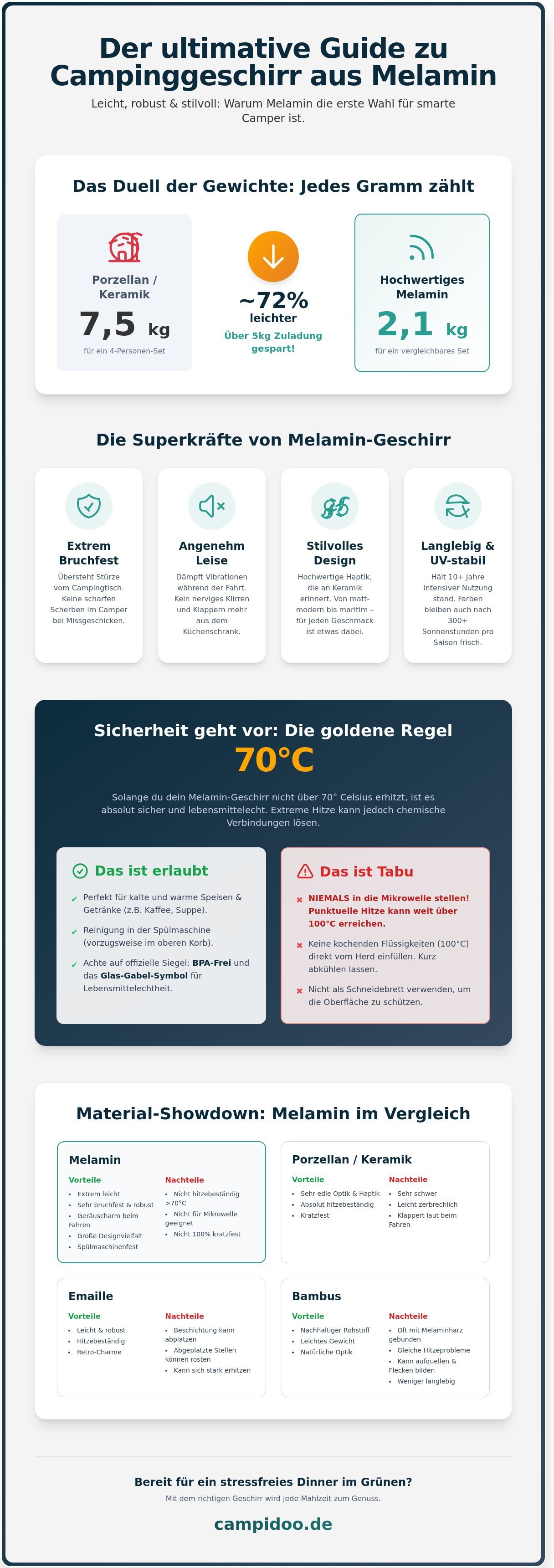
Melamine vs. enamel, bamboo & plastic: The big comparison
You are faced with the decision of which dinnerware should accompany your camper life. The selection is huge, but not every material lives up to its promise. If you call your melamine camping dinnerware your own, you have already chosen a favorite known for its durability. But how does it fare in a direct comparison with the alternatives? We are taking a close look at the most common materials so that you can make the best choice for your next tour.
Enamel dinnerware: Nostalgia meets the danger of rust
Enamel is the epitome of the retro look. It evokes memories of campfires and adventures. A major advantage is heat resistance. You can place an enamel mug directly on a gas stove or at the edge of a fire, as the material easily withstands temperatures of up to 400 degrees Celsius. However, the idyll has cracks. Enamel is a composite of glass and iron. If you drop the plate on the hard floor of a parking space, the glass layer is almost guaranteed to chip. This not only looks unsightly, but quickly leads to rust spots. When eating, enamel conducts heat extremely quickly. While your coffee stays hot, you can easily burn your lips, and cutlery makes unpleasant scratching noises on the hard surface.
Bamboo and cornstarch: Why caution is advised
Bamboo dinnerware was long celebrated as the green solution. But appearances are often deceptive. Most products do not consist of pure wood, but of ground bamboo fibers bound with an adhesive. In about 90 percent of cases, this glue is a melamine-formaldehyde resin. The problem: the fibers prevent the plastic from building a stable structure. At temperatures above 70 degrees Celsius, harmful substances can migrate into your food. The safety of melamine dinnerware according to the FDA is guaranteed for pure melamine, but consumer advocates advise caution with these unstable bamboo mixtures. In addition, bamboo absorbs moisture quickly in the high humidity of a camper. This often leads to mold growth in the fine pores after one season, making the dinnerware unusable.
In addition to these classics, there are also polycarbonate (PC) and polypropylene (PP). These plastics are extremely light and almost unbreakable. They score primarily in weight, which is decisive for hikers with backpacks. In a motorhome, however, they often fall behind. Polypropylene is very soft. After just ten meals, you will see deep cut marks from your steak knife on the plate. These grooves become permanently discolored by tomato sauce or curry. High-quality melamine camping dinnerware, on the other hand, has a significantly harder surface that still shines after 500 dishwasher cycles just like on the first day.
Which material now suits your style? Here is a short checklist for your decision:
- The aesthete: Opts for enamel, but has to live with nicks and rust.
- The weight optimizer: Chooses polypropylene for the absolute minimum in load.
- The quality camper: Relies on melamine for the real porcelain feel without the risk of breakage.
- The eco-fan: Uses real wood or stainless steel, but avoids bamboo-plastic mixes.
In the end, melamine wins for most campers because it offers the best compromise. It is quiet when driving, easy to clean, and simply looks high-quality on the camping table. While enamel chips and bamboo swells, melamine remains your loyal companion over many years. It is the smart solution for everyone who loves order and style in their van without wanting to constantly buy new dinnerware.
Care tips for your melamine dinnerware: How to keep it looking new
Your melamine dinnerware will accompany you through countless sunsets and cozy evenings in front of the van. To ensure the surfaces still shine like on the first day even after three years of intensive use, you need the right strategy. While melamine is extremely resistant, it is not immune to improper cleaning agents. Those who cut corners here or reach for the wrong tools risk a dull look or even cracks in the material.
Consistently avoid steel wool or scouring cream. These utensils are the greatest enemy of melamine camping dinnerware because they scratch the protective glossy layer (the so-called overlay). Once roughened, food residue and bacteria settle in significantly faster. Instead, use the soft side of a conventional dish sponge. If stubborn remains from stick bread or grilled meat are stuck, a short soak in warm water for about 10 to 15 minutes helps.
Coffee and black tea in particular often leave unsightly rings. A simple trick from the camper's bag of tricks proves its worth here: baking soda. Mix a tablespoon of baking soda with a little water into a paste, apply it to the discoloration, and let it sit for 20 minutes. After rinsing, 90% of the stains will have disappeared without you having to mechanically strain the surface.
- Dishwasher: Most sets are dishwasher safe up to 70 degrees Celsius. Ensure the plates are not packed too tightly in the rack to avoid friction damage.
- Winter break: Store your dinnerware in a dry place over the cold months. Extreme sub-zero temperatures below -15 degrees in combination with humidity can make the material brittle.
- Microwave: Absolute restricted zone! Melamine must never go in the microwave, as it can decompose above 70 degrees.
Gentle cleaning for glossy surfaces
Use mild organic dish soap to protect the environment at your campsite and avoid damaging the material. Hand-painted decorations or delicate prints will thank you if you dry them immediately with a soft cotton cloth after washing. This prevents limescale stains, which often form after just a few minutes in hard water on campsites. A dry plate not only shines more beautifully, it is also immediately ready for the next stack in the cupboard.
Anti-slip solutions: The end of rattling in the cupboard
Nothing is more annoying while driving than the constant rattling of plates in the rearview mirror. Modern sets for melamine camping dinnerware now often feature integrated anti-slip silicone rings on the underside. This rubber coating reduces the noise level in the motorhome by up to 80% and ensures that the plate stays securely on the table even if the camper is tilted slightly. If your favorite set doesn't have this feature, you can retrofit it with felt pads or custom-fit silicone mats. These also serve as transport protection and prevent the plates from rubbing against each other during a bumpy ride over gravel roads and causing scratches.
The Campidoo selection: Functionality meets design
At Campidoo, we don’t sell you anonymous mass-produced items that we only know from catalogs. Every piece in our range has passed the rigorous everyday test in our own campers. We know exactly how it feels when the dishes rattle in the cupboard on a winding alpine pass or when you're starving after a hike and your plate needs to stay steady. If you are looking for high-quality melamine camping tableware, you will find solutions that we have put through their paces ourselves. At our warehouse in Geesthacht, we select only those products that are both aesthetically and functionally convincing.
Our favorites for the 2026 season reflect the diversity of modern vanlife. The trend is clearly moving in two directions. On one side is the simple Scandinavian design. Matte surfaces in anthracite, sage green, or sand tones dominate here, fitting perfectly with a minimalist conversion. On the other side, we see a return to bold, colorful patterns that immediately spread a good mood, even if it happens to be raining outside. Our melamine camping tableware scores points with its extreme durability and a feel that is barely distinguishable from real porcelain. At the same time, it remains completely dimensionally stable and food-safe up to a temperature of 70 degrees Celsius.
Choosing the right set size determines how often you stand at the sink during the day. For couples who travel minimalist, an 8-piece set is the foundation. It usually consists of two dinner plates, two breakfast plates, two bowls, and two mugs. However, those who enjoy cooking or hosting guests at the campsite should go straight for a 12- or 16-piece set. A 16-piece set fully covers the needs of four people and offers enough buffer so you don't have to wash up immediately after every snack. We recommend supplementing the sets with individual pieces.
- Large serving platters: Ideal for a barbecue evening together in front of the camper.
- Deep pasta plates: These are often more practical than flat plates, as nothing slides over the edge when eating on your lap.
- Stackable bowls: Indispensable for salads or as a fruit bowl on the camping table.
- Mugs with handles: They must fit comfortably in the hand and stand stably in common cup holders.
From campers for campers: Our quality promise
For us at Campidoo, quality means more than just break resistance. We pay meticulous attention to stackability. Space in a motorhome is a precious commodity. A good set must fit together so compactly that not a millimeter is wasted in the kitchen unit. In our showroom in Geesthacht, we are happy to advise you personally on the various surface structures and show you how to stow your dishes so they don't rattle. We use special anti-slip coatings on the undersides so that your meal stays safely on the table even on a slight incline.
Your path to the perfect camping dinner
A beautifully set table in the great outdoors immediately increases the recreational value of your trip. It's that one moment in the evening when the sun sets and everything falls into place. Our melamine collections can be perfectly combined with our camping furniture, creating a harmonious overall look. It's not just about food; it's about the feeling of freedom and style. Check out our melamine tableware sets now! We will help you take your outdoor kitchen to the next level so that every bite tastes like a vacation.
Upgrade your camper kitchen for the 2026 season
Your next adventure starts right behind the steering wheel, and the right equipment provides the necessary relaxation. You now know that high-quality melamine camping tableware weighs up to 70% less than conventional porcelain. That easily saves 5 to 8 kilograms in your total payload. Our products easily withstand temperatures of up to 70 degrees Celsius and survive falls from a height of 1 meter without any splintering at all. We have tested every set ourselves for over 500 nights in a van under real conditions. At Campidoo, you buy quality from campers for campers. Your new set is shatterproof, featherlight, and, thanks to our fast shipping from Germany, usually arrives in just 48 hours. Get the upgrade for your mobile home that perfectly combines modern aesthetics and extreme longevity. This leaves more time for the really important things: the sunset and a relaxed dinner in the open air.
Discover our robust melamine tableware sets for your next adventure now!
Enjoy the freedom on the road and have a great meal on your next trip!
Frequently asked questions about melamine tableware
Is melamine tableware dishwasher safe?
Yes, you can clean your melamine tableware in the dishwasher without any problems, as long as the temperature does not exceed 70 degrees Celsius. Most manufacturers state this value as an upper limit in order to maintain the protective surface seal in the long term. On a gentle cycle, the typical shine remains almost like new for over 500 wash cycles. It is best to place the items in the top rack to ensure they stay at a safe distance from the heating element at the bottom.
Why is melamine tableware not allowed in the microwave?
You must never heat melamine in the microwave because the material decomposes at temperatures above 70 degrees Celsius. At this heat, harmful substances such as melamine and formaldehyde are released from the plastic and migrate directly into your food. The Federal Institute for Risk Assessment has explicitly warned against this type of use since 2011. Instead, use microwave-safe glass or ceramic containers to warm up your meals.
Is melamine tableware shatterproof?
Yes, high-quality melamine camping tableware is extremely robust and usually survives falls from a table height of about 80 centimeters onto a hard floor completely unscathed. Compared to classic porcelain, the material is virtually indestructible, making it the perfect companion for bumpy rides in the camper. Only with very strong blows against sharp stone edges can small corners chip off. It is the ideal choice if you want to save weight and rely on maximum durability at the same time.
How do I know if my camping tableware is BPA-free?
You can usually recognize BPA-free tableware by a corresponding embossing or a sticker labeled "BPA-free" directly on the bottom of the plates. Since pure melamine resin itself does not contain bisphenol A, high-quality products are naturally free of this plasticizer. When buying, look for the quality seal according to EU Regulation 10/2011, which guarantees safety for contact with food. Reputable brands declare this property transparently in the enclosed product description.
Which is better for camping: melamine or enamel?
The decision depends on your preferences, although melamine is impressive due to its low weight of only about 300 grams per plate and its quiet handling. While enamel is heat-resistant up to over 400 degrees Celsius, it rattles much louder in the cupboard while driving and can chip over a large area if dropped. If you value a cozy atmosphere and a low total vehicle weight, melamine camping tableware is the smart solution. It also scratches less quickly with intensive use of knives.
How do I remove coffee stains from melamine cups?
You can most effectively remove stubborn coffee stains with a paste made of baking powder and a little water, which you leave to work for about 15 minutes. Under no circumstances should you use scouring milk or hard steel wool, as these roughen the smooth surface and make the tableware more susceptible to new discoloration. A gentle cleaning solution with 5 grams of baking soda per 100 milliliters of warm water often works wonders. This way, your cups will still shine like on the first day even after the third camping season.
At what temperature does melamine tableware become dangerous?
It becomes critical for your tableware at a constant temperature of 70 degrees Celsius. Above this threshold, chemical components are released from the resin structure that can burden your health. You should therefore never pour boiling water at 100 degrees directly into a melamine cup; let it cool down to about 80 degrees beforehand. The BfR therefore recommends using the tableware exclusively for serving and never for cooking or frying in a pan.
Can melamine tableware be recycled?
Unfortunately, melamine tableware cannot be recycled in the traditional sense, as it is a thermosetting plastic that does not melt again when heated. Instead of ending up in the yellow bag, it ends up in the residual waste at the end of its life cycle and is used in waste incineration plants for energy generation. However, since the service life is often 10 to 15 years with good care, the ecological balance is very positive compared to disposable solutions. Invest in high quality so that your set accompanies you on your travels for as many years as possible.