










 About us
 Magazine
 Contact



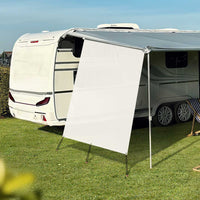



What if you could save a whopping 38 kilograms of valuable payload while still sitting in the cool shade in exactly 8 minutes? Many campers invest over 1,350 euros in heavy box awnings, even though a camper van sun sail is often the significantly smarter and more flexible solution for your mobile home. We know this from our own experience: the longing for freedom is great, but the worry about unstable sails in wind speeds of force 5 or the uncertainty regarding 5mm or 7mm piping sizes causes hesitation. You want a setup that doesn't unnecessarily weigh down your vehicle, but instead impresses with a minimal pack size and a modern look.
In this guide, you will learn step-by-step how to choose the perfect sun sail and mount it so it is completely windproof. We promise that after reading, you will know exactly why this accessory will finally replace the awning by 2026. We will clear up the myths surrounding stability and show you how to master the setup even alone in record time. From material science to the perfect fit for your camper, you will get all the info you need for your next trip into the sun.
Key Takeaways
- You will learn why a camper van sun sail is often the smarter choice over a heavy awning, especially when you need to be mindful of your payload in the 3.5-tonne class.
- We will introduce you to various mounting systems from piping rails to magnetic adapters so you can find the most stable and flexible solution for your vehicle.
- Learn how to choose the ideal size and the right material to perfectly tailor your mobile living room to your individual needs.
- With our professional tips on guying out at a 45-degree angle, you ensure that your shaded spot remains safe and stable even in freshening winds.
- Discover why well-thought-out details from experienced campers make all the difference for your freedom and true peace of mind on the road.
Why a sun sail for your camper often beats an awning
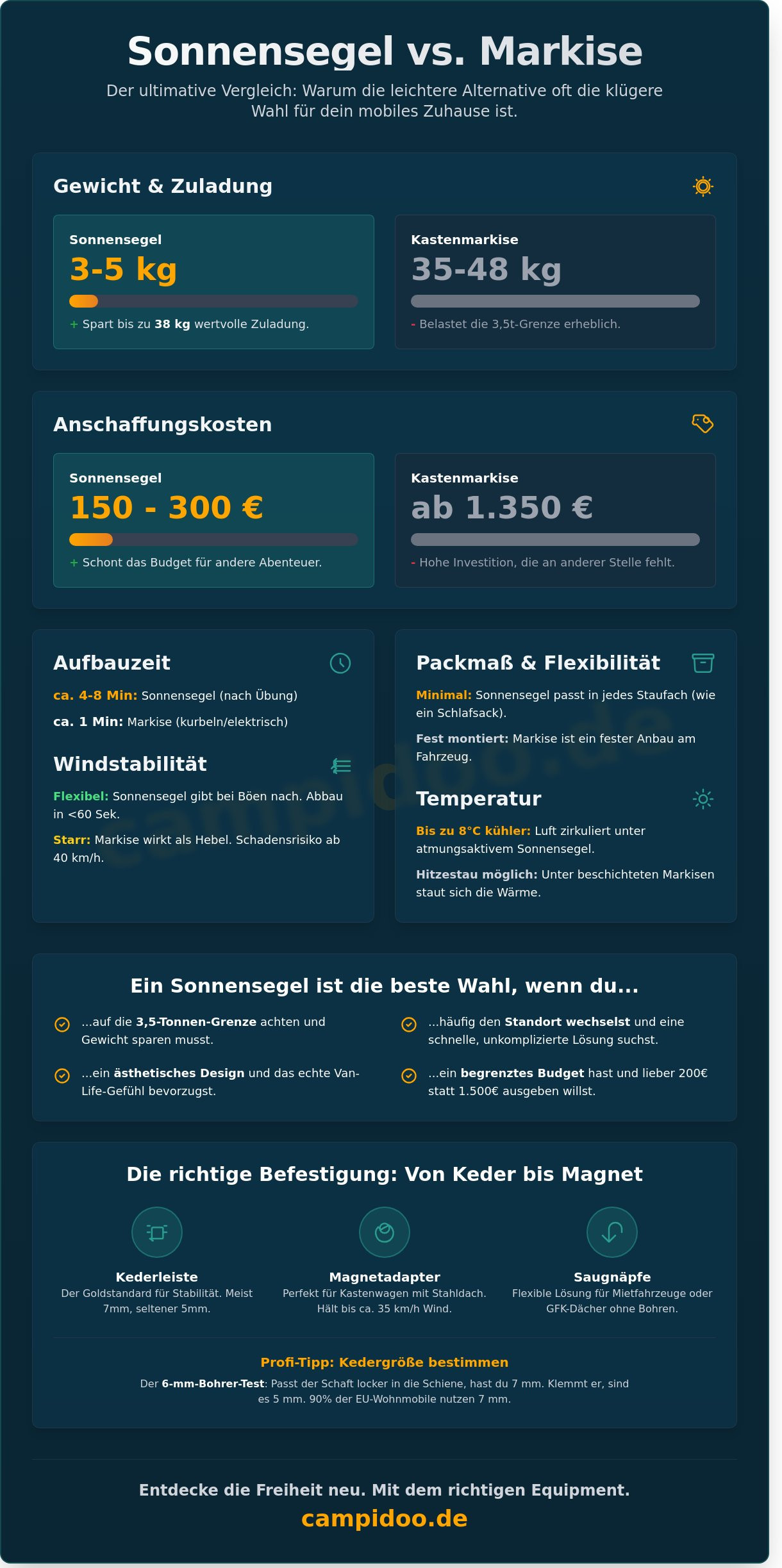
You know the problem: every kilo counts when you want to stay under the critical 3.5-tonne limit. A classic box awning weighs between 35 and 48 kilograms, depending on the model. That is massive weight that you will miss when calculating your payload for e-bikes or water supplies. A high-quality camper van sun sail, including telescopic poles, often weighs only 3 to 5 kilograms. You save around 90 percent in weight directly, which gives you more reserves and safety in your daily driving.
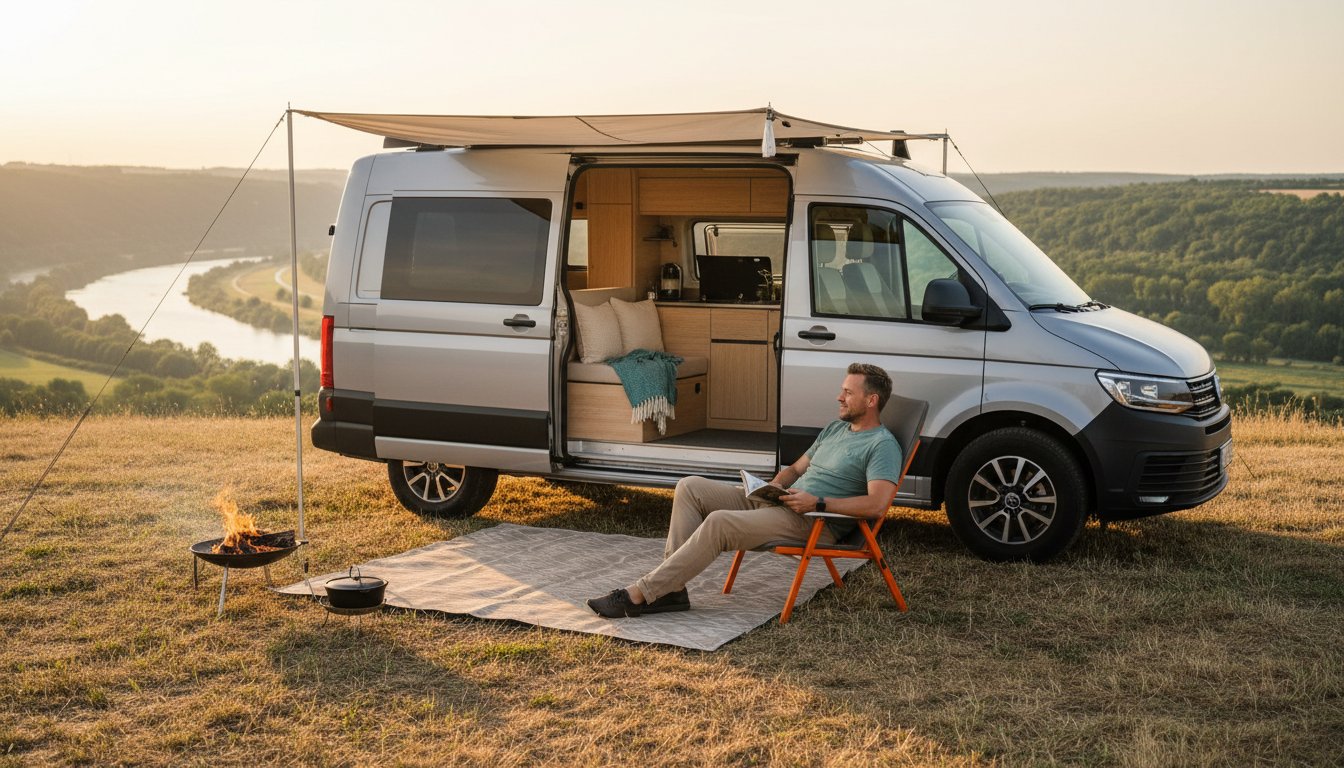
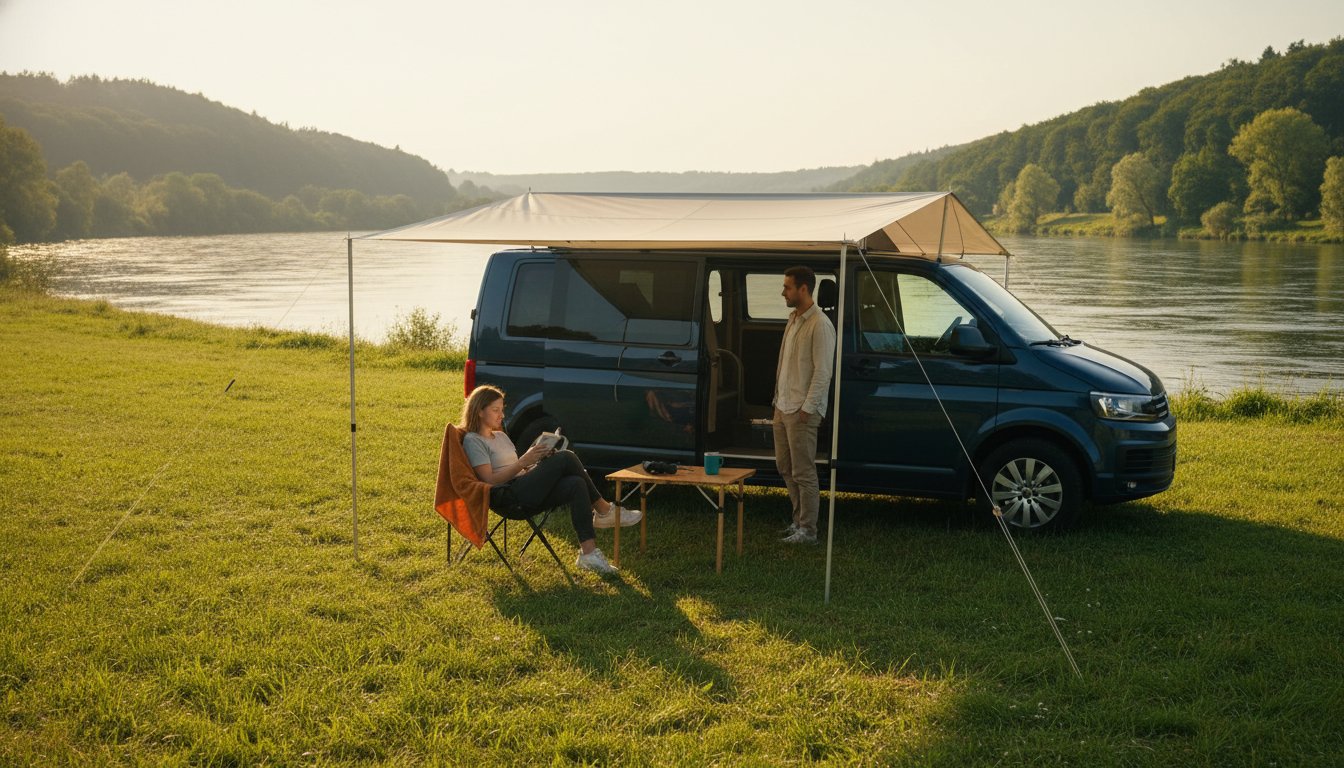
Besides the load, flexibility plays a crucial role. Awnings are rigid and act like a lever on your vehicle wall in a storm. Even with wind gusts from 40 km/h, you risk expensive damage to the bodywork. A sail is more elastic and can be unhooked in less than 60 seconds when the weather changes. Furthermore, a fabric sail conveys the true van-life feeling much more intensely. It looks less like a permanent attachment and more like an invitation to freedom that blends organically into nature.
Sun sail vs. awning: The honest comparison
Assembly time is often the main argument for an awning. But let’s be honest: with two simple steps and a piping rail, your camper van sun sail will be up in exactly 4 minutes once you have some practice. When it comes to maintenance, the sail wins by a landslide. There are no mechanical jointed arms that squeak or attract greasy dirt. If you store the sail in winter, it takes up no more space in the basement or rear storage compartment than a rolled-up sleeping bag. That creates the space for order that we campers love so much.
When a sun sail is the best choice for you
The sail is the smartest solution, especially for owners of camper vans and compact campers. It prevents the typical heat build-up because air can circulate better under the breathable fabric. Measurements show that the temperature under a sail can be up to 8 degrees Celsius lower than under a coated PVC awning. It is ideal for you if you:
- Frequently scrape against the 3.5-tonne limit and need to optimize weight.
- Change locations often and are looking for an uncomplicated solution.
- Value an aesthetic design that does not overwhelm your vehicle visually.
- Prefer a budget of 150 to 300 euros for professional equipment instead of spending 1,500 euros for an awning.
In the end, it is the combination of lightness and the feeling of infinite freedom that makes the sail so unbeatable. You remain mobile, save fuel through less air resistance, and still enjoy maximum comfort at your favorite spot.
The different mounting systems: piping, magnet, or suction cup?
Choosing the right mount determines whether your camper van sun sail will hold securely even in a stiff breeze on the North Sea or fly away at the first gust of wind. There are four common systems, each with its own justification. The classic piping rail is the gold standard for long-term and frequent campers. Magnetic adapters are perfect for camper vans with a sheet metal roof. Suction cup mounts are the savior for rental vehicles, while clamping systems are often used on older models with rain gutters.
Everything about the piping rail on a camper
The piping rail is the most stable connection between the fabric and the vehicle. You need to know two standard sizes: 5 mm and 7 mm. About 90% of all European campers use the 7 mm piping. You will often find the narrower 5 mm variant on VW California rails or in the groove rails of awning front profiles. Want to be sure? Take a 6 mm drill bit in hand. If it fits loosely into the rail, you have a 7 mm piping rail. If it gets stuck, it is the 5 mm version.
- Measure: Measure the exact straight length of the rail without the curved end pieces.
- Insert: Clean the rail thoroughly with a damp cloth before the season.
- Lubricant: A drop of dish soap or special silicone spray works wonders against annoying snagging during insertion.
Mounting without a piping rail: Your options
Not everyone wants to drill holes or has a permanently installed rail on their vehicle. Magnetic tape adapters adhere to steel roofs with a tensile force of up to 150 Newtons per meter. This keeps your sail securely in place even at wind speeds of 35 km/h. For fiberglass roofs or modern vans without metal in the roof, lever-action suction cups are the best choice. A high-quality suction cup often holds over 10 kg vertically. Ensure the surface is absolutely dust-free, otherwise, the vacuum will lose its power after a short time. If you want to perfect your outdoor living room under the camper van sun sail, you will find practical helpers for more organization with us that make your shaded spot even cozier.
Clamping systems for rain gutters have become rarer, but they offer an extremely resilient base on classics like the VW T3 or old Mercedes transporters. Here, the sail is fixed using a metal rod (lock rod) and screw clamps. This takes about 5 minutes longer than mounting a magnet, but it withstands even stronger gusts without slipping. For unconventional vehicle shapes, DIY hacks like bungee cords that you attach directly to the roof rack or wheel holes often help. This requires some creativity, but grants you maximum freedom in choosing your location.
Step-by-step to the perfect sun sail: Your selection check
So that your holiday doesn't turn into a sweaty affair, choosing the right equipment is crucial. A camper van sun sail must be able to do more than just provide shade. It is your extended living room under the open sky and must withstand wind, rain, and intense radiation. We will now take a look at what really matters technically.
Finding the right size for your vehicle
The width of your sail is based directly on the length of your piping rail. A proven rule of thumb for 2026: choose a sail about 30 to 50 centimeters shorter than the rail. This gives you the necessary room for maneuvering when tensioning to avoid wrinkles. A depth of 240 centimeters has established itself as the gold standard for projection. This space is sufficient to accommodate a camping table and four chairs comfortably. If your camper is higher than 2.60 meters, you should consider a depth of 300 centimeters. Since the shade falls at a steeper angle with tall vehicles, you would otherwise lose valuable usable space in the cool.
Materials in a stress test: What really lasts?
Cheap fabrics often fade after just 45 days of intense sunlight and become brittle. High-quality camper van sun sail fabric like Airtex or specialized polyester with acrylic coating is the better choice here. While simple PU coatings are waterproof, heat often builds up underneath them. Acrylic fabrics, on the other hand, are breathable and ensure a pleasant climate. When buying, pay attention to the following key data for maximum longevity:
- UV protection: A certified UPF 50+ blocks over 98 percent of UV rays.
- Water column: At least 3,000 millimeters are mandatory so that you stay dry even during a two-hour downpour.
- Tear resistance: Double-stitched edges and reinforced eyelets prevent tearing during sudden gusts.
The choice of poles determines stability in the wind. Steel tubes with a diameter of 25 millimeters are extremely robust and ideal for windy coastal spots. However, they carry a high inherent weight. Aluminum telescopic poles with a wall thickness of 1.2 millimeters are the modern alternative. They weigh about 45 percent less than steel and can be adjusted continuously to uneven ground. Fiberglass is light and flexible, but quickly reaches its limits at wind speeds of 6 Beaufort and above. For real freedom and peace of mind, we recommend anodized aluminum, as it is also absolutely corrosion-resistant against salty sea air.
Assembly & professional tips: How to keep your sun sail secure even in the wind
A stable setup begins long before the first hammer strike. 75 percent of stability depends on preparation. First, check the condition of the ground and the current wind direction. Your camper van sun sail should never act like a sail in the wind. Ideally, position your camper so that the wind blows over the roof and does not get under the fabric. This reduces the load on the piping rail by up to 40 percent.
When guying out, the 45-degree angle is the absolute gold standard. If you lead the lines away from the upright poles at this angle, the tensile forces are distributed evenly between the ground and the vehicle. As soon as the wind speed exceeds 35 km/h, you should use additional storm lines. These are attached directly to the sturdy corner points or the spikes of the telescopic poles. A small trick from practice: mark the ideal position of your pegs with small marking plates in case you have to briefly dismantle the sail for a day trip.
Care is crucial so that you can enjoy your equipment for years. Never pack the fabric away while it is damp. Mildew stains often form after just 24 hours in the storage bag. If you are caught by rain while dismantling, spread the sail out wide to dry at home within 12 hours at the latest. Re-impregnating every 2 seasons preserves the water column of usually 3,000 millimeters and protects the fibers from UV radiation.
Instructions: Setting up a sun sail on a camper
First, pull the piping of the sail evenly into the rail. A silicone spray in the rail noticeably reduces resistance. Afterward, position the upright poles at the front corners. Build up a slight base tension by fixing the middle lines first. For optimal water drainage during sudden showers, fine-tuning is important: lower one of the outer poles by about 15 centimeters. This creates a slope that effectively prevents the formation of heavy water pockets.
Accessories that make the difference
- Screw-in pegs vs. ground nails: On soft ground, screw-in pegs with a length of 20 centimeters offer significantly more pull-out resistance than smooth nails.
- Rubber tensioners: These elastic helpers act like shock absorbers. They catch hard wind gusts and prevent the tension from permanently stressing the material of your camper.
- Telescopic poles: Opt for continuously adjustable aluminum poles. They allow you to compensate for unevenness in the ground down to the centimeter so that the fabric always remains taut.
With the right technique and high-quality equipment, you transform your pitch into a secure oasis of well-being. For perfect organization, check out our practical organizational systems for your camper immediately so that your accessories also remain within reach.
Your mobile living room: Why Campidoo sun sails make the difference
For us, camping is not a hobby; it is a way of life. We know exactly how annoying it is when equipment gives way at the first gust of wind or the assembly takes longer than the well-deserved cold drink afterward. That is why we developed our products directly from practical experience. A camper van sun sail from Campidoo is the result of over 500 nights under the open sky and the desire for true perfection in detail. We are not an anonymous corporation, but your specialized partners who know the daily challenges of van life from our own experience.
Quality determines whether your holiday remains relaxed or descends into stress. We consistently rely on tear-resistant 300D Oxford polyester with a water column of 3,000 millimeters. The material not only defies heavy rain showers but also offers extremely high protection against aggressive UV radiation with UPF 50+. The Campidoo promise is simple: you save valuable life time. Thanks to our optimized piping system, your shaded spot is set up securely in less than 5 minutes, leaving you more time for freedom.
- Developed by campers: Every seam and every eyelet is optimized for intensive use in everyday camper life.
- True longevity: Our sails are constructed so robustly that they last 6 years or longer with normal care.
- Smart handling: Small pack size meets maximum stability so that your storage space remains efficiently used.
Our philosophy: Order and aesthetics in the camper
A beautiful camper is a place where you immediately feel at home. We believe that functionality and design must go hand in hand. Our sails are simple, modern, and avoid unnecessary frills. For us, sustainability means you don't have to replace your equipment every season. If you are unsure which camper van sun sail best fits your camper van or motorhome, we will advise you personally and at eye level. We will find the fitting, ingenious solution for every space problem.
Make yourself comfortable: Completing your setup
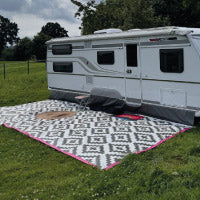
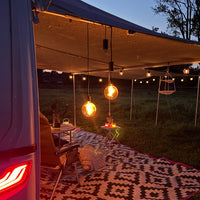
The shade under the sail is just the beginning for your perfect outdoor living room. To ensure no sand or dirt is carried into your interior, it is best to combine your setup with our special awning carpets. These have a high material density of 400g/m², which makes them particularly foot-friendly and durable. With a few fairy lights and your personal decor, you turn the space in front of your vehicle into a true oasis of well-being for mild summer evenings. Discover the Campidoo sun sail collection now and make your next trip unforgettable.
Your upgrade for maximum freedom and cool shade
A high-quality camper van sun sail is far more than just a shade provider; it is your mobile living room that gives you 100% flexibility at every pitch. You have seen how clever mounting systems make the annoying drilling on the vehicle completely unnecessary. While heavy awnings often become a risk in the wind, a Campidoo sail scores with its low weight and enormous stability. We developed these solutions directly from practice. Our team looks back on over 20 years of camping experience itself. Our products consist of extremely robust material designed for a longevity of many seasons. You can usually manage the assembly in under 4 minutes. This way, you use the time gained immediately for relaxation in nature. Trust in well-thought-out details that noticeably make your everyday life in the camper easier and give you the peace of mind you deserve on holiday. Pack your things. Get ready for unforgettable moments under the open sky.
Get your Campidoo sun canopy now for your next trip!
Enjoy the sun and the feeling of true independence on your next tour.
Frequently asked questions about motorhome sun canopies
Can I leave a sun canopy up when it rains?
You can leave your sun canopy up in the rain without any problems, provided the material has a water column of at least 3,000 millimeters and a waterproof coating. A slope of at least 15 degrees is important so that the water runs off quickly. Without this incline, heavy water pockets will form, which can bend the poles with just a few liters of water. A high-quality motorhome sun canopy will reliably protect you from summer showers in 2026 and keep your entrance area dry.
What piping size do I need for my motorhome?
Most classic motorhomes use a standard 7 mm piping, while compact camper vans often have a 5 mm rail installed. About 90 percent of all European manufacturers use these two sizes. You can easily check the diameter at the opening of your rail using a caliper. If you switch between different vehicles, practical adapter piping can help, connecting both sizes and ensuring maximum flexibility during setup.
What is the best way to clean my sun canopy of resin or bird droppings?
The best way to remove stubborn dirt such as resin or bird droppings is with special camping cleaning agents and a soft brush, so as not to scratch the sensitive UV coating. Aggressive household cleaners with a pH value below 5 or above 9 will attack the fibers and make the fabric brittle. Soak dried-on stains for about 10 minutes with lukewarm water. After this soaking time, the residue can usually be wiped off without leaving a trace, without damaging the waterproofing of your canopy.
Is a sun canopy safe in strong wind?
A sun canopy is safe up to wind speeds of about 50 kilometers per hour if you anchor it firmly to the ground with sturdy tent pegs at a 45-degree angle. Compared to a permanently installed awning, the fabric is more flexible and absorbs gusts better. However, as soon as the weather forecast predicts wind force 7 or gusts over 60 km/h, you should take down the canopy within 5 minutes. This not only protects your equipment from tears but also prevents damage to your vehicle's piping rail.
What is the difference between a sun roof and a sun canopy?
The main difference lies in the design and weight, as a sun roof usually has a sturdier, all-round pole system and is more like an awning without side walls. While a classic motorhome sun canopy often weighs only 3 to 5 kilograms, a sun roof can easily weigh 12 kilograms or more. The canopy scores with its minimal pack size of about 40 by 20 centimeters. It is the perfect choice for campers who value lightness and quick relocation.
Can I set up a sun canopy on my own?
You can set up a modern sun canopy completely on your own in about 12 to 15 minutes without any help. First, feed the fabric into the piping rail and use small retaining clips so that it does not slide out again while you set up the telescopic poles. Then tension the middle guy lines first to give the system stability. With a little practice, your shaded spot will stand almost by itself after the second or third attempt, without the need for a second person to hold it.
How do I prevent water pockets on the sun canopy?
You can effectively prevent water pockets by setting one of the front telescopic poles at least 20 to 30 centimeters lower than the other. This asymmetrical tension creates a natural slope, allowing rainwater to drain to one side immediately. When tensioning, make sure the fabric is taut and free of wrinkles. Even a small crease in the fabric can cause water to collect and stretch the material unnecessarily.
Which poles are best suited for motorhomes?
Aluminum telescopic poles are the ideal choice, as they are extremely light at only 600 grams per pole, yet infinitely adjustable up to a height of 250 centimeters. They are completely rust-proof and can be stored in any storage compartment thanks to their compact design. Compared to heavy steel poles, you save about 4 kilograms of weight with a set of three poles. This is a crucial advantage for your payload when traveling with full water tanks and complete equipment.