












 About us
 Magazine
 Contact








Last updated: November 10, 2026
Quick overview
You can make a side awning windproof by aligning it straight, checking the articulated arms, and tensioning the fabric evenly with storm ropes. Anchor the ropes to the ground with pegs or water bags. In the event of a storm or strong gusts, it is best to retract the awning.
- Align the awning straight so that it lies flat and without tension.
- Attach storm ropes or guy ropes to the designated eyelets on the fabric.
- Choose screw-in pegs for soft grass, water bags for asphalt or gravel.
- Retract the awning if the fabric flutters erratically or the tensioning gives way.
- Check the joints, eyelets, and fabric after every trip with stronger winds.
Table of Contents
- Why side awnings become dangerous in the wind
- Tensioning the awning on the motorhome: Step by step
- Correctly attaching a storm rope to a motorhome awning
- Awning pegs for motorhomes: Which ground fastening is right
- At what wind strength you should retract the awning during a storm
- Special case side awning: Angle, campsite, and material fatigue
- Your next steps for a secure campsite
- Frequently asked questions
Why side awnings become dangerous in the wind
A side awning that is windproof on the motorhome may seem harmless until the first gust of wind gets under the fabric. Side awnings are designed for moderate winds, not for storms. In gusts, a large fabric surface acts like a sail and pulls on the articulated arms, rail, and fastening. In stronger winds, the awning should be retracted in good time instead of relying solely on the securing system.
The good news: With the right tensioning and a little preparation, the awning can be operated safely in most weather conditions. It is important to know the weak points. The articulated arms and the aluminum rail absorb the forces. Cutting corners here risks damage to the vehicle and the fabric.
- Danger 1: In gusts, the fabric acts like a sail and lifts the joint out of the holder.
- Danger 2: Loose fastenings rattle against the vehicle and rail in the wind.
- Danger 3: The fabric tears or distorts if it is unevenly tensioned.
No awning is completely stormproof. Even with a securing system, retracting it in strong winds remains the safest method.
Tensioning the awning on the motorhome: Step by step
Proper tensioning makes all the difference. The following steps work for most side awnings. Check your model's operating instructions beforehand.
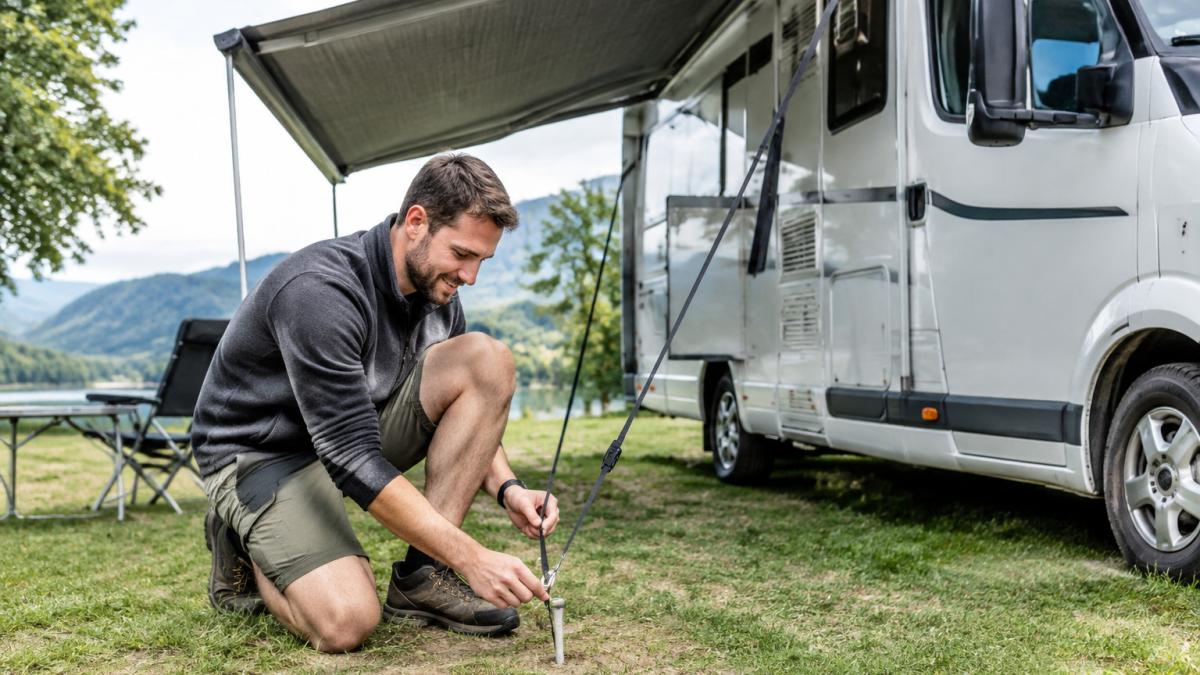
- Align the vehicle straight so that the awning lies flat and without tension.
- Fully extend the awning and check that the articulated arms are firmly seated.
- Hook guy ropes or storm ropes to the designated eyelets on the fabric.
- Lead the ropes outward to the ground and secure them there with pegs or screw-in pegs.
- Adjust the tension evenly. The fabric should be taut but not overstretched.
| Step | What to check | Common mistake |
|---|---|---|
| Alignment | Awning lies flat | Mounted at an angle, tension on one side |
| Articulated arms | Firmly seated | Overlooked loose screws |
| Tensioning | Even tension | One rope much tighter than the other |
| Anchoring | Peg is deep | Peg loosened in soft ground |
Attention: Do not pull the ropes so tightly that the fabric tears under tension or the articulated arms bend.
Correctly attaching a storm rope to a motorhome awning
Storm ropes connect the awning to the ground and absorb lateral forces. A storm rope should not be attached to the edge of the fabric, but to sturdy fastening points. If a storm rope is only loosely attached, it quickly loses tension in the wind.
Position the rope at a shallow angle to the ground. A very steep pull puts more strain on the awning, while a too-shallow pull can twist it sideways. A good middle ground ensures a stable position. For complete solutions, the storm rope set with D-ring from our range is ideal, as it contains all the necessary parts.
Compare the options before purchasing. Our guide Storm rope or storm line for awning explains the detailed difference between a storm rope and a storm line. Those who cannot drive pegs in will find a suitable alternative in the set without pegs.
- Do not lead the rope over sharp edges, otherwise it will wear through.
- After the first trip, recheck the tension and seating.
- Retighten the ropes in the rain, as the fabric and ropes change.
Awning pegs for motorhomes: Which ground fastening is right
The best tensioning is of little use if the ground does not hold. Screw-in pegs bite deep and are suitable for soft grass or loose soil. Classic pegs need firm ground; on hard ground, they quickly slide out.
Pegs are hardly usable on asphalt or hard gravel. Here, weights or water bags help to additionally weigh down the awning foot. A 2-piece set of water bags for awning feet holds about 8 liters each and is only filled at the campsite. This keeps the transport weight low.
A short decision aid:
- Soft grass or loose soil: Screw-in pegs.
- Firm, unpaved ground: Classic pegs.
- Asphalt, gravel, or slabs: Water bags or weights.
For your campsite: Test the hold before leaving the awning to the elements.
At what wind strength you should retract the awning during a storm
The question of a fixed wind strength is misleading because the fabric size, model, and tensioning of a side awning greatly change the load. A more reliable decision aid is the combination of three observations: How the fabric behaves in the wind, how strong the gusts are, and whether the tensioning gives way.
The observation of the fabric is the fastest indicator. If the fabric flutters erratically, beats against the rail, or the awning visibly moves in the joints, the limit of the tensioning has been reached. A short, steady vibration in continuous wind is usually not critical, but sudden movements in gusts are. Pay special attention to gusts that are significantly stronger than the continuous wind, as they put the articulated arms under the greatest load.
The second observation concerns the gust forecast. Plan to retract it before such a warning arrives, not during the storm, because retracting it in strong winds puts mechanical strain on it and can additionally damage the joint.
The third observation is the tensioning itself. If pegs loosen, a storm rope slips, or the rope pulls unevenly, the limit has already been exceeded. In this case, retracting it is the right decision, even if the wind strength appears moderate.
Attention: An awning should never be left unattended in wind in the warning range, even if it has held up without problems so far.
As a practical rule: If two of the three observations indicate strain, retract it. This takes a few minutes and prevents damage that would be significantly more expensive.
Special case side awning: Angle, campsite, and material fatigue
Side awnings are treated as a variant of the main awning in most guides. However, they differ significantly in their position: It stands to the side of the vehicle, catches wind frequently from the flank, and transfers the load unevenly to the articulated arms and the rail. Precisely this asymmetry determines how you tension it and what you should pay attention to.
The angle of the tensioning is the most important lever here. A storm rope that pulls almost vertically downwards presses the awning against the vehicle and loads the articulated arms in compression. A very shallow pull, on the other hand, tips the fabric sideways and twists the rail. A pull at a shallow to medium angle to the ground is useful for stability, whereby the tensioning points should be applied evenly. Check the angle before every longer stay, because the fabric and ropes settle after the first gusts.
The campsite amplifies these effects. A side awning that stands directly next to a hedge, a house wall, or a vehicle with little distance can trap gusts and throw them back. Whirlwinds occur especially at building edges and between closely parked vehicles. Choose an open campsite if possible and leave as much space to the side as possible so that the fabric does not beat against neighboring vehicles in the wind.
Material fatigue from wind rarely shows up suddenly. Pay attention to three warning signs: First, play in the articulated arms, which shows when shaking the extended awning and creates abrasion at the bearing points. Second, longitudinal tears or frayed edges on the fabric around the eyelets, because these points immediately absorb every gust. Third, a rail that easily warps in the wind or whose fastening screws need to be tightened after a season. Repeated wind loading often distributes damage inconspicuously, so a visual inspection after every trip with stronger winds is worthwhile.
Attention: An articulated arm that gives way or cracks under load should not be loaded further until it has been checked.
Those who regularly check these points recognize weak points before they lead to failure. In the event of visible structural damage, look at the manufacturer's operating instructions and contact customer service before using the awning again.
Your next steps for a secure campsite
Start with a check: Joints, rail, eyelets, and fabric. Then align the tensioning neatly and secure the ground with the right peg or water bag. In the wind, retract the awning before it becomes critical.
Those who want to assemble the securing system completely will find suitable sets for storms and campsites at Campidoo. With the right material, the vacation remains relaxed, even if the weather changes.
Frequently asked questions
How can I secure a side awning on a motorhome against the wind?
The best way to secure a side awning is with a tensioning set: Storm lines are attached to the awning arms and the vehicle and anchored in the ground. The lines should run at a shallow angle and be tautly tensioned so that the fabric does not flutter. In addition, tensioning rods help to stabilize the awning fabric. Check the fastenings regularly, especially after gusts, as pegs can loosen in soft ground.
At what wind strength should I retract the motorhome awning?
Side awnings are only designed for moderate wind conditions. In strong winds or storms, they must be retracted. Observe gusts and weather forecasts: As soon as wind gusts increase, the fabric flutters, or the arms bend, you should retract the awning immediately. Even tensioning does not offer complete protection, so retracting it is considered the safest method as soon as the wind increases significantly.
Which pegs are suitable for tensioning an awning?
For firm ground, sturdy metal pegs with sufficient length are suitable. On soft ground such as grass, screw-in pegs are often the better choice, as they can be anchored deeper and more firmly. Drive the pegs in at an oblique angle so that the pulling force is optimally absorbed. Make sure that the pegs are not only superficially seated in the ground.
Can an awning stay outside in strong winds?
This is not recommended in strong winds. Even with a storm rope and tensioning set, the risk of damage to the articulated arms or aluminum rail remains. If you leave the campsite or go to sleep while the wind picks up, retracting it is the only truly safe option.


