










 About us
 Magazine
 Contact










Imagine standing at Lake Garda on a sunny morning, ready to enjoy your first coffee with a view of the mountains, only to see a milky gray haze. Last summer, this is exactly what happened to a camper friend who kindly cleaned his windows with standard glass cleaner and paper towels; the bitter result was an expensive 940-euro repair bill for a complete window replacement. We all know that acrylic windows are the most sensitive part of your camper. Often, one wrong move or the wrong acrylic glass cleaner for motorhomes is enough to permanently ruin the surface.
Understandably, you don’t want to risk scratches or watch the material become brittle and develop ugly stress cracks due to harsh chemicals. In this guide, you will learn how to clean your windows gently, protect them from harmful UV radiation, and preserve the value of your motorhome for many years. We will show you our field-tested routine for crystal-clear visibility without streaks, so you can finally enjoy the freedom of your travels unclouded once again.
Key Takeaways
- Learn why conventional household cleaners are poison for your windows and how to prevent dangerous stress cracks by choosing the right materials.
- We show you what to look for in the perfect acrylic glass cleaner for motorhomes so that dust doesn't stand a chance, thanks to an anti-static effect.
- Discover the optimal 5-step technique for removing heavy dirt without scrubbing, preventing the formation of new scratches from the start.
- Discover the crucial difference between cleaning and polishing to safely remove existing cloudiness and increase your camper’s value.
- Benefit from genuine practical knowledge “from campers for campers” and learn which special products we use ourselves to guarantee maximum transparency and material protection.
Why conventional cleaners ruin your motorhome windows
You know the feeling: the sun is shining over the campsite, the route for the day is set, but the view through the window is cloudy and blurred. At this moment, many campers instinctively reach for the glass cleaner from their home kitchen or the all-purpose cleaner from the garage. This is a fatal mistake that can end up being expensive. Your motorhome windows are not made of mineral glass like the ones in your house, but of poly(methyl methacrylate), or PMMA for short. While real window glass has a Mohs hardness of about 5.5 to 6.5, acrylic glass is significantly softer and more sensitive to external influences. Using the wrong acrylic glass cleaner for motorhomes risks permanent clouding and material damage.
To understand the chemical properties of acrylic glass, you must know that it is a thermoplastic material. It reacts extremely sensitively to alcohols, spirits, and solvent-based substances. These substances strip the material of its plasticizers. The result is a brittle surface that loses its shine. Often, "blind" spots develop that refract light poorly and severely impair visibility. Even your beloved household microfiber cloth can become an enemy. Many standard cloths have sharp loop structures that act like 1500-grit sandpaper on the soft plastic. They leave microscopic scratches in which dirt and algae settle even faster.
The phenomenon of stress cracks
Stress cracks are every van owner's nightmare and are often the result of unsuitable surfactants. On a molecular level, aggressive ingredients penetrate the polymer chains of the acrylic glass. This leads to a local change in volume and builds up enormous tension in the material. The tricky part is the time delay. Such cracks often appear only 3 to 7 months after the actual cleaning, when the material is further stressed by UV radiation or temperature fluctuations. For a safety check, view your window at a 45-degree angle in direct sunlight. Do you see fine, spiderweb-like lines inside the pane that cannot be wiped away? Then the structure is already permanently damaged.
The list of sins: These products are taboo
To ensure your mobile home retains its value and you always have a clear view of nature, you should steer clear of the following products:
- Glass cleaner: It almost always contains alcohols or ammonia. These ingredients cause the plastic to become brittle up to 25 percent faster than water.
- Scouring cream and aggressive all-purpose cleaners: What removes limescale in the bathroom acts like a sandblaster on a camper. Just a single application can reduce the surface gloss level by over 30 units.
- Home remedy myths like toothpaste: Often touted as a secret tip against scratches, toothpaste contains abrasive particles with a grain size often exceeding 12 micrometers. That is far too coarse for the delicate PMMA surface and only creates new, fine networks of scratches.
Instead, always use a special acrylic glass cleaner for motorhomes that is explicitly certified for plastics. This is the only way to ensure the chemical composition preserves the plasticizers in the material and reduces static buildup. A high-quality cleaner ensures that dust adheres less, meaning you have to reach for the rag less often. This saves time and protects your camper's material in the long term.
The chemistry behind acrylic glass: Why special cleaners are indispensable
You are standing in front of your camper and the windows look rather cloudy after your last trip through the pine forest or the dusty tracks of Spain. Thinking of just grabbing the glass cleaner from the kitchen? Stop. Acrylic glass, technically called polymethyl methacrylate (PMMA), is a sensitive plastic. It weighs about 50 percent less than real glass but is much softer. A high-quality acrylic glass cleaner for motorhomes must encapsulate and lift dirt particles like insect remains or tree sap without scratching or chemically attacking the surface. The goal is a deep-pore cleaning that preserves optical clarity for years.
The greatest danger to your windows is invisible chemical reactions. Conventional cleaners often contain alcohols, ammonia, or aggressive solvents. These substances strip the plastic of its plasticizers. The result is tiny stress cracks that look like fine spiderwebs at first and can make the window completely blind after 3 to 4 years. A specialized cleaner preserves the material's flexibility and ensures the panes do not become brittle even in strong sunlight.
Ingredients under the microscope
A look at the label tells you a lot about quality. A good acrylic glass cleaner for motorhomes relies on mild, water-based surfactants. These effectively dissolve organic contaminants like insect secretions or sticky sap without destabilizing the structure of the plastic. Here are the most important criteria for choosing your cleaner:
- Neutral pH value: Ideal cleaners are in the pH 7 to 8.5 range. This is material-neutral and also gentle on the rubber seals of your windows.
- No re-greasing: Many car shampoos contain waxes or oils for shine. On acrylic glass, these often leave greasy streaks that severely obstruct visibility when backlit.
- Solvent-free: Ensure that no ethanol or isopropanol is contained. These substances are the main cause of dreaded cracking.
Anti-static effect: The secret protective shield
Do you know the phenomenon where you’ve just cleaned your window, and five minutes later a fine layer of pollen and dust is already sticking to it? This is due to electrostatic buildup. Plastics are poor conductors. The friction from drying with a cloth creates an electrical voltage of up to 10,000 volts on the surface. This acts like a strong magnet on dust particles in the air.
Specialized cleaners therefore contain anti-static agents. These change the surface tension of the acrylic glass and immediately neutralize the charge. The effect is brilliant: dirt finds no hold and simply rolls off during the next drive or the next rain shower. This saves you valuable time while traveling, especially if you have organized your storage space for cleaning supplies cleverly and don't want to pull out the spray bottle after every stop.
Additionally, modern cleaners offer integrated UV protection. Since motorhome windows are often exposed to the elements 365 days a year, this protection prevents the material from yellowing. Tests have shown that specially maintained windows have a lifespan up to 15 years longer than untreated panes. This keeps the view of nature crystal clear and your camper's value stable.
Removing scratches vs. prevention: Cleaner and polishes checked
Clean windows are the be-all and end-all for your sense of freedom in the camper. But the line between simple maintenance and necessary repair is often thin. While a special acrylic glass cleaner for motorhomes prevents dirt and static buildup during daily use, it reaches its limits with mechanical damage. Here you have to decide: is gentle cleaning enough or does the polish need to remove the top layer? Choosing wrong here risks permanent cloudiness that decreases your camper's value.
Decision support: Cleaning or polishing?
To check the condition of your windows, the proven fingernail test helps. Run your finger carefully over the scratch. If your nail catches, the gouge is deeper than 0.05 millimeters. In this case, cleaning won't help; you must polish. For surface cloudiness caused by UV light, which often occurs after about 5 to 8 years of intense sun exposure, a cleaner is also insufficient. In these cases, combo products that combine a cleaning component with fine abrasive particles have proven effective. These 2-in-1 solutions save you about 15 minutes of time per window but are only suitable for micro-scratches. For deep scratches from branches, you need a set with different grit levels, usually starting with 1500-grit wet sandpaper up to a high-gloss paste.
- Too much pressure creates localized heat above 70 degrees Celsius.
- The material plastically deforms and becomes "blind".
- Less pressure and circular movements lead to the goal faster.
- Better to polish in three short 30-second intervals than three minutes at once.
Accessories check: The right tools
The best acrylic glass cleaner for motorhomes is of little use if the cloth contains abrasive particles. Consistently avoid standard supermarket microfiber cloths. These act like fine sandpaper on the soft plastic and leave thousands of tiny scratches. Use special polishing cloths or soft, washed cotton cloths without seams instead. A decisive factor is pre-cleaning: use at least 5 liters of water per window side to rinse away sand grains before working mechanically. A single grain of sand under the polishing cloth causes damage that will take you hours to fix later.
An absolute taboo for a motorhome is the electric polishing machine. Even at the lowest setting, the speeds are often too high for the thermally sensitive acrylic glass. Professionals work exclusively by hand. While this takes a good 20 to 30 minutes for a large panoramic window, it protects you from total damage due to overheating. Manual control allows you to feel the heat development directly with your fingers and take breaks in time.
If you look at the costs, DIY refurbishment is unbeatable. A high-quality polishing set will cost you between 25 and 45 euros. A new side window for common camper van models quickly costs 550 to 850 euros including installation. With an investment of two hours of work and the right acrylic glass cleaner for motorhomes, you effectively save over 90 percent of the cost compared to a replacement. This not only spares your travel budget for the next trip but also preserves the vehicle's originality.
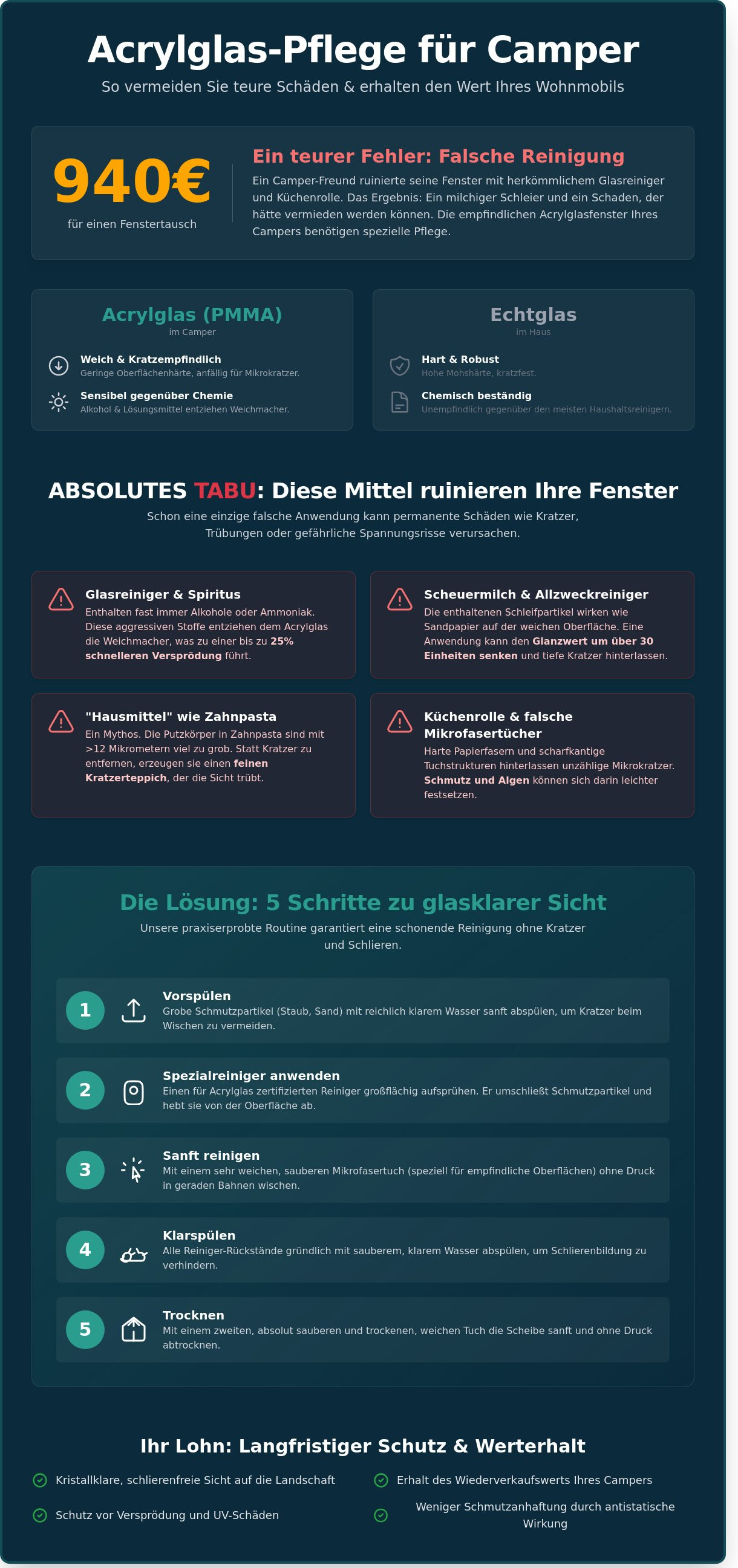
The 5-step guide for a streak-free and scratch-free view
For your mobile home to shine even after years, it needs more than just soap and water. Acrylic glass is extremely sensitive to chemical solvents and mechanical friction. Getting this wrong risks fine hairline cracks that are often only visible after 12 to 18 months and compromise the stability of the window. With our field-tested instructions, you ensure that your panes remain crystal clear and the value of your camper is preserved.
Steps 1 & 2: Contactless pre-wash and cleaning
The biggest mistake in window care happens right at the start. Dust and sand grains act like sandpaper on the soft surface. Before you pick up a cloth, you must remove heavy dirt without contact. Thoroughly rinse the windows with at least 5 liters of clean water per pane. A gentle stream of water is your best friend here; avoid high-pressure cleaners at all costs, as the pressure, often over 100 bar, can seep under the seals.
Insect remains are particularly stubborn and can practically bake into the surface at an outside temperature of 30 degrees. Here, only patience helps. Spray a special acrylic glass cleaner for motorhomes generously and let it sit for exactly 3 to 5 minutes. The active ingredients encapsulate the chitin shells of the insects and gently lift them from the surface. Scrubbing is a no-go. Instead, use the two-cloth method for a perfect result:
- Cloth 1: A wet, long-pile microfiber cloth picks up the dissolved dirt without pressure.
- Cloth 2: A second, clean cloth is used exclusively to rinse away cleaner residue with fresh water.
Through this process, you prevent rubbing dirt particles from one area to another. A high-quality acrylic glass cleaner for motorhomes also leaves an anti-static film, which reduces dust attraction by up to 60 percent, saving you time on your next trip.
Steps 3 to 5: Finish and care for details
After cleaning comes drying, where you should also avoid any pressure. A clean synthetic fiber window cloth absorbs moisture almost on its own. Dabbing is better than wiping here. As soon as the pane is dry, a polymer-based sealant is recommended. This protects the material from UV radiation, which causes acrylic glass to become brittle and yellowish over 3 to 5 years. A good sealant lasts about 6 months and lets rainwater simply roll off while driving.
Never forget the details when maintaining. The black rubber seals are the heart of your windows. Treat them twice a year with a silicone-based care pen or talcum powder to keep them supple and prevent them from sticking to the acrylic glass. This prevents the typical squeaking when opening and protects against leaks. For tilt-and-slide windows, you should also check the locks and keep them moving smoothly with a drop of resin-free oil if necessary.
An often overlooked area is the roof hatch, often known as a Heki. Due to their horizontal position, they are most exposed to the sun and environmental influences like tree sap. Clean them using the same 5-step principle as your side windows to avoid stress cracks. For perfect organization in the interior and the protection of your equipment, you will find the right system with us.
Discover our practical camping accessories nowInterior cleaning requires a special approach. Here, you are usually dealing with fingerprints or cooking grease. Make sure that no cleaner drips onto the pleated blinds or shades, as this can cause stains. A slightly damp cloth is often sufficient on the inside. If you carry out these steps consistently every second vehicle wash, your windows will maintain their full transparency for the next 10 to 15 years.
Professional care from campers for campers: The Campidoo solution
At Campidoo, we are passionate travelers ourselves and spend every spare minute in nature. That's why only products we have tested extensively on our own tours through Europe land in our shop. Each product has at least 5,000 kilometers of test driving behind it before we recommend it to you with a clear conscience. We know exactly that you don’t want complicated chemical hammers that do more harm than good in the end. Our heart and soul go into selecting solutions that noticeably make your camper everyday life easier and leave you more time for the beautiful moments in front of the sliding door.
The Campidoo promise is simple: We combine maximum cleaning performance with extreme gentleness on materials. Especially with sensitive surfaces like windows, caution is advised. The wrong motorhome acrylic glass cleaner can cause stress cracks within seconds, leading to expensive repairs. Our formulas are designed to dissolve dirt without stripping the plasticizers from the material. We use ingredients that provide an antistatic effect. This ensures that dust adheres up to 40% more slowly, giving you more valuable free time.
Sometimes a standard cleaning is not enough, especially if the previous owner didn't treat the vehicle with care. In stubborn cases or with deep scratches, we won't leave you on your own. Our consultation service is here to provide help and advice. Simply send us a photo of your problem case, and together we will find the right trick from our treasure trove of experience. Whether it's stubborn tree resin or cloudy spots, we have the right strategy ready.
Our range for your window care
In our range, you will find only highlights that impress in terms of efficiency. Our special cleaning kits are particularly popular because they contain perfectly coordinated components. If you choose a set, you often save up to 15% compared to purchasing items individually and have everything you need right at hand. Over 98% of our customers report significantly improved visibility and very easy application in their feedback. We supply the matching motorhome acrylic glass cleaner directly with the right microfiber cloths, which have an extra-high grammage for scratch-free work.
Your path to the perfect camper
A clean camper is the foundation, but we want more for you. You can ideally combine cleaning with a visual upgrade. Our furniture foils and decor give your interior a completely new look without you having to intervene deeply in the structure. This not only makes your van look better but also protects the original surfaces from wear and tear. A well-maintained vehicle with clear windows and a fresh interior demonstrably fetches up to 4,500 euros more upon resale than a neglected model. Value retention is ultimately hard cash that you can invest in your next trip. Get started now and treat your mobile home to the spa treatment it deserves.
Are you ready for the perfect view?
Your path to streak-free camping happiness: Clear views for every adventure
Your motorhome windows are your gateway to nature; they deserve care that truly keeps its promises. Conventional cleaners with aggressive ingredients often lead to microscopic stress cracks after just a short time, which permanently cloud your glass. Opt for a 100% alcohol-free special formula instead to massively extend the lifespan of your windows. With our proven 5-step guide and the right motorhome acrylic glass cleaner, you prevent annoying scratches before they can even form. At Campidoo, we developed these solutions from daily practice for true camping fans, so you can fully concentrate on your travel experience. Our products reliably protect the sensitive material against cracking and are delivered to you via express shipping in the EU and Switzerland, usually within just 2 to 3 working days. This way, your view of the Alps or the Mediterranean remains absolutely clear. Pack your bags, enjoy the freedom, and trust in professional quality at every stop. See you on the road!
Get the professional cleaners for your motorhome at Campidoo now!
Frequently asked questions about motorhome window care
Can I use glass cleaner for my motorhome windows?
No, you should under no circumstances use conventional glass cleaner for your plastic windows. About 90 percent of these household cleaners contain alcohols or solvents that make acrylic glass brittle and cause fine stress cracks. This damage is usually irreparable and affects the stability of the pane. Instead, use a special motorhome acrylic glass cleaner that comes without aggressive additives. This way, your windows will remain clear and safe even after 10 years on the road.
How do I remove deeper scratches from the acrylic glass?
Deeper scratches are most effectively removed with a special polishing kit for plastic surfaces. For furrows deeper than 0.1 millimeters, start carefully with 1500-grit wet sandpaper and plenty of water. Then work your way through with a polishing paste in circular motions until the area shines again. After about 5 minutes of polishing, the scratch disappears almost completely. This saves you the expensive replacement of the pane, which can quickly cost 450 euros.
Why do my plastic windows turn yellow over time?
The yellowing is caused by the constant UV radiation from the sun and the gradual loss of plasticizers in the material. After about 12 years of outdoor use, almost every window without protection shows initial discoloration. The harsh UV rays break the molecular chains in the plastic and alter its optical properties. A care spray with an integrated UV blocker can delay this process by up to 35 percent. When parking, try to avoid exposing the windows unnecessarily to the blazing midday sun for hours.
Can I drive the motorhome into a normal car wash?
No, please do not drive into a normal car wash with rotating brushes. The hard nylon brushes create thousands of tiny scratches per wash, which make your window appear dull within 3 minutes. Only special truck washes with soft textile strips or foam elements are conditionally suitable for campers. The safest method is gentle hand washing with a soft microfiber cloth and plenty of running water. This protects the surface and ensures you keep a clear view on your travels.
What is the difference between acrylic glass and Plexiglas?
Technically speaking, there is no difference, as Plexiglas is merely a protected brand name of the company Röhm GmbH. Both terms refer to the plastic polymethyl methacrylate, or PMMA for short. In about 95 percent of all European motorhomes, windows are made of this lightweight and shatterproof material. Whether you call it acrylic or Plexiglas, the care requirements remain absolutely identical. It is a high-quality material, but it reacts sensitively to the wrong chemicals.
How often should I clean the windows on my motorhome?
Ideally, clean your windows after every major trip or at least four times a year thoroughly. Dust, sand, and road grime act like sandpaper when they are rubbed across the pane by wind or touch. Regular care every 3 months prevents stubborn dirt from burning into the surface. This extends the lifespan of your windows by up to 50 percent. This ensures you have a perfect view from your mobile home at every sunrise.
What should I do about tree resin on the plastic windows?
The best way to remove tree resin is with ordinary cooking oil or special cleaning clay for vehicles. Apply a drop of oil to the sticky area and let it work for 10 minutes before gently wiping it off with a soft cloth. Definitely avoid harsh agents like nail polish remover or turpentine substitute. Such substances permanently destroy the plastic surface in less than 5 seconds. With the oil method, you dissolve the resin safely and without scratches from the window.
Do home remedies like baking powder help with cloudy windows?
No, baking powder is completely unsuitable as a home remedy and actually makes the windows even cloudier due to its coarse structure. The small particles in the powder act as an abrasive and cause hundreds of micro-scratches per square centimeter. A high-quality motorhome acrylic glass cleaner is the only right choice for your vehicle. It dissolves dirt on a chemical basis instead of scratching it off mechanically. It is better to trust products that have been developed exactly for the sensitive needs of campers.