










 About us
 Magazine
 Contact








Table of Contents
- Powerstation as an alternative to a conventional generator
- Powerstation or generator: Direct comparison for motorhomes
- Capacity and energy requirements: How to calculate runtime correctly
Last updated: October 8, 2026
Powerstation as an alternative to a conventional generator
A power station is a portable energy storage device and one of the best power station generator alternatives for providing power to your motorhome—without an engine, noise, or exhaust fumes. Unlike a conventional generator, it runs on rechargeable batteries that provide alternating current and various connection types.
The main difference lies in how they work: A generator produces electricity using an internal combustion engine—it is noisy, requires intensive maintenance, and depends on gasoline or diesel.
Generators require regular maintenance and produce noise and odors. Power stations require no maintenance, are silent, and can be charged anywhere—from a wall outlet, in the car, or via solar panels. This is more convenient and environmentally friendly.
Power station or generator: Direct comparison for motorhomes
Which solution is right for your motorhome? It depends on your requirements—the differences are significant.
| Criterion | Power station | Generator |
|---|---|---|
| Noise level | 0–60 dB (quiet) | 70–100 dB (loud) |
| Maintenance | None | Regular maintenance required |
| Upfront cost | Medium to high | Low to medium |
| Operating costs | Electricity for charging only | Gasoline/diesel + oil |
| Environmental friendliness | Zero emissions | CO₂ emissions |
| Runtime without charging | Limited (depending on capacity) | As long as fuel is available |
| Weight | 2–30 kg | 20–100 kg |
| Space requirements | Compact | Bulky |
Power stations win on convenience and environmental impact. You won't sleep next to a running engine, you won't wake the neighbors, and you won't need to change the oil.
Generators have one advantage: unlimited runtime. If you are traveling for weeks without an external power source and need a lot of energy, a generator may be a good choice—as a backup alongside the power station, not as the main power supply.
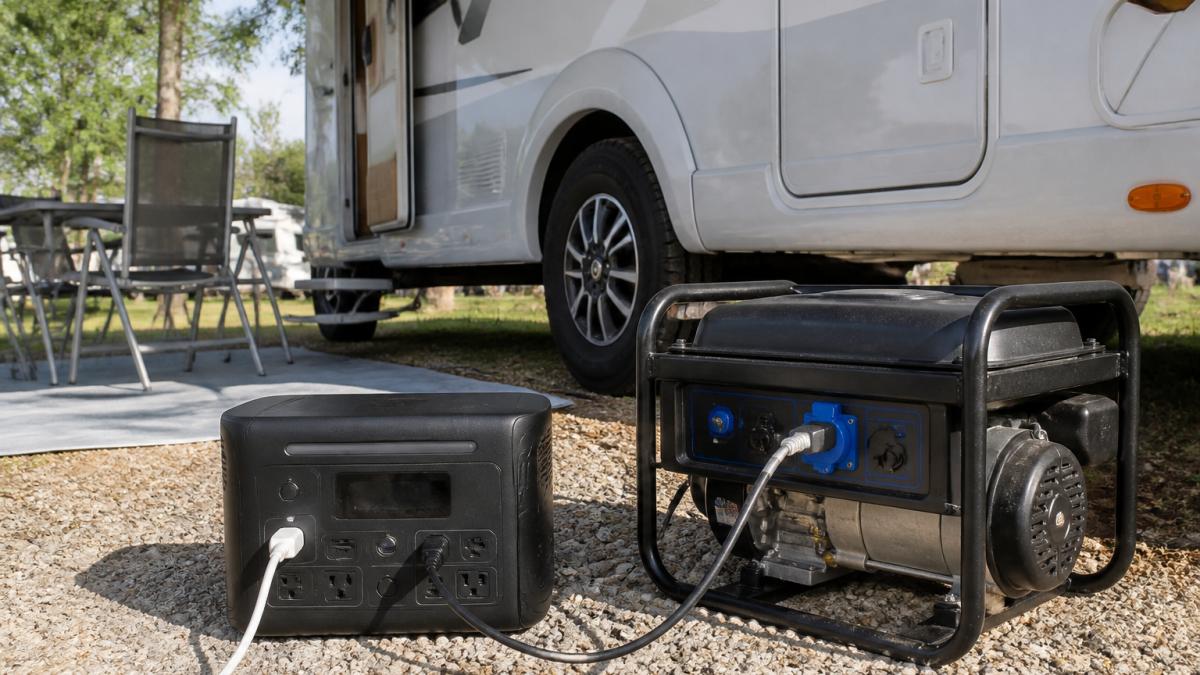
Most modern campers choose a power station as their main system and a small generator as a backup for emergencies.
Capacity and energy requirements: How to calculate runtime correctly
The right size for a power station depends on which devices you want to power and for how long. Many campers choose models that are too small and are disappointed when the refrigerator dies after a day. That is why we calculate using real devices and realistic runtimes—not the manufacturer's specifications on the data sheet.
Step 1: Determine the daily consumption per device
Note the power consumption in watts and the daily usage time in hours for each device. The formula is: Watts × hours = watt-hours (Wh). A refrigerator with a 60 W compressor and approximately 8 hours of actual runtime per day uses around 480 Wh, while a laptop with 65 W over 4 hours uses 260 Wh.
Typical daily values for a motorhome with two people:
| Device | Power | Usage/day | Daily consumption |
|---|---|---|---|
| Compressor refrigerator (90 l) | approx. 60 W | approx. 8 h runtime | approx. 480 Wh |
| LED lighting | approx. 10 W | 5 h | approx. 50 Wh |
| Charging a laptop | approx. 65 W | 3 h | approx. 195 Wh |
| Smartphones (2×) | approx. 10 W | 2 h | approx. 40 Wh |
| Water pump | approx. 40 W | 0.5 h | approx. 20 Wh |
| Coffee maker (filter) | approx. 800 W | 0.2 h | approx. 160 Wh |
| Total basic supply | approx. 945 Wh |
This means that a realistic daily requirement for two people is around 900–1000 Wh—without heating, air conditioning, or a hairdryer. Anyone using a fan heater (1000–2000 W) or an air conditioner (700–1200 W) will quickly reach 2000–4000 Wh per day.
Step 2: Runtime for typical power station sizes
Now divide the usable capacity by your daily requirement. With LiFePO4 batteries, you can use about 80–90% of the rated capacity, while older lithium-ion batteries offer around 70–80%. Calculate conservatively.
| Power station | Usable capacity | Runtime at 950 Wh/day | Runtime at 2000 Wh/day |
|---|---|---|---|
| 500 Wh | approx. 400 Wh | approx. 0.4 days | approx. 0.2 days |
| 1000 Wh | approx. 850 Wh | approx. 0.9 days | approx. 0.4 days |
| 1500 Wh | approx. 1300 Wh | approx. 1.4 days | approx. 0.65 days |
| 2000 Wh | approx. 1700 Wh | approx. 1.8 days | approx. 0.85 days |
| 3000 Wh | approx. 2600 Wh | approx. 2.7 days | approx. 1.3 days |
This shows that a 1000 Wh power station is enough for one full day of camping without shore power—but not two. Anyone who wants to be self-sufficient for two to three days needs at least 2000–3000 Wh or daily recharging via solar panels or the alternator.
Step 3: Don't forget surge currents
Capacity is only half the story. The continuous power output (in watts) must match the surge current of your devices. A compressor refrigerator briefly draws three to five times its rated power at startup: a 60 W refrigerator therefore briefly requires 180–300 W. Power stations with a continuous output of at least 500 W can handle this without any problems—inexpensive models with 300 W will trigger the safety shut-off at startup.
Step 4: Allow for a reserve
Always allow for a 20–30% reserve: Colder days increase refrigerator consumption, battery capacity drops noticeably below 10 °C, and charging efficiency varies between 75% and 90% depending on the source (wall outlet, alternator, solar panels). Anyone calculating a daily requirement of 950 Wh should plan for around 1200 Wh.
Charging a Power Station with a Solar Panel: Independence Without Shore Power
Solar panels turn your power station into a true independence solution: You charge it for free with sunlight during the day and don't have to wait for a campsite with shore power.
How much power do you need? A 100-watt solar panel generates about 400-600 Wh per day in good weather. That is enough for a refrigerator, lighting, and small devices.
The calculation is simple: daily energy requirements divided by the average solar output gives the required number of panels. In Germany, solar panels deliver maximum output for 5-6 hours in summer and 2-3 hours in winter.
In practical terms, this means: With two 100-watt panels and a 1500-Wh power station, you can camp completely independently in summer.
Mount the panels on the roof or on a portable stand: Portable systems are more flexible, while permanently mounted ones save space and weight during transport.
Charging a Power Station While Driving: Leisure Battery and Vehicle Charging
Your motorhome has a leisure battery—use it. While driving, the engine charges it, and with the right charge controller, this energy flows directly into your power station.
The principle: A DC-DC converter or a charge controller connects the leisure battery to the power station. While driving, the alternator charges your leisure battery, the converter reduces the voltage, and your power station is charged—without you having to do anything.
This works particularly well on longer trips (over 2-3 hours); on short trips, the charge is often not sufficient. Do not discharge the leisure battery too much—it must still have enough capacity to start the engine.
Many modern power stations have an integrated vehicle charging connection (12V or 24V). Check the user manual to see if your model supports this.
Output, Connections, and Practical Handling
The output determines which devices you can operate at the same time. There are two values here:
- Continuous output: This is realistic. A 1000-Wh power station with 1000 W continuous output can easily power a refrigerator (200 W) and LED lighting (50 W).
- Peak output: Short-term, for starting currents. A compressor or a fan heater needs more power when switched on than during continuous operation.
Connections are crucial. Good power stations have:
- 230V AC outlets (for refrigerator, laptop, kettle)
- 12V DC connections (for camping devices such as water pumps)
- USB ports (for smartphones and tablets)
- Possibly XT60 or Anderson connections for solar panels
The more connections, the more flexible you are. Cheap models often only have one outlet—that is frustrating if you want to charge several devices at the same time.
Weight and portability: Small power stations (500 Wh) weigh 5-10 kg and fit in any trunk, large models (5 kWh) weigh 20-50 kg and need a fixed place. If you want to take the power station with you when you leave the motorhome, it must be portable.
Cost Comparison: What Does Power Supply Really Cost?
Most guides only compare the purchase price—that is too narrow. We calculate over five years, including purchase, running costs, maintenance, and additional devices. All prices are estimates for the German market (as of 2026).
Purchase: What Is at the Beginning of the Bill?
| Solution | Purchase | Typical Additional Devices |
|---|---|---|
| Power station 1000 Wh | 700-1200 € | Solar panel 200 W: 250-500 € |
| Power station 2000 Wh | 1300-2200 € | Solar panel 400 W: 450-900 € |
| Gasoline generator 2 kW | 400-900 € | Canister, oil, spark plugs: 50-100 € |
| Leisure battery + inverter | 600-1500 € | Charge booster, cabling: 200-500 € |
| Permanently installed solar system (300 W) | 800-1500 € | Mounting material, charge controller: 150-300 € |
Running Costs Over Five Years
Power station + solar panel (2000 Wh, 400 W solar):
- Purchase: approx. 2000 €
- Electricity for recharging at the outlet: at 0.30 €/kWh and 200 charging cycles of 2 kWh each, around 120 €
- Maintenance: 0 €
- Replacement after 8-10 years: not within this period
- Total after 5 years: approx. 2120 €
Gasoline generator 2 kW:
- Purchase: approx. 700 €
- Gasoline: at 0.5 l/h at full load and 1.80 €/l, around 0.90 €/h. Over 100 operating hours per year for 5 years: 450 €
- Maintenance: oil change, spark plug, air filter—approx. 60-100 € per year, so 300-500 € over 5 years
- Repairs/wear: based on experience, 100-300 €
- Total after 5 years: approx. 1550-1950 €
Leisure battery + inverter (retrofitted):
- Purchase: approx. 1000 €
- Charging via the alternator: practically free during driving
- Maintenance: low, but battery wear. An AGM battery lasts 4-6 years, a LiFePO4 battery 8-10 years. For AGM: replacement after 5 years approx. 300-500 €
- Total after 5 years: approx. 1300-1500 €
What the Numbers Really Mean
The generator is the cheapest to buy, but becomes expensive to operate—gasoline, oil, maintenance, and repairs add up. Over five years, depending on usage, it is on par with a power station with solar. The decisive difference: The generator produces noise, exhaust fumes, and maintenance requirements, which the power station does not.
The leisure battery with inverter is often the cheapest solution in the long term—but only if you drive regularly and the alternator reliably recharges it. If you stay stationary a lot, you need solar or a power station in addition.
The Hidden Cost Factor: Comfort and Neighbors
What is not in any table: A generator at the campsite can cause trouble with neighbors. Many campsites in Germany and Europe prohibit combustion generators during quiet hours or entirely. Those who rely on a generator limit their choice of campsite. A power station is allowed everywhere—a soft factor that can decisively influence the vacation.
Amortization: When Is It Worth It?
- Power station + solar: Amortizes compared to a generator after about 4-6 years with regular use (from approx. 50 generator operating hours per year).
- Leisure battery + inverter: Amortizes fastest if you already drive a lot—the alternator charges for free.
- Generator: Is only worth it if you rarely need it and the purchase was cheap. As a backup alongside a power station, it makes sense; as a main power supply, it is expensive.
For a typical camping vacation (2-3 weeks per year) with a shore power connection: A power station with solar saves money and nerves. For full-time nomads without shore power: A power station plus leisure battery plus solar is the most economical combination—the generator remains the emergency reserve for extreme cases.
Conclusion: The Right Choice for Your Camping Lifestyle
A power station instead of a generator is the better choice for most motorhome owners: quieter, maintenance-free, environmentally friendly, and cheaper in the long term. With solar panels and vehicle charging, you achieve true independence.
Choose the size realistically—better one size larger than too small. Monitor your power consumption for a week before you buy. Combine your power station with at least one solar panel for summer independence.
At Campidoo, you will find high-quality camping accessories that upgrade your motorhome technically and enhance its appearance—from LED lighting to cleaners and even customizable sun awnings. Our team will help you put together the right equipment for your camping adventures. With our advice and service, you will discover solutions that suit your camping lifestyle—and that with free shipping from 99 euros, purchase on account, and the trust of over 10,000 satisfied campers.
Frequently Asked Questions
What alternatives to a generator are there in a motorhome?
The most important alternatives are power stations (mobile energy storage with lithium iron phosphate batteries or LiFePO4), permanently installed leisure batteries, solar panels for power generation, and inverters that convert direct current into alternating current. Power stations offer the best compromise of weight, portability, and power for flexible campers without shore power.
Is a power station sufficient for a motorhome?
That depends on your energy requirements. A power station with 1000-2000 Wh battery capacity reliably powers portable refrigerators, LED lighting, laptops, and mobile phones. For a hot water boiler, air conditioning, or heating, you need a larger capacity or additional solar panels. Calculate your daily power consumption and choose the power station accordingly.
Can you charge a power station while driving?
Yes, many power stations can be charged via the motorhome's 12-volt connections or through vehicle charging (via the inverter). However, the charging power is limited—full charging during a day trip is often not possible. Solar charging while driving only works if solar panels are installed on the roof.
How much capacity should a power station for a motorhome have?
That depends on your power consumption. For basic camping (lighting, portable refrigerator, charging mobile phones), 500-1000 Wh is sufficient. For longer independence from shore power and more devices, you should plan for 1500-3000 Wh. Calculate: Daily power consumption (Wh) × Number of days without shore power = required battery capacity.