










 About us
 Magazine
 Contact








Quick Overview
For sustainable clothing on your camping holiday, opt for durable natural fibers such as merino wool, hemp, and linen, pack using the layering principle in three layers, and wash sparingly with little water. This keeps your luggage small and your clothes lasting for several holidays.
- Merino wool keeps you warm even when damp and does not develop an unpleasant odor for a long time.
- Organic cotton dries slowly and is better suited for warm, dry days.
- The layering principle with a base, middle, and outer layer adapts to changeable weather.
- For hand washing, about 2 to 3 liters of lukewarm water and a small amount of detergent are sufficient.
- Dry clothes in the shade, as direct sunlight damages the fibers.
Table of Contents
- Why sustainable clothing makes a difference when camping
- Sustainable materials for outdoor clothing compared
- The layering principle: Layers for changeable weather
- Camping clothing packing list by trip duration and type of camping
- Washing and drying environmentally friendly when camping
- Repairing, buying second-hand, and wearing for longer
- Your next steps: Putting together clothes for the next trip
- Frequently asked questions
Sustainable clothing for camping: How to pack properly
Last updated: November 1, 2026
Why sustainable clothing makes a difference when camping
When you camp, you wear your clothes for days over meadows, through rain, and around the campfire. That is why the question of sustainable clothing is particularly relevant when camping. According to the German Environment Agency, Conscious and Sustainable Clothing Consumption, durable items with environmental and social standards are the better choice.
The good thing: You do not have to buy everything new. Those who choose consciously have less clothing that quickly breaks. Campidoo focuses on quality "Made in Germany".
- Durable items save money over several holidays
- Buying less new means less waste in your luggage
- Good materials remain comfortable even after many washes
We live sustainably, and sustainable camping shows how much sustainability begins with the planning of the trip.
Sustainable materials for outdoor clothing compared
Not every material is suitable for every use. The choice of material determines breathability, care, durability, and how comfortable clothes still feel after several days without a proper washing machine. Therefore, when packing for a camping holiday, you should not only choose based on the ecological footprint, but also on the specific use: a campsite with showers, wild camping with a backpack, or a van with limited storage space all place different demands.
Natural fibers such as organic cotton, hemp, linen, and merino wool
Natural fibers are often the first choice for sustainable materials for outdoor clothing, but they behave very differently.
- Organic cotton does not use synthetic pesticides and is pleasantly soft on the skin. However, it dries slowly, retains moisture, and is not a good heat provider in cool, damp conditions. It is ideal for warm, dry days and sleeping, but less so for rainy days.
- Hemp is very durable, tear-resistant, and dries faster than cotton. The fiber is naturally resistant to mold and odors, but feels somewhat stiff at first. Hemp is well suited for trousers, shirts, and sturdy outerwear.
- Linen cools pleasantly, absorbs moisture well, and dries relatively quickly. It wrinkles heavily and is less abrasion-resistant than hemp, but it is very light and a good choice for summer camping days.
- Merino wool keeps you warm even when damp, does not develop an unpleasant odor for a long time, and regulates temperature well. It is more expensive, more sensitive to friction, and should be treated at low temperatures with mild detergent. It is hard to beat for cool evenings, sleeping bags, and layered outfits.
According to the German Federal Ministry of the Environment, Fashion and Textiles, it is worth paying attention to labels and origin. In addition, check whether the garment is suitable for your planned use.
Recycled performance materials and their limitations
Recycled synthetic fibers such as recycled polyester sound good, but they have limitations. They release microfibers during washing, are harder to repair than natural fibers, and can quickly lose their functionality if cared for incorrectly. Those who use them should ensure long-term use, wash them less frequently, and use a microfiber filter or laundry bag when washing, provided the washing facilities on site allow it.
Material comparison by use, comfort, and care
The following overview summarizes the most important differences for practical camping.
| Material | Warmth when damp | Drying time | Weight | Care requirements | Typical use |
|---|---|---|---|---|---|
| Organic cotton | low | slow | medium | low | warm days, sleeping, leisure |
| Hemp | low | medium | medium to heavy | low | trousers, shirts, sturdy layers |
| Linen | low | medium to fast | light | low, but prone to wrinkling | summer, hot days |
| Merino wool | high | medium | light | increased (wash cool, dry flat) | cool evenings, sleeping, base layer |
| Recycled polyester | low to medium | fast | light | low, but consider microfiber release | rain and wind protection, performance layers |
A common mistake is to decide based only on the material name. The key factors are workmanship, fabric weight, and fit. A thicker merino shirt provides warmth differently than a thin one, and hemp trousers with an elastane content are more comfortable than pure hemp trousers. Those who are sensitive to wool should test merino wool directly on their skin before packing it for several days.
For the specific selection: Combine materials by function, not by eco-label alone. A merino wool base layer, hemp or linen trousers for warm days, and a recycled performance jacket for rain create a set that uses the strengths of the individual fibers and compensates for their weaknesses.
The layering principle: Layers for changeable weather
Camping weather changes quickly. The layering principle helps because you can add or remove layers depending on the temperature.
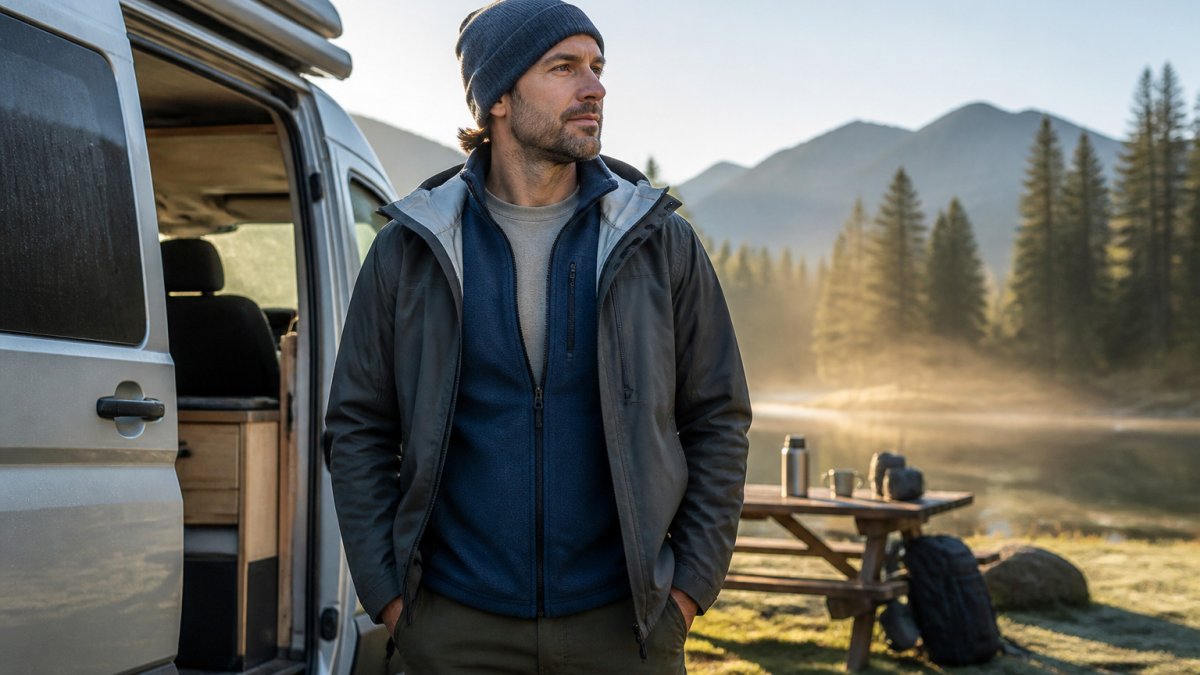
The three layers at a glance:
- Base layer: breathable merino or organic cotton shirts directly on the skin
- Middle layer: warm fleece or wool jacket for insulation
- Outer layer: windproof, water-repellent jacket against rain and wind
This combination ensures that you do not get cold or sweat. This is particularly practical for families with children.
Camping Clothing Packing List by Trip Duration and Type of Camping
The right camping clothing packing list depends on the duration and style. A weekend in a tent requires less than two weeks in a motorhome.
- Weekend: 2 base shirts, 1 fleece, 1 rain jacket, 2 pairs of socks
- One week: 4 base shirts, 2 trousers, 1 fleece, 1 rain jacket, 4 pairs of socks
- Two weeks: clothes for 7 days, wash in between, plus change of shoes
Pack by layers instead of by outfits. This leaves room in the storage space.
Washing and drying environmentally friendly when camping
When camping, water is scarce and wastewater is often difficult to dispose of. Therefore, wash clothes sparingly, specifically, and with as little chemistry as possible. Those who know the right technique often only need a few liters of water per wash cycle and can wear clothes again sooner.
Hand washing with little water
For individual garments, hand washing is usually the most resource-efficient method. Here is how you do it:
- Fill a basin or bucket with about 2 to 3 liters of lukewarm water. For merino wool, hand-warm water is sufficient, never hot.
- Add only a small amount of mild, biodegradable detergent - often a teaspoon is enough for one to two garments.
- Soak the clothes briefly, move them gently, and do not wring. For merino wool, carefully press the water out instead of twisting.
- Rinse with clear water until no soap residue is visible. Dispose of the rinse water as specifically as possible, do not pour it into nature.
- To dry, lay flat or hang up, depending on the material.
A common mistake is too much detergent. It is difficult to rinse out, requires more water, and can leave residues that stress the fibers.
Using biodegradable detergent correctly
Biodegradable detergents make sense when camping, but are not a free pass. Pay attention to a mild formulation without aggressive bleaching agents and without unnecessary fragrances. Dose sparingly and follow the manufacturer's instructions. For merino wool and other sensitive natural fibers, special wool detergents without enzymes are suitable.
Drying without electricity and direct sunlight
Dry clothes in the shade or under the awning, not in the direct sun. UV radiation damages fibers, and for merino wool, direct heat can felt the wool. Hang clothes so that air can circulate - a clothes rack or a line under the awning is often sufficient. For quick-drying materials such as linen or recycled polyester, one night is often enough. Merino wool needs longer and should dry flat so that it retains its shape.
Avoiding microfibers
With synthetic fibers such as recycled polyester, microfibers are released during washing, which can enter bodies of water. Wash such clothes less frequently, use a laundry bag or a microfiber filter, if available, and avoid unnecessary spinning. Those who have no filtering option while traveling should wash performance clothing only when it is really necessary - airing and brushing often remove odors and dust.
Repair, Buy Secondhand, and Wear Longer
The best clothes are the ones you already own. Sew up small tears immediately before they get bigger. A patch costs little and significantly extends the life of your clothing.
Buying secondhand is a good alternative. Used outdoor jackets are often barely worn and cheaper than new ones. The German Federal Ministry for the Environment calls avoiding fast fashion an important step.
Your Next Steps: Pack Clothes for Your Next Trip
First, check your wardrobe. Which items are still in good condition, and what are you missing? Then create a packing list based on the length of your trip and the type of camping.
Campidoo supports you with high-quality camping accessories and excellent service. More than 10,000 satisfied campers trust Campidoo and rate us 4.8 out of 5 stars in over 7,000 reviews.
Frequently Asked Questions
What clothes do you need for a camping trip?
For a camping trip, you mainly need clothes that can be layered: a breathable base layer, a warm midlayer made of fleece or wool, and a wind- and water-resistant jacket. Add comfortable, sturdy trousers, at least a few pairs of spare socks per day, and sturdy footwear for walking around the campsite. By choosing the right amount of clothes for the weather, you can pack more easily and wash less often while away. A list of essentials helps ensure you don't forget anything important.
Which materials are suitable for sustainable camping clothes?
Organic cotton, linen, hemp, and merino wool are suitable because they generally require fewer pesticides and less water and are biodegradable. Recycled polyester materials are available for rainwear and functional items, reducing the environmental impact of new fibers. Workmanship and durability are also crucial, as a jacket worn for a long time is usually more sustainable than a cheap item that needs frequent replacement. Looking for recognized labels with environmental and social standards makes choosing easier.
How can you wash clothes environmentally at a campsite?
When camping, it is worth washing clothes less often and airing them out instead, as many functional fabrics release odors well. If washing is necessary, use a small amount of detergent without harsh additives and as little water as possible, for example by hand washing in a bucket. Wastewater should only be discharged at designated disposal points. Air drying in the wind is better than using a dryer, which is often not available at campsites.
What should you wear when camping in changeable weather?
In changeable weather, layering helps: several thin layers can be put on or taken off depending on the temperature. The innermost layer should wick moisture away from the body, the middle layer provides warmth, and the outer layer protects against wind and rain. Dressing this way keeps you flexible even during sudden temperature drops. It is important not to sweat too much while hiking, as wet clothes cool down more quickly.