










 Over ons
 Tijdschrift
 Contact








Inhoudsopgave
- Wat betekent autonomie bij een camper?
- Elektriciteitsbehoefte en dagelijks energieverbruik berekenen
- Zonnepanelen in een camper achteraf plaatsen: kosten en dimensionering
- Batterijopslag en batterijcapaciteit: lithiumbatterij en LiFePO4
- Omvormer achteraf plaatsen: 230-voltvoorziening in de camper
- Water- en drinkwatervoorziening autonoom inrichten
- Complete kostenopstelling: materiaal, montage en totaalbudget
- Gevolgenkosten en levensduur: wat kost autonomie op de lange termijn?
- Veelgestelde vragen
Laatst bijgewerkt: 12 oktober 2026
Wat betekent autonomie bij een camper?
Autonomie bij een camper betekent onafhankelijkheid van externe voorzieningen tijdens het kamperen. Een autonome camper kan meerdere dagen of zelfs weken staan zonder elektriciteitsvoorziening, drinkwater of afvoerverbinding.
De realiteit is genuanceerder dan vaak wordt voorgesteld. Volledige autonomie is zelden zinvol; wat telt, is de juiste uitbouw voor uw gebruik. Wie voornamelijk op bewaakte campings staat, heeft andere systemen nodig dan iemand die regelmatig wild kampt.
Bij Campidoo ondersteunen wij campers bij deze beslissing met praktische accessoires. De volgende hoofdstukken laten zien hoe u uw energiebehoefte realistisch berekent, welke componenten u daadwerkelijk nodig hebt en welke totale budgetten voor verschillende uitbouwstadia realistisch zijn.
Elektriciteitsbehoefte en dagelijks energieverbruik berekenen
De elektriciteitsbehoefte vormt de basis voor alle andere beslissingen. Zonder een eerlijke berekening leidt te veel uitbouw tot onnodige kosten; te weinig leidt tot frustratie tijdens het staan.
Apparaten in de camper identificeren
Begin met een inventarisatie: welke apparaten gebruikt u dagelijks? Een typische camper verbruikt elektriciteit voor verlichting (LED-lampen besparen hier aanzienlijk), de koelkast, waterpomp, verwarming, laptops en smartphones.
De ledverlichting is hier een echt voordeel: terwijl oude halogeenspots 20-50 watt per uur trekken, verbruiken ledlampen 3-8 watt. Over een kampeerdag bespaart u hier 100-200 Wh. Campidoo biedt ledverlichting voor campers.
Schrijf elk apparaat op met zijn vermogen (in watt) en geschatte dagelijkse gebruiksduur (in uren). Vermenigvuldig: watt × uren = wattuur (Wh) per dag. Tel alle waarden bij elkaar op - dat is uw dagelijkse energieverbruik.
Voorbeeldbudgetten per uitbouwstadium
BasGebruiker (3-5 dagen autonoom staan, eenvoudige uitrusting):
- Verlichting: 10 Wh/dag
- Koelkast: 400 Wh/dag
- Waterpomp: 50 Wh/dag
- Opladen van apparaten: 100 Wh/dag
- Totaal: ca. 560 Wh/dag
Comfortcamper (7-10 dagen autonoom staan, regelmatig gebruik):
- Verlichting: 30 Wh/dag
- Koelkast: 400 Wh/dag
- Waterpomp: 100 Wh/dag
- Verwarming/warm water: 300 Wh/dag
- Opladen van apparaten: 200 Wh/dag
- Totaal: ca. 1.030 Wh/dag
PremiumGebruiker (14+ dagen autonoom staan, comfortabele uitrusting):
- Verlichting: 50 Wh/dag
- Koelkast: 400 Wh/dag
- Waterpomp: 150 Wh/dag
- Verwarming/warm water: 500 Wh/dag
- Airconditioning (af en toe): 1.000 Wh/dag
- Opladen van apparaten: 300 Wh/dag
- Totaal: ca. 2.400 Wh/dag
Deze cijfers zijn oriëntatiepunten. Uw werkelijke waarden kunnen afwijken - daarom is de eerlijke inventarisatie zo belangrijk.
Zonnepanelen in een camper achteraf plaatsen: kosten en dimensionering
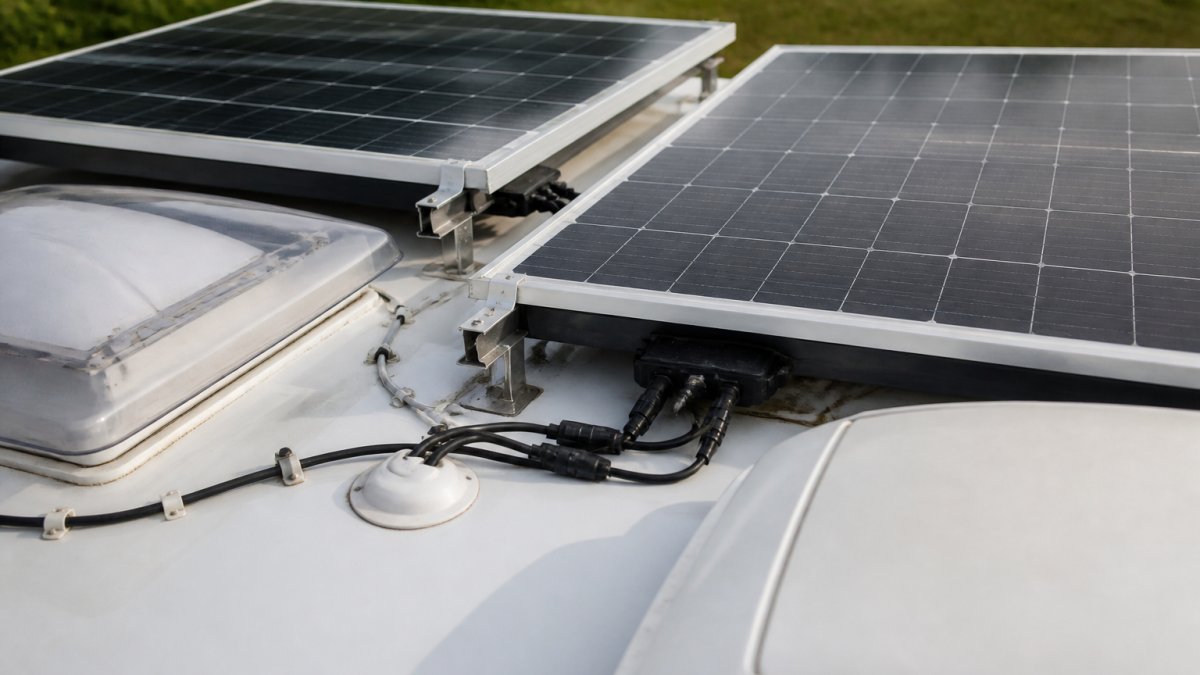
Een zonnepaneleninstallatie is het hart van de autonomie. Hij laadt uw batterij overdag op, terwijl u staat of rijdt. Zonder zonnepanelen moet u voortdurend externe stroombronnen gebruiken of een enorme batterij meenemen.
Zonnepanelenvermogen en opbrengst correct dimensioneren
Het zonnepanelenvermogen wordt gemeten in watt-piek (Wp). Dit is het maximale vermogen onder ideale omstandigheden (volle zon, loodrecht inval). In de praktijk haalt u dit vermogen zelden.
Een praktische vuistregel: reken met ongeveer 70-80% van de nominale waarde als gemiddelde zonnepanelenopbrengst over een jaar. In de zomer is de opbrengst hoger, in de winter aanzienlijk lager.
Voor de basGebruiker (560 Wh/dag) volstaat vaak een installatie van 100-150 Wp.
De Comfortcamper (1.030 Wh/dag) moet plannen op 200-300 Wp. PremiumGebruikers met 2.400 Wh/dag hebben vaak 400-600 Wp of meer nodig, vooral als ze in de winter kamperen.
Montage door een vakbedrijf of zelf doen
De montage van een zonnepaneleninstallatie op het dak is met de hand te doen, maar vereist zorgvuldigheid. Fouten leiden tot waterinval, beschadigde dakopbouw of veiligheidsrisico's.
Een vakbedrijf kost ongeveer 500-1.500 euro voor arbeidstijd en kleine materialen (beugels, bekabeling, kit). Daarvoor krijgt u garantie en zekerheid. Veel bedrijven bieden ook een garantie op hun werk.
Zelf doen bespaart deze kosten, maar vereist gereedschap (boormachine, siliconenpistool, multimeter), basiskennis van elektriciteit en meerdere uren tijd. Als u onzeker bent: laat een vakbedrijf het werk doen. Een beschadigde dakafdichting kost snel meer dan de montage.
Batterijopslag en batterijcapaciteit: lithiumbatterij en LiFePO4
De batterij slaat de zonne-energie op voor de nacht en voor bewolkte dagen. Hier scheidt het kaf van het koren vaak - een slechte batterij maakt de hele installatie onbruikbaar.
Lithium- en LiFePO4-batterijen vergelijken
Lithium-ionbatterijen (standaardlithium) zijn goedkoper, maar minder langdurig. Ze gaan ongeveer 1.000-2.000 laadcycli mee en houden niet van extreme temperaturen. In de winter verliezen ze capaciteit; bij vorst kunnen ze beschadigd raken.
LiFePO4-batterijen (lithium-ijzerfosfaat) zijn de betere keuze voor campers. Ze gaan 3.000-5.000 laadcycli mee, zijn beter bestand tegen temperatuur en veiliger. LiFePO4 is de technologie die op de lange termijn minder kost - de hogere aanschafprijs verdient zich over de jaren heen terug.
Batterijcapaciteit voor verschillende standtijden
De batterijcapaciteit wordt gemeten in kilowattuur (kWh) of ampere-uur (Ah). Een praktische richtlijn: vermenigvuldig uw dagelijkse energieverbruik met het aantal dagen dat u autonoom wilt staan en voeg 20% buffer toe (de batterij mag niet volledig worden ontladen).
BasGebruiker (560 Wh/dag, 3 dagen autonoom):
- (560 Wh × 3 dagen) + 20% buffer = ca. 2.000 Wh = 2 kWh
- Aanbeveling: 100 Ah LiFePO4 (bij 24V) of 200 Ah (bij 12V)
Comfortcamper (1.030 Wh/dag, 7 dagen autonoom):
- (1.030 Wh × 7 dagen) + 20% buffer = ca. 8.700 Wh = 8,7 kWh
- Aanbeveling: 300-400 Ah LiFePO4 (bij 24V) of 600 Ah (bij 12V)
PremiumGebruiker (2.400 Wh/dag, 14 dagen autonoom):
- (2.400 Wh × 14 dagen) + 20% buffer = ca. 40.000 Wh = 40 kWh
- Aanbeveling: Meerdere batterijmodules met in totaal 800+ Ah LiFePO4 (bij 24V)
Omvormer achteraf plaatsen: 230-voltvoorziening in de camper
De omvormer zet de 12V of 24V gelijkspanning uit de batterij om in 230V wisselspanning - de spanning die u kent van het stopcontact thuis.
Een goede omvormer kost 300-800 euro, afhankelijk van het vermogen. Het vermogen wordt gemeten in watt - typisch zijn 1.000W tot 3.000W voor campers.
Dimensioneer de omvormer op basis van uw grootste individuele verbruikers. Een waterkoker heeft ongeveer 2.000W nodig, een magnetron 800-1.500W, een laptopoplader 100-200W.
De efficiëntie is belangrijk: goede omvormers hebben een rendement van 90-95%. Dit betekent dat 5-10% van de batterijenergie verloren gaat als warmte. Bij veelvuldig gebruik bespaart u hierover de jaren heen batterijcapaciteit.
Water- en drinkwatervoorziening autonoom inrichten
Water is de tweede pijler van autonomie. Een typische camper verbruikt 30-50 liter drinkwater per dag (koken, wassen, toilet).
De drinkwatertank moet voldoende zijn voor 5-7 dagen autonoom staan.
Een extra watertank kost 200-600 euro, afhankelijk van de grootte en het materiaal. Kunststof tanks zijn goedkoper en lichter; roestvrijstalen tanks zijn robuuster en duurzamer.
De waterpomp (12V of 24V) kost 50-200 euro. Hij moet voldoende druk leveren voor de douche en wasbak - minimaal 2-3 bar.
Voor de afvalwaterafvoer heeft u een grijswatertank (voor spoelwater) en een zwartwatertank (voor toiletvervuiling) nodig. Deze tanks kosten samen 300-800 euro.
Complete kostenopstelling: materiaal, montage en totaalbudget
De totale kosten voor het achteraf plaatsen van autonomie in een camper hangen sterk af van uw uitbouwstadium. Hier is een gedetailleerde opstelling voor drie realistische scenario's.
Basisuitbouw: instap in autonomie
Dit uitbouwstadium is geschikt voor campers die 3-5 dagen autonoom willen staan, zonder in te leveren op comfort.
| Component | Materiaal | Montage | Totaal |
|---|---|---|---|
| Zonnepaneleninstallatie (100 Wp) | 400-600 € | 300-500 € | 700-1.100 € |
| LiFePO4-batterij (100 Ah, 24V) | 1.200-1.600 € | 200-300 € | 1.400-1.900 € |
| Omvormer (1.000W) | 300-500 € | 150-250 € | 450-750 € |
| Oplader & bekabeling | 150-250 € | 100-150 € | 250-400 € |
| Watertank & pomp | 300-500 € | 150-250 € | 450-750 € |
| Totaal basisuitbouw | 2.350-3.450 € | 900-1.450 € | 3.250-4.900 € |
Realistische totale kosten: 3.500-5.000 euro
Gemiddelde uitbouw: comfortabel autonoom staan
Dit uitbouwstadium maakt 7-10 dagen autonoom staan mogelijk met goede comfortvoorzieningen.
| Component | Material | Installation | Total |
|---|---|---|---|
| Solar system (250 Wp) | €900-1,200 | €500-800 | €1,400-2,000 |
| LiFePO4 battery (300 Ah, 24V) | €3,500-4,500 | €300-500 | €3,800-5,000 |
| Inverter (2,000W) | €500-800 | €200-350 | €700-1,150 |
| Charge controller, cables & fuse | €300-400 | €150-250 | €450-650 |
| Water tank (200L) & pump | €500-800 | €200-350 | €700-1,150 |
| Freshwater heater | €200-400 | €150-250 | €350-650 |
| Total medium conversion | €5,800-8,100 | €1,500-2,500 | €7,300-10,600 |
Realistic total cost: €8,000-11,000
Premium conversion: Maximum independence
This conversion level supports 14+ days of off-grid use with full comfort equipment.
| Component | Material | Installation | Total |
|---|---|---|---|
| Solar system (500 Wp, 2 modules) | €1,800-2,400 | €800-1,200 | €2,600-3,600 |
| LiFePO4 battery (600 Ah, 24V or 2x 300 Ah) | €7,000-9,000 | €500-800 | €7,500-9,800 |
| Inverter (3,000W) | €800-1,200 | €300-500 | €1,100-1,700 |
| Charge controller, cables & fuse | €500-700 | €200-350 | €700-1,050 |
| Water tank (300L) & pump | €800-1,200 | €300-500 | €1,100-1,700 |
| Freshwater heater & insulation | €400-700 | €250-400 | €650-1,100 |
| Additional components (monitoring, backup charger) | €500-800 | €200-300 | €700-1,100 |
| Total premium conversion | €11,800-16,000 | €2,550-4,050 | €14,350-20,050 |
Realistic total cost: €15,000-21,000
These budgets are realistic for professional installations. Doing it yourself saves 30-50% of the installation costs, but requires time and manual skills.
At Campidoo you will find high-quality accessories such as LED lighting and specialized cleaners. Our products are designed to meet the requirements of motorhome owners.
Follow-up costs and lifespan: What does autonomy cost in the long term?
The purchase costs are just the beginning. Follow-up costs arise from maintenance, replacement, and wear and tear.
LiFePO4 batteries last 3,000-5,000 charge cycles.
Solar panels lose about 0.5% of their performance per year. After 20 years they still operate at 90% of their original performance. Replacement is rarely necessary.
Inverters have a lifespan of 10-15 years. Replacement then costs €300-800.
Water pumps last 5-10 years and cost €50-200 to replace.
Maintenance costs per year:
- Battery: €0 (with LiFePO4)
- Solar system: €50-100 (occasional cleaning)
- Inverter: €0 (maintenance-free)
- Water system: €50-100 (filter, seals)
- Total: €100-200 per year
Over 10 years, the purchase costs are often amortized through saved campsite fees.
The costs for retrofitting motorhome autonomy are therefore not just a purchase, but a long-term investment in independence and freedom on vacation.
Autonomy while camping means real freedom - but only with the right planning. At Campidoo we support you with high-quality accessories, so that your autonomous motorhome works reliably.
Frequently Asked Questions
What does autonomy mean for a motorhome?
Autonomy for a motorhome means that the vehicle works independently of external power sources, water, and wastewater connections. An autonomous motorhome generates its own electricity through solar systems, stores water in tanks, and has an autonomous onboard electrical system. This enables longer stays at free sites without a campsite connection.
How do I calculate my power requirements for an autonomous motorhome?
List all consumers in the motorhome (LED lighting, refrigerator, heater, water pump, laptop) and their power in watts. Multiply the daily operating time of each device by its power. Add up all values for the daily energy consumption in watt-hours. Example: 100W refrigerator × 24h = 2,400 Wh daily. This calculation determines the necessary solar power and battery capacity.
Is a solar system on the motorhome financially worth it?
A solar system pays off in the medium term if you want to stay autonomous regularly and for longer periods. The purchase costs are amortized through saved campsite fees and the long lifespan (20+ years). With frequent short vacations with a campsite connection, the benefit is lower. For year-round camping or long-term stays, a solar system is practically indispensable.
What battery size do I need for my motorhome?
The battery capacity depends on your daily energy consumption and the desired duration of the stay. Rule of thumb: Multiply your daily consumption by the number of days you want to stay without solar yield (e.g., in bad weather). A 100-Ah LiFePO4 battery (approx. 3,000-5,000 Wh usable capacity) is sufficient for 2-3 days of moderate use. For longer stays, 200-300 Ah are required.
Is an inverter useful in a motorhome?
An inverter is useful if you want to use 230-volt devices (coffee machine, laptop charger, hair dryer). It converts 12V or 24V direct current from the battery into 230V alternating current. However, it consumes a lot of energy, so it is only economical for occasional use. For frequent 230V use, the battery capacity should be dimensioned accordingly larger.
Can I convert my motorhome myself with a solar system and battery?
DIY solar installation is possible if you are skilled in manual work and know the safety regulations. The roof must be stable, the cabling correctly dimensioned, and the watertightness ensured. For the battery and inverter, professional expertise is important to rule out short circuits and fire hazards. Many owners combine DIY (roof work) with professional installation (electrical) for optimal safety.
How long can I stay autonomous with a motorhome battery?
The duration of the stay depends on battery capacity, energy consumption, and solar yield. With a 100-Ah LiFePO4 battery and moderate consumption (500 Wh/day), you will last 6-10 days without external charging. With a solar system, this is significantly extended, as the battery is recharged during the day. In winter with less solar yield, the autonomous stay time decreases significantly. Larger batteries (200-400 Ah) enable 2-4 weeks of autonomous stay with a good solar system.
What does it cost to retrofit a motorhome for autonomy?
The costs vary greatly depending on the conversion level. A basic setup (100W solar system, 100-Ah battery, simple controller) costs significantly less than a premium system (400W solar system, 300-Ah LiFePO4 battery, inverter, water system). Installation costs by professional companies are added. You will find the exact prices on the Campidoo website for the products you need.